
Ordering a loose lab-grown diamond online can be convenient, but the risk is that the stone you see, the report you check, and the diamond that arrives may not all be clearly tied together; this is especially relevant in a loose diamond vs finished jewelry decision, because a grading report is important, but it does not confirm visual appeal, setting fit, seller reliability, or whether the listing uses actual media for the exact diamond.
For the full framework, read Loose Lab-Grown Diamonds Buying Guide.
This guide helps you judge whether a loose stone is ready to buy, needs clarification, or should be avoided. It focuses on practical checks: matching the report number, verifying measurements and proportions, reviewing real photos or video, confirming written seller answers, understanding return terms, and documenting delivery before the diamond is set or altered.
| What to Check | Why It Matters | Best Action |
|---|---|---|
| Report number and lab lookup | Confirms the listed grading report exists | Match it to the listing and invoice |
| Actual video or photos | Shows bow-tie, haze, tint, inclusions, and shape issues | Avoid listings using only stock media |
| Millimeter measurements | Determines face-up size and setting compatibility | Compare length, width, depth, and ratio |
| Seller responses | Tests whether the exact stone is available and understood | Save written answers tied to the report number |
| Return, payment, and shipping terms | Protects you if the diamond is mismatched or unsuitable | Use secure payment and insured, trackable delivery |
| Post-delivery inspection | Catches problems before setting or alteration | Document packaging, report, and stone immediately |
Quick Questions Before You Read
Q: Is a grading report enough to trust a loose lab-grown diamond?
No. It is a starting point, but you still need matching media, measurements, seller confirmation, and clear order terms.
Q: Should I compare loose diamonds by carat weight first?
Not by itself. Millimeter size, proportions, depth, and shape ratio can change how large and balanced the diamond looks.
Q: What is a major warning sign before ordering?
Vague answers, missing report-number confirmation, stock imagery, unclear returns, or pressure to pay outside normal checkout.
Q: When should I inspect the diamond after delivery?
Immediately, before setting or altering it. Photograph the package, match the report details, and raise concerns quickly.
Start With the Risk Profile of Buying Loose Lab-Grown Diamonds Online
The safest way to approach buying loose lab-grown diamonds online is not to trust one attractive photo, one strong grade, or one unusually low price. The safer approach is to stack evidence: the grading report, actual stone video, photos, measurements, seller answers, return terms, payment path, and shipping details should all point to the same specific diamond.
This matters because a loose diamond is not just a grade on a screen. It is a physical lab-created diamond with its own dimensions, proportions, inclusions, outline, light behavior, and setting requirements. Two stones with the same carat weight, color, and clarity can look different in real use, especially in fancy shapes such as oval, pear, emerald, cushion, and radiant cuts.
Online diamond buying is not automatically risky, and it is not automatically better than buying in person. The difference is control. A structured loose diamond verification process gives the buyer a way to separate a well-documented diamond listing from one that simply looks appealing at first glance. A lower price should not be rejected immediately, but it should trigger closer review before payment.
For buyers, the practical point is to separate facts, tradeoffs, and preferences. A report number and measurements are facts to verify. Bow-tie strength, face-up size, and setting fit are tradeoffs to compare. Shape style, ratio, and sparkle pattern are preferences that should match the wearer rather than a universal rule.
Compliance Boundaries to Keep in Mind While Comparing
Laboratory-grown diamonds should be clearly identified as laboratory-grown, and they should not be presented as mined diamonds. Lab-grown diamonds and natural diamonds are both diamonds, but they have different origins. Diamond simulants are a separate category and should not be confused with laboratory-grown diamonds.
A grading report helps document key characteristics, but it should not be treated as a guarantee of beauty, value, or sourcing ethics. Environmental, sustainability, and responsible-sourcing claims should be specific, documented, and limited to what can be substantiated by the seller or producer.
Prices can change with market conditions, report type, seller channel, availability, and stone-specific details, so exact comparisons should be verified at the time of purchase. For custom jewelry, stone measurements and setting compatibility should be confirmed before finalizing a purchase.
Why Loose Stones Need a More Careful Checklist Than Finished Jewelry
Finished jewelry gives the buyer at least one visible context: the diamond is already mounted, proportioned to the setting, and presented as a completed piece. A loose diamond is different. It still has to fit a ring, pendant, or custom design plan, which means the buyer has to evaluate the stone before the final jewelry exists.
That makes millimeter measurements more important than many first-time buyers expect. Carat weight tells you how much the diamond weighs, but length, width, depth, and shape outline determine how the stone will sit in the design and how large it appears from the top. A diamond that looks like a good value by carat weight alone may be too deep, poorly spread, or awkward for the intended setting.
Girdle condition, corner shape, and outline symmetry also matter more with a loose stone because they can affect how the jeweler secures the diamond. A princess cut, pear, marquise, or emerald cut may require more careful prong planning than a standard round brilliant. If the setting will be custom-made, the jeweler should work from the exact stone’s measurements, not a generic carat size.
The Main Online Buying Risks This Checklist Controls
The most avoidable risks usually come from missing or inconsistent information. A report number may not match the listing. A video may show a similar diamond instead of the exact stone. The return terms may be vague until after the order is placed. A seller may answer general questions quickly but avoid confirming the report number, availability, or setting fit in writing.
Payment and shipping create another layer of risk. A secure diamond purchase should leave a clear paper trail: itemized invoice, payment confirmation, tracking expectations, shipping protection, and delivery requirements. Requests to pay through informal channels, unclear business identity, or pressure to act before basic details are confirmed are warning signs, not minor inconveniences.
The final risk happens after delivery. Some buyers wait too long to inspect the diamond, compare it with the report, or raise a concern. That can create problems if the return or issue-reporting window is short. The verification process should continue until the received stone, documents, and order record all match.
Evidence Standard: What Counts as Enough Proof Before You Order
A strong online diamond listing should give you several independent points of confirmation, not one impressive-looking claim. The report number identifies the graded stone, the media helps you judge appearance, the measurements help you test setting fit, and the seller’s written answers help connect those pieces to the actual order. If all of those items agree, the purchase is easier to defend if a question comes up later.
It is also useful to separate seller statements into “verifiable” and “promotional.” A report number, millimeter measurement, return deadline, shipment method, and invoice detail can be checked. Phrases such as “best value,” “premium sparkle,” “eco-friendly,” or “investment quality” need more caution because they may reflect marketing language rather than a specific, documentable fact. When in doubt, ask the seller to translate broad language into something you can verify before payment.
Build a Traceability File Before You Pay
For an online loose diamond purchase, traceability means being able to follow the same stone from the product page to the report, from the report to the seller’s written answers, and from the invoice to the delivered package. This does not require complicated software. A simple folder with screenshots, PDFs, saved videos, emails, chat transcripts, invoice details, and tracking information can make the purchase much easier to review if a question arises.
The file should be organized around the report number or listing ID. Save the product page while it is still live, including the price, stone specifications, media, return language, and seller name. If the seller sends a new photo, confirms availability, or clarifies setting fit, save that answer with the date. The goal is not to create conflict with the seller; it is to make the evidence trail clear enough that both sides know which diamond was discussed, purchased, shipped, and inspected.
Scenario Grounding: A Realistic Buyer Situation
Maya is shopping for a 1.80 carat oval lab-grown diamond online for a custom solitaire ring. One diamond listing is cheaper, but it uses only a stock image, gives limited measurement detail, and does not clearly explain the return policy. Another listing costs slightly more but includes an IGI report number, a 360-degree video of the exact stone, millimeter dimensions, written confirmation that the oval can work with her intended setting, and insured shipping details.
The cheaper option may still be legitimate, but Maya cannot fairly judge it without more evidence. The second option gives her more ways to verify the stone before ordering and fewer chances for a costly surprise during custom design. In a real purchase, lower risk often comes from better documentation, not just a better-looking headline price.
What This Means Before You Compare Prices
Price comparison should begin only after each stone has enough evidence to compare fairly. A low price without report verification, actual media, measurements, written policy terms, and seller confirmation is not a complete offer. It is an incomplete decision.
Before treating one loose lab-grown diamond as a better value than another, confirm that both listings are equally verifiable. If one diamond has full documentation and the other has missing media or unclear terms, you are not comparing two equivalent purchases. You are comparing one defined stone against one unresolved risk.
Verify the Lab-Grown Diamond Grading Report Before You Trust the Listing
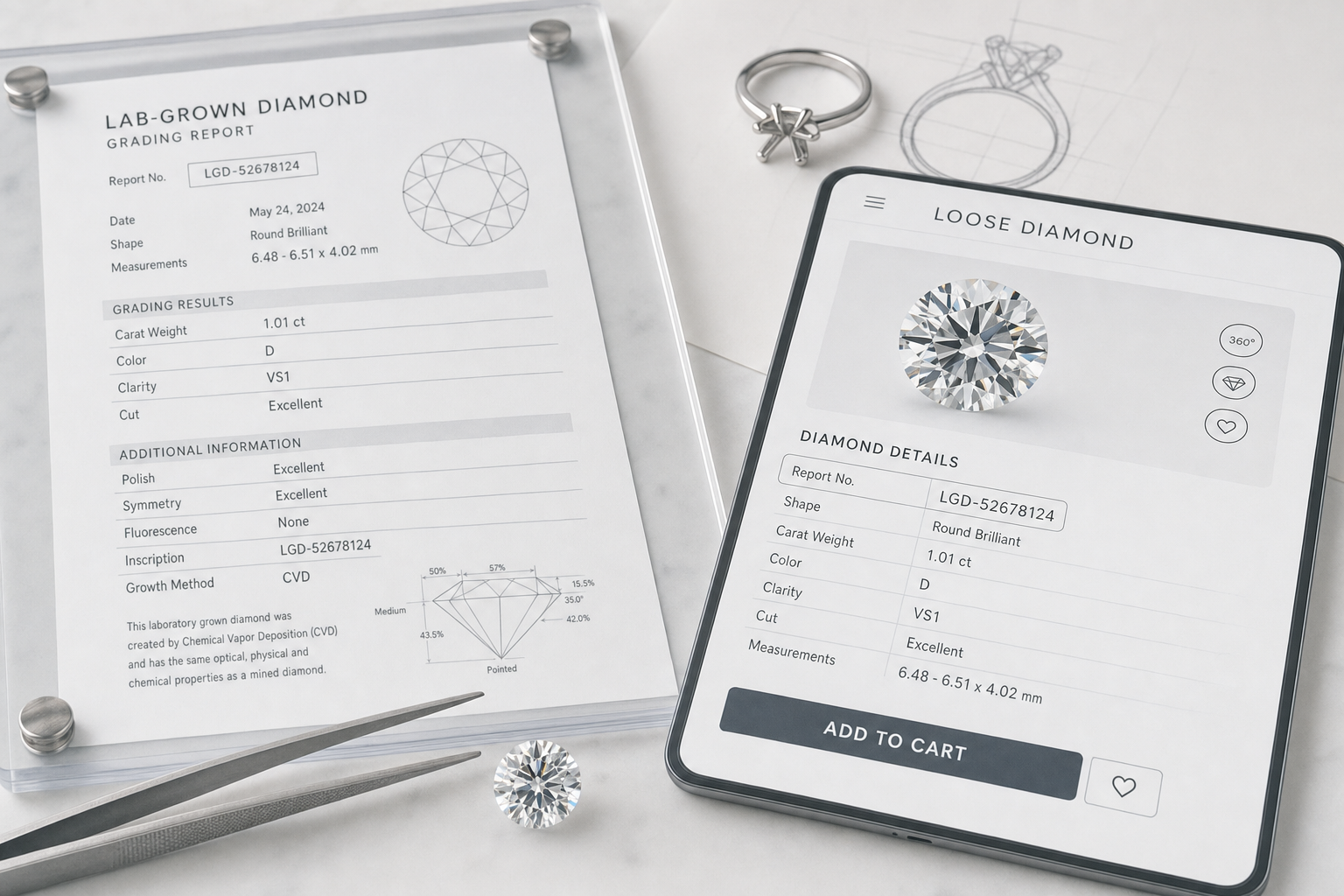
A lab-grown diamond grading report is the first document to verify before taking an online listing seriously. Many buyers call it a diamond certificate, but “grading report” is the more accurate term because it records the lab’s assessment of the stone’s characteristics rather than guaranteeing beauty, value, or future performance.
For pre-order verification, the report’s job is practical: it helps confirm that the listed diamond has a specific identity. Depending on the lab and report format, it may include carat weight, shape, color, clarity, measurements, proportions, growth method, and laser inscription details. It does not tell you everything you need to know, but without it, the buyer has far less to verify.
IGI, GIA, GCAL, and other grading reports may present information differently, so the useful question is not which name appears on the report alone. The useful question is whether the report can be matched to the listing, checked through the issuing lab when possible, and supported by real visual evidence of the same stone.
A report should also be read for what it actually documents, not for what a seller implies from it. Color and clarity grades help describe the stone under grading conditions, but they do not prove that the diamond will be the best-looking option for your design or budget. Growth method information, when included, identifies how the lab-grown diamond was produced, but it should not be stretched into unsupported claims about sustainability, ethics, or value without separate documentation.
Match the Report Number to the Seller’s Listing
Start with the report number. It should appear consistently on the seller’s diamond listing, report image or PDF, invoice details, and any written communication about the stone. If the listing gives a report number but the report image is missing, ask for it before payment.
Then compare the core details: shape, carat weight, color grade, clarity grade, measurements, and any listed laser inscription. Small formatting differences are normal, but factual mismatches are not. If the report shows one set of measurements and the listing shows another, the buyer should pause and ask for written clarification.
This step matters most when listings are pulled from shared inventory or supplier databases. A seller may display many similar stones, and a buyer can easily assume two near-identical diamonds are interchangeable. They are not. A 1.80 carat oval with one report number is a different physical stone from another 1.80 carat oval with the same color and clarity grades.
Check the Report Directly With the Issuing Lab
When the issuing lab provides an online lookup tool, use it. Enter the report number directly on the lab’s website and confirm that the returned details match the seller’s listing. Screenshots are helpful for records, but they should not be the only proof if direct report lookup is available.
The lab lookup does not prove that the seller’s video is accurate or that the diamond will look attractive in person. It confirms that the report number corresponds to a graded diamond with specific listed attributes. That is still an important control point because it reduces the chance of relying on a copied image, outdated listing, or incorrect product data.
If the report cannot be found through the lab’s lookup system, do not assume fraud immediately. Some reports may have lookup limitations, recent issue timing, or format differences. The right response is to ask the seller for clarification in writing and request the full report document before making a payment decision.
When a grading report is available, buyers should verify the report details through the issuing laboratory’s official report-check tool where available and compare those details with the listing, invoice, and actual stone media.
Read Growth Method and Disclosure Language Carefully
Some lab-grown diamond reports or listings may identify a growth method, such as CVD or HPHT, while others may present the information differently. For a buyer, the key point is not to treat the growth method as a shortcut for beauty or value. The visual appearance, proportions, grading details, and seller documentation still need to be reviewed stone by stone.
Disclosure language should be clear throughout the listing, invoice, and conversation. If the stone is lab-grown, lab-created, or laboratory-grown, the seller should not present it in a way that could be confused with a natural diamond. Clear language protects both sides: the buyer knows what is being purchased, and the seller’s documents remain consistent from product page to invoice.
Be cautious with environmental or ethical claims attached to growth method alone. A statement that a diamond is lab-grown describes origin, not automatically the full impact of production, energy use, labor practice, or supply chain documentation. If sustainability matters to the purchase, ask for specific documentation rather than relying on broad claims.
Sustainability claims should be specific and documented. Broad green language is less useful than clear information about production context, energy use, sourcing records, and seller transparency. A careful seller should be able to explain what a claim refers to without turning “lab-grown” into a blanket environmental promise.
When growth method or post-growth treatment is relevant, buyers should look for clear disclosure in the grading report or seller documentation. HPHT and CVD are commonly discussed as laboratory-grown diamond growth methods; they should not automatically be described as treatments unless the report or seller documentation specifically says a post-growth treatment was applied.
Understand What the Report Does Not Tell You
A grading report does not replace visual review. It will not fully show whether an oval has a distracting bow-tie effect, whether an emerald cut has visible windowing, or whether a diamond looks lively in normal lighting. It also does not prove that a video shows the same stone unless the seller connects the media to the report number.
The report also does not confirm whether the diamond is suitable for a specific setting. Measurements and proportions can support that decision, but the jeweler still needs to evaluate how the stone will be held, especially for fancy shapes with points, corners, or elongated outlines. For a custom ring, a strong report is useful only if the stone also works physically with the design.
Service quality sits outside the report as well. A diamond can have a legitimate grading document and still be attached to a weak return policy, vague communication, or unclear shipping protection. Treat the report as the first filter, not the final approval.
Certificate and Visual Review Check
Before ordering, the report number, report image or PDF, lab lookup confirmation, stone video, and listing details should all refer to the same diamond. If one piece of evidence does not match the others, do not resolve the issue in your head. Ask the seller to confirm the discrepancy in writing before you pay.
A complete pre-order check should make the diamond’s identity easy to trace from listing to report to invoice. If the report says one measurement set and the listing shows another, or if the video cannot be tied to the report-numbered stone, the listing is not ready for purchase.
Review Videos, Photos, and Visual Evidence Like a Buyer, Not a Gemologist
You do not need to become a professional grader to inspect a loose lab diamond video well. Your job is narrower: decide whether the listing gives enough visual evidence to keep the stone in consideration, ask for more media, or move on. The best media helps you judge the exact diamond’s appearance, not just imagine what a similar diamond might look like.
Magnified videos are useful because they can reveal inclusions, facet patterns, and outline details that a still photo may hide, especially when comparing loose lab grown diamonds for how their shape and light performance will interact with a specific setting. They can also make small characteristics look more dramatic than they would in normal wear. A tiny inclusion that looks obvious under magnification may be invisible to the naked eye, while a broad dark zone or heavy bow-tie can still matter even without magnification.
Video should support the grading report, not replace it. A beautiful clip does not prove authenticity, and a report does not prove the diamond looks good in motion. The safer judgment comes from using both together.
In practical buying, the most helpful media is consistent rather than theatrical. A bright studio video can show sparkle, but a simpler hand or tweezer video can reveal body color, outline, and how the stone behaves when it is not being filmed under ideal conditions. If the only available media is heavily edited, overly bright, or disconnected from the report number, treat the visual evidence as incomplete rather than conclusive.
Confirm the Media Shows the Exact Diamond
Ask whether the video and photos show the exact report-numbered stone. This is one of the simplest questions in online loose diamond verification, and the answer should be direct. A seller who can provide the report number should also be able to explain whether the media is tied to that same diamond.
Stock images are acceptable for showing a setting style, diamond shape, or general design inspiration. They are not enough for evaluating a loose diamond before purchase. If you are buying a specific 1.50 carat radiant cut, a generic radiant cut image does not show that stone’s actual inclusions, facet pattern, outline, or brightness behavior.
Be especially careful with listings that use only one beauty photo and no magnified video. A polished presentation can make an incomplete listing feel more trustworthy than it is. For a loose stone, actual media is not a luxury feature; it is part of the evidence.
Look for Visual Red Flags Without Overreacting
Some reflections, dark flashes, and contrast patterns are normal in diamond videos. A diamond that goes dark for a moment as it rotates is not automatically a poor choice. The concern is persistent visual behavior that seems distracting across the video, especially in the center of the stone.
Watch for broad dark zones that do not move much, a strong bow-tie across elongated shapes, obvious inclusions under the table, a cloudy or hazy appearance, extreme body tint, or video lighting that makes the diamond impossible to judge. Inconsistent lighting can hide problems or create problems that are not really there, so avoid making a final call from one overly stylized clip.
The most important mistake is overvaluing clarity grades while ignoring visible appearance. A higher-clarity diamond can still have a shape pattern you dislike, and a lower-clarity diamond may be perfectly acceptable if the inclusions are not visible in normal viewing. For online buying, what you can see in realistic media often matters more than what sounds better on paper.
Use Shape-Specific Visual Checks
Round brilliant diamonds are usually more forgiving because their facet pattern can hide some inclusions and deliver a familiar brightness pattern. For rounds, look for an overall impression of balanced brightness, clean symmetry, and no obvious dead areas. Do not judge a round only by sparkle in a high-intensity video, since strong lighting can make many stones look better than they will in everyday conditions.
Oval, pear, and marquise diamonds need a closer look at the bow-tie effect and outline symmetry. Some bow-tie contrast is normal, but a heavy dark band across the center can become the first thing you notice every time you look at the stone. Also check whether the shoulders, tip, or ends look balanced, because uneven outlines can become more obvious once the diamond is set.
Emerald and asscher cuts require a different standard. Their broad, step-cut facets make clarity characteristics and windowing easier to see, so an “eye-clean” claim deserves visual support. If the center looks glassy, flat, or see-through in a way that bothers you on video, the setting will not necessarily fix it.
Cushion, radiant, and princess cuts depend heavily on personal preference. Some buyers like a crushed-ice look with many small flashes, while others prefer broader, cleaner flashes. For these shapes, look at the corner appearance, facet pattern, and whether the video style matches what you actually want, not just whether the grades seem strong.
What to Ask If the Video Is Not Enough
If the listing media leaves too much uncertainty, ask for one or two specific additions instead of sending a vague request for “more photos.” Useful requests include a daylight-style video, a tweezer video, a hand video, or a side-by-side comparison with another stone you are considering. These formats can reveal scale, tint, bow-tie strength, and real-world appearance better than a single rotating studio clip.
Also ask the seller to confirm that all media is linked to the report number. The answer should identify the exact diamond, not just the shape or carat weight. If a seller cannot confirm whether the video belongs to the specific stone, the safer decision is to treat the media as incomplete.
Check Measurements, Proportions, and Setting Compatibility Before You Order
Loose diamond measurements are not a technical detail to skim past. They tell you how the stone will look from the top, how much depth is hidden below the surface, and whether the diamond can physically work in the setting you have in mind. Carat weight matters, but it is only weight. The millimeter dimensions are what determine how much visual presence the diamond has on the hand.
This is especially important when buying a loose lab-grown diamond online. You are not holding the stone, dropping it into a mounting, or seeing how it sits next to side stones. Before you order, you need to check length, width, depth, and, for fancy shapes, length-to-width ratio. A diamond can look attractive in a listing and still create problems later if it is too deep, too shallow, too wide for the intended setting, or shaped differently than the design requires.
Use Millimeters to Understand Face-Up Size
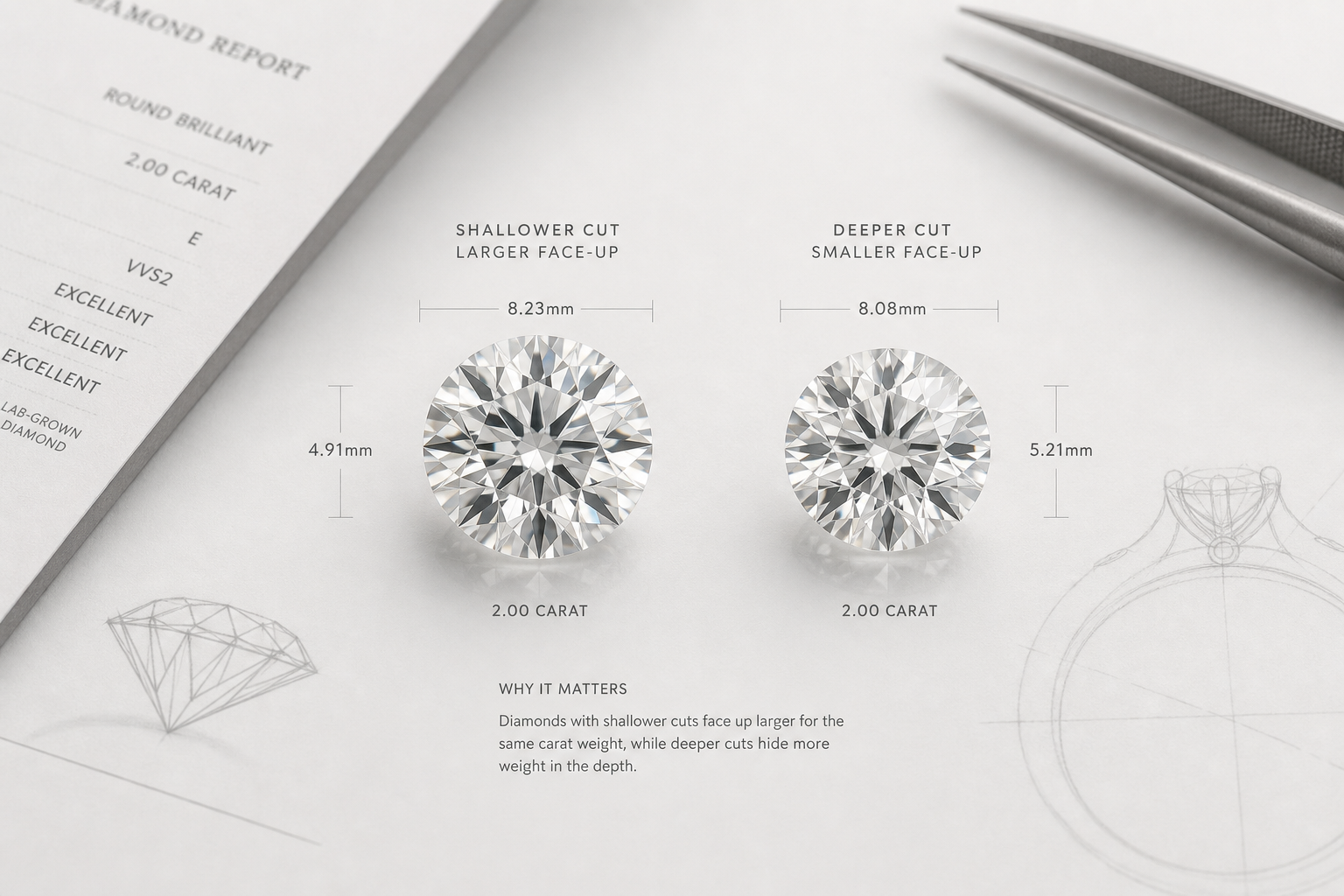
Two diamonds with the same carat weight can face up differently. A deeper 2.00 carat diamond may carry more of its weight below the girdle, making it look smaller from the top than another 2.00 carat stone with a broader spread. The deeper stone is not automatically bad, but if your goal is visible size, the millimeter dimensions matter more than the carat number alone.
For online comparison, check the listed length, width, and depth against the grading report. If a stone appears unusually small for its carat weight, depth may be the reason. If it appears unusually large, look more carefully at the video and proportions, because an overly shallow stone can sometimes trade brightness or structure for spread. The better choice is usually not the largest-looking stone on paper, but the one where face-up size, proportions, and appearance support each other.
For fancy shapes, the length-to-width ratio also affects the look. A 1.80 carat oval with a 1.32 ratio will look fuller and wider, while one near 1.45 will look more elongated. Neither is universally better. The right ratio depends on the wearer’s style, finger coverage preference, and setting design. What is risky is choosing based on carat weight alone and discovering later that the shape outline does not match the ring you imagined.
Screen Proportions Without Treating Numbers as the Whole Story
Lab-grown diamond proportions are useful screening tools, not automatic pass-or-fail rules. A strong report number can help you eliminate obvious mismatches, but it cannot fully predict how the diamond performs in video or in real viewing conditions. Use the numbers to decide which stones deserve closer visual review, then let the actual media confirm whether the stone looks right.
The ranges below are practical buyer guidance, not absolute grading standards:
- Round brilliant: Many well-performing rounds fall around a 54 percent to 58 percent table and 60 percent to 62.5 percent depth. If the stone falls far outside that zone, it deserves closer review, but the full proportion set and visual performance still matter.
- Oval: A common balanced length-to-width ratio is about 1.30 to 1.45. Lower ratios look wider and softer; higher ratios look more elongated. Bow-tie appearance and outline symmetry should be checked in video.
- Emerald cut: Many buyers prefer about 1.30 to 1.50 for a rectangular look. Lower ratios appear squarer, which may be right for some designs but less ideal if the buyer expects a long, elegant profile.
- Cushion: Near 1.00 appears square, while around 1.10 to 1.20 appears softly rectangular. This is a style choice, but it should match the setting and the buyer’s expectation before payment.
- Pear: Many buyers consider about 1.45 to 1.75, depending on whether they prefer a wider or slimmer pear. The point, shoulders, and rounded end should look balanced, not just numerically acceptable.
The most common mistake is treating a single number as the decision. For example, a pleasing oval ratio does not erase a distracting bow-tie, and a nice emerald-cut ratio does not fix visible windowing or an inclusion under the table. Measurements help you avoid obvious problems, but they should work alongside the grading report and actual stone video.
Confirm the Stone Can Work With the Intended Setting
Setting compatibility is where loose diamond measurements become practical. A jeweler or seller needs the exact millimeter dimensions, not just “2 carat oval” or “1.5 carat emerald cut.” Prong placement, basket size, bezel fit, halo layout, and three-stone proportions can all depend on the stone’s actual length, width, depth, girdle, corners, and outline.
Fancy shapes need extra attention. Pears require secure protection at the point. Princess cuts and radiants need careful corner support. Marquise and oval stones can look noticeably different depending on how the prongs frame the tips and shoulders. Emerald and asscher cuts may need a setting that protects the corners without blocking too much of the clean step-cut appearance.
For custom CAD design, the safest approach is to build the setting around the specific diamond after its measurements are confirmed. A generic mounting made for a carat size can create avoidable fit issues, especially with elongated shapes or stones that sit deeper than expected. For a custom ring project, the diamond and setting should be evaluated together because a strong stone on paper still needs to be physically right for the design.
For custom design, trust comes from matching the stone to the setting, budget, and wearer’s daily use, not from choosing grades in isolation. A diamond with attractive report details may still be the wrong choice if its depth, corners, ratio, or visual pattern complicates the intended design. Before finalizing a loose stone, confirm the fit logic with the person responsible for the mounting so the diamond choice and design plan support each other.
Stone-to-Setting Fit Check
Before payment, confirm the exact millimeter dimensions with whoever will make or supply the setting. Ask whether the stone’s length, width, depth, girdle, corners, and shape outline are suitable for the intended mounting. If the diamond will be used in a custom design, confirm that the setting will be built around that specific stone rather than a generic carat size.
Evaluate Price Only After the Diamond Has Enough Evidence
Loose lab-grown diamond price should not be judged before the stone has enough evidence to compare fairly. A low number can be attractive, but price only becomes meaningful after the report, actual media, measurements, seller terms, and return protection are clear. Without those details, you are not comparing value. You are comparing incomplete listings.
Lower price can reflect efficient sourcing, leaner seller margins, lower color or clarity, weaker cut quality, less complete media, limited service, stricter policies, or a stone that has not been presented with enough information. Higher price can reflect better documentation, stronger visual selection, more responsive support, more flexible policies, or simply higher markup. The point is not to assume cheap is bad or expensive is better. The point is to identify what the price includes and what risk it leaves with you.
Price also should not be treated as a prediction of long-term value. Loose lab-grown diamond pricing can reflect supply, specifications, seller model, and presentation quality, but a lower or higher price does not guarantee resale performance or future market behavior. For most buyers, the more useful question is whether the stone is well documented, visually suitable, fairly compared, and compatible with the jewelry project it is meant for.
Compare Like With Like Before Judging Value
A fair diamond value comparison starts with similar stones. Compare shape to shape, not just carat to carat. A 2.00 carat oval and a 2.00 carat round are not equal comparisons because shape, cutting style, demand, face-up spread, and visual behavior differ. Even within the same shape, two stones with the same carat weight can vary meaningfully in millimeter size, color grade, clarity grade, cut appearance, and report detail.
Before deciding that one loose lab-grown diamond is a better deal, check whether the stones share the same basic evidence: grading report type, report number, actual video, measurements, color grade, clarity grade, and visual quality. If one diamond has a verified report and a clear 360-degree video while another has only a basic listing image, the cheaper option may not be an equal comparison yet.
Visual quality deserves special weight. A stone with a slightly lower clarity grade but no visible concern in normal viewing may be a better buy than a higher-clarity stone with poor proportions or distracting light behavior. On the other hand, saving money on a stone with obvious tint, a strong bow-tie, or unclear identity can turn into a poor decision even if the grade line looks acceptable.
Document Price Context Without Treating It as Proof
When comparing prices, save the full context of the offer rather than only the number. Keep the product page, report details, media links, seller name, return terms, shipping terms, and any written answers that explain availability or setting fit. If the price later changes or the listing disappears, those saved records help show what you actually evaluated before ordering.
Do not assume that a price difference is explained by one grade alone. Two diamonds with similar carat, color, and clarity can differ because of cut appearance, measurements, growth notes, report type, supplier channel, seller service, return flexibility, and how much visual documentation is provided. A careful buyer treats price as one part of the evidence file, not as proof that the diamond is automatically better or worse.
Separate Stone Price From Total Ring Cost
If the loose diamond will become a finished ring, the stone price is only part of the budget. The setting, metal choice, side stones, halo design, customization, resizing, shipping, insurance, and appraisal needs can all change the final cost. A stone that looks like a bargain may not be the best project choice if it requires a more complex setting or creates design limitations.
This matters most for custom work. An elongated stone, unusual ratio, deep pavilion, or delicate corner structure may need a more carefully engineered mounting. That does not make the diamond wrong, but it means the total project cost should be evaluated before you order. A slightly more expensive stone that fits the intended design cleanly can be the lower-risk option.
When a Cheaper Listing Deserves Extra Questions
A cheaper listing deserves closer review when the report lookup is missing, the media does not show the actual stone, the measurements conflict with the grading report, or the seller gives vague answers about availability. Unclear return terms are another warning sign. A low price matters less if you cannot return the stone after discovering a mismatch or visual issue.
Be especially cautious if the seller pressures you to pay outside a secure checkout, avoids providing a written invoice, or cannot clearly identify the business behind the transaction. These issues are not diamond-quality details; they are order-risk details. Even a visually appealing stone becomes a poor online purchase if the payment path, documentation, or seller identity is unclear.
Use Price Claims Carefully in Online Listings
If a seller advertises a discount, market comparison, wholesale claim, or factory-direct advantage, ask what the claim is being compared against and when the comparison was made. A percentage discount without source, date, currency, comparable specifications, and policy context may not help you judge the actual offer.
China-linked or overseas supply chains can offer manufacturing depth and scale in some categories, but buyers still need to evaluate consistency, documentation, communication, and quality control. Do not assume that factory-direct, wholesale, or international sourcing automatically means lower risk, lower total cost, or better fit for your project.
Value Check Before You Decide
A good comparison includes the diamond price, report verification, actual media, return window, shipping protection, setting cost, and written seller answers. If one offer is cheaper but missing several of these, the lower number may not represent lower risk. Treat price as the final comparison layer, not the first filter that overrides missing evidence.
Read Return Policies, Upgrade Terms, and Written Conditions Before Payment
A loose diamond return policy should be read before payment, not after delivery. This is one of the simplest ways to reduce online buying risk, yet many buyers skip it because the listing looks convincing or the price feels time-sensitive. The policy controls what happens if the stone does not match expectations, does not fit the setting plan, or arrives with a documentation issue.
Do not rely on a general impression that the seller “accepts returns.” Read the actual conditions and save a copy. The key questions are practical: Is the loose diamond returnable? When does the return window begin? Are shipping fees refundable? Is there a restocking fee? Are special orders, sourced stones, or modified stones treated differently? What condition must the diamond, report, packaging, and tags be in?
A useful policy is specific enough that you can understand the sequence before there is a problem. If the wording is broad, ask the seller to confirm the exact terms for the report-numbered stone you are considering. Written clarification matters because return rights, exchange options, and custom-order conditions may not be identical across every product on the same website.
Confirm Whether the Loose Diamond Is Returnable
Some sellers treat loose diamonds differently depending on how the stone is sourced, reserved, modified, or paired with a custom order. A standard in-stock loose stone may have one policy, while a special-order stone or final-sale listing may have another. Do not assume return eligibility applies unless the policy clearly says it does.
This matters because a loose stone is often purchased before the final ring is made. If you later learn that the diamond does not suit the setting, has a visual issue you missed, or does not match the report details, the return policy becomes your practical safety net. A vague policy is not a small inconvenience; it can shift the full risk of the purchase to you.
Check the Return Window and Condition Requirements
Return timing should be specific. Confirm whether the return window starts on the order date, shipment date, delivery date, or another trigger. A 10-day or 30-day window can mean very different things depending on when the clock begins, especially if shipping or inspection takes time.
Condition rules matter just as much. Some sellers may require the diamond to be returned unset, undamaged, and with all original documents, packaging, tags, labels, and grading report materials. If you set the loose diamond before inspecting it fully, return or exchange eligibility may become more complicated depending on the seller’s terms. The safer sequence is to inspect the diamond, confirm identity and appearance, resolve concerns in writing, and only then move forward with mounting.
Also check whether there are restocking fees, nonrefundable shipping charges, insurance requirements for return shipping, or approval steps before sending the stone back. These details affect the real cost of changing your mind or correcting an issue.
Understand Upgrade or Exchange Terms Separately
An upgrade policy is not the same as a return policy. A return policy addresses whether you can send the diamond back and under what conditions. An upgrade or exchange policy may apply later, often with separate requirements about value, timing, stone condition, documentation, or eligible products.
Do not let an attractive upgrade promise replace a clear return window. If the diamond is not right when it arrives, you need to know your immediate options first. Upgrade terms may be useful for long-term planning, but they do not solve a short-term mismatch unless the policy specifically allows it.
Policy Confirmation Checklist
Before paying, save or screenshot the return policy, shipping policy, payment receipt, product page, loose lab diamond buying guide notes, report number, and any written seller confirmations. If a sales representative gives an assurance by phone or chat, ask for it in writing before you rely on it.
If the order is connected to a custom setting, confirm whether the loose stone and setting have different terms. Custom-made jewelry may carry stricter conditions than a loose diamond, and mixing the two without clarification can create avoidable confusion if you need to pause, exchange, or return part of the order.
Test Supplier Communication Before You Trust the Order
Seller communication is part of loose diamond verification, not a separate customer service detail. A reliable online diamond seller should be able to connect their answers to the exact stone you are considering, not just respond with broad reassurance. Fast replies are helpful, but a quick vague answer is less valuable than a slower answer that confirms the report number, measurements, media, availability, and order terms clearly.
The strongest questions before ordering are specific and documentable. Avoid asking only, “Is this a good diamond?” That gives the seller too much room to answer in general terms. Ask questions that force the lab-grown diamond supplier to verify the actual listing, the actual stone, and the actual purchase process.
Ask Questions That Reveal Whether the Seller Knows the Exact Stone
Before payment, send a short message that references the diamond by report number or listing ID. The goal is not to test the seller with trick questions. The goal is to see whether the seller can confirm the details that matter if something later needs to be corrected.
- Can you confirm this video is of the exact diamond shown on the grading report?
- Can you confirm the report number and laser inscription if available?
- Can you provide the exact length, width, and depth measurements?
- Is this stone currently available, or does it need to be sourced after purchase?
- Will this diamond work for the setting style I am considering?
For a loose stone that may go into a custom ring, the setting question is especially useful. A seller who only repeats the carat weight may not be thinking about the physical fit. A better answer will mention millimeter dimensions, shape outline, corners, prong placement, or whether the final setting needs to be built around the exact stone.
At NUVU, this type of question is treated as part of a buyer-first education process because a loose diamond is not just a grade combination. It is a specific physical stone that has to match the buyer’s design plan, budget, and documentation expectations.
Watch for Vague or Contradictory Answers
A weak answer does not always mean the diamond is bad, but it does mean the order carries more uncertainty. Be cautious if the seller avoids the report number, cannot confirm whether the video is of the exact diamond, gives different measurements than the grading report, or answers setting questions with a generic “yes, it should work” without explanation.
Pressure is also a warning sign. Loose lab-grown diamond inventories can move quickly, but urgency should not replace verification. If a seller pushes you to pay immediately, discourages written confirmation, or asks you to move payment outside the normal checkout process, the safer move is to pause. A legitimate purchase should leave a clean record of what was offered, what was confirmed, and what you paid for.
Save the conversation before ordering. Screenshots or email records can matter if there is a dispute about availability, return eligibility, report details, or whether the media represented the exact stone. Verbal reassurance is useful only if it is backed by written confirmation.
Confirm Availability Before You Pay
Online diamond inventories are not always static. Some listings are connected to broader supplier networks, and the same stone may appear across multiple selling channels. A diamond can look available on a website while still requiring final confirmation from the supplier before it is reserved for your order.
Before you submit payment, ask whether the stone is currently available and whether it will be reserved once the order is placed. This matters most when the listing appears unusually attractive, when the diamond is being sourced rather than held directly, or when you are timing the purchase around a proposal, custom design appointment, or production schedule.
If the seller cannot confirm availability, ask what happens if the stone is no longer obtainable after payment. The answer should be clear: refund, replacement options, timing, and whether you are required to accept an alternative. Do not assume a replacement stone will be equivalent simply because it has the same carat, color, and clarity grades.
Keep Communication Tied to Documentation
Good supplier communication should reduce ambiguity, not add more opinions. If the seller says the diamond is “eye-clean,” ask what viewing distance, lighting, and media support that statement. If they say the stone is suitable for a setting, ask whether that conclusion is based on the exact millimeter measurements and shape outline. If they say the report is available, ask for the full report image or PDF and confirm how the report number will appear on the invoice.
This is especially important when multiple people are involved in the order, such as a sales representative, sourcing contact, designer, and bench jeweler. The buyer should not have to reconstruct the decision from scattered messages. A clear communication trail should connect the report number, media, measurements, design notes, payment record, and shipping record in one consistent sequence.
Supplier Communication Check
A reliable answer should reference the exact stone, report number, measurements, policy terms, or order process. If the seller cannot connect their answer to the specific diamond, ask again or choose a better-documented listing.
Use Secure Payment, Clear Invoices, and Protected Shipping
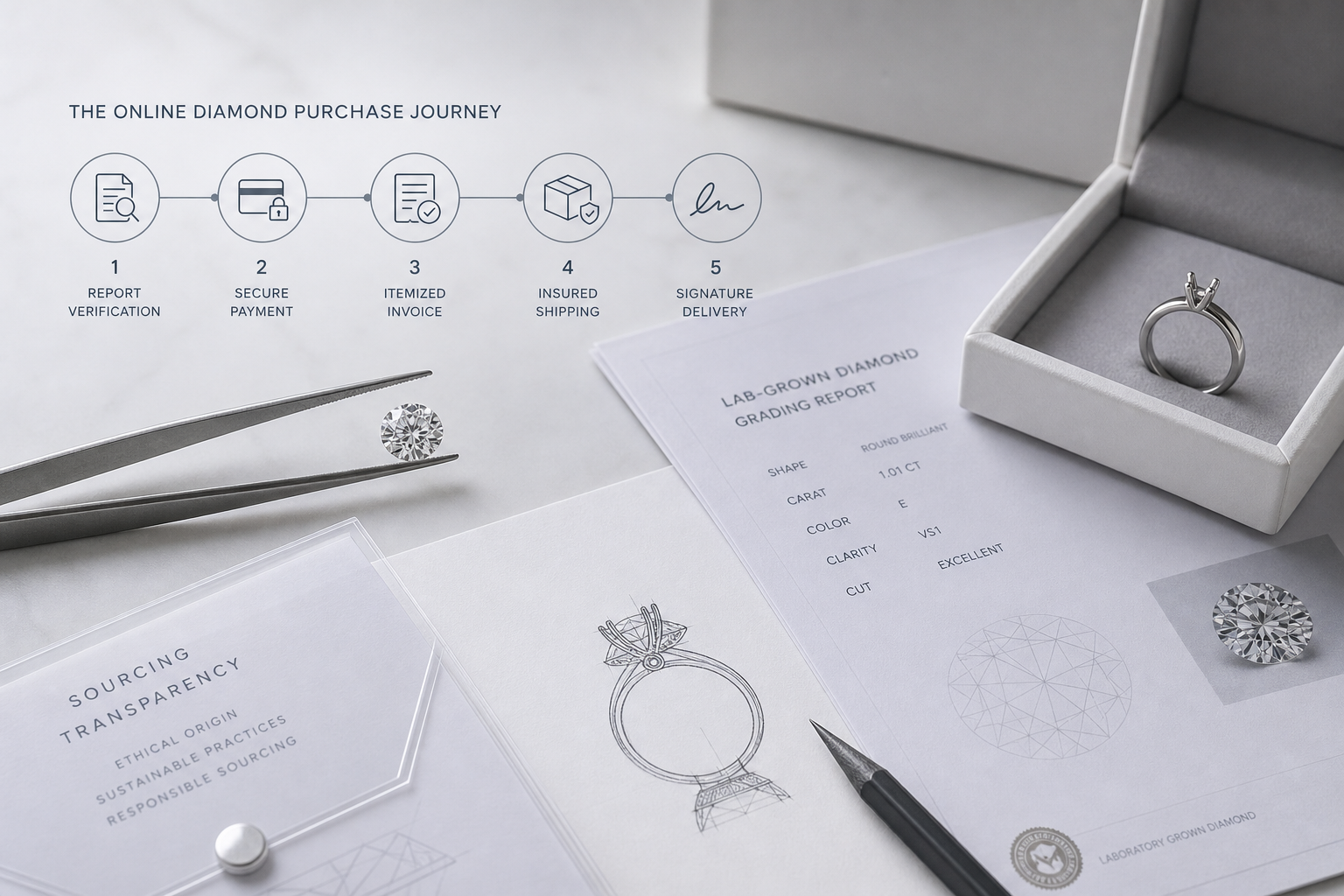
Once the diamond itself has been verified, the transaction still needs its own safeguards. To buy a loose diamond online safely, the payment record, invoice, and shipping plan should all identify the same stone and create a traceable path from purchase to delivery.
This is not the place to rely on informal arrangements. A secure diamond purchase online should involve a recognized checkout process, written order confirmation, itemized documentation, and a shipping method appropriate for a high-value item. If the transaction feels detached from the listing you verified, the risk has increased even if the diamond looked strong on paper.
Make Sure the Invoice Identifies the Exact Diamond
The invoice should be specific enough to connect your payment to the diamond you intended to buy. At minimum, it should include the order number, diamond shape, carat weight, color, clarity, price, and grading report number when available. If the invoice only says “lab diamond” or “loose stone,” ask for a corrected version before the package ships.
This matters because many loose lab-grown diamonds can look similar in basic description. Two stones may both be listed as 2.00 carat, F color, VS1 clarity ovals, but they are not interchangeable if their measurements, report numbers, videos, and visual character differ. The invoice should remove that ambiguity.
Avoid Payment Paths That Reduce Your Recourse
Use a secure checkout or other traceable payment method that produces a written receipt. Avoid informal transfers, unrecorded payment requests, or instructions that ask you to bypass the seller’s normal order system. This is not legal or financial advice, but from a practical buyer standpoint, a payment path with no clear paper trail is a poor fit for a valuable loose diamond purchase.
Be especially cautious if the seller changes payment instructions at the last minute, asks for payment to an unrelated name, or offers a discount for moving the transaction outside the platform where the diamond was listed. A lower price is not worth losing the ability to connect the purchase to the seller, the order, and the exact stone.
Confirm Shipping Protection Before the Package Moves
Before shipment, confirm whether the package will be trackable, insured, and delivered with a signature requirement. For higher-value orders, adult signature delivery is often preferable because it reduces the chance of the package being left unattended. Make sure the delivery address is accurate and that someone trusted can be available when the package is expected.
Ask how tracking information will be provided and what you should do if the package appears delayed, damaged, or misdelivered. The seller does not need to overpromise a delivery outcome, but they should be able to explain the shipping method, documentation, and issue-reporting process before the diamond leaves their possession.
Transaction Safety Check
Before payment, the buyer should have the seller’s legal or business identity, secure checkout page, itemized invoice, payment confirmation, shipping method, tracking expectations, and written delivery requirements.
Inspect the Loose Lab-Grown Diamond Immediately After Delivery
The verification process does not end when the order is placed. The first day the package arrives is one of the most important points in the purchase because the return window, issue-reporting period, and setting timeline may already be moving. Do not leave the package unopened for several days or wait until the diamond is ready to be mounted before checking it.
Your goal is not to perform a laboratory authentication at home. The practical goal is to confirm that the package arrived in good condition, the documents match the order, the stone appears consistent with the listing, and any concern is raised while you still have options.
Home inspection has limits, so avoid making claims you cannot verify yourself. You can compare documents, look for obvious mismatches, review appearance, and preserve packaging, but you may not be able to confirm every grading detail without proper tools. If the purchase is high value, the setting is complex, or the stone seems inconsistent with the listing, an independent jeweler’s review can add another practical check before the diamond is mounted.
Document the Package and Contents
Inspect the outer packaging before opening it. If the box looks damaged, tampered with, wet, crushed, or resealed unexpectedly, photograph it before going further. Keep the shipping label, packing material, inner stone packaging, tags, and included documents until you are confident there is no issue.
As you open the package, take clear photos of what was included. This does not need to be a complicated process; it simply creates a timeline of delivery condition and contents. If a report, receipt, stone holder, or tag is missing, you want to know immediately rather than discovering it after the return window is nearly over.
Compare the Received Stone With the Report and Order
Check the received documents against your saved order record. The report number, shape, carat weight, color, clarity, and measurements should match the diamond you ordered. If the grading report mentions a laser inscription and you have access to a jeweler or magnification sufficient to view it, that can provide another helpful identity check.
If something does not match, contact the seller immediately in writing. Do not send the stone to be set, resized into a project, or independently altered while the issue is unresolved. A mismatch in report number, shape, or measurements is not a minor cosmetic concern; it goes to the identity of the diamond itself.
Review Appearance Before Setting the Diamond
Look at the diamond under normal lighting, not only under intense spotlights. Compare it with the original listing video and photos, keeping in mind that lighting and magnification can change how inclusions, reflections, and tint appear. The question is whether the stone is broadly consistent with what was represented and acceptable for the way it will be worn.
If you are unsure, a qualified local jeweler can provide an independent look at the stone and help confirm basic consistency with the report and intended setting. This is optional for many buyers, but it can be worthwhile for higher-value purchases, custom settings, or situations where something feels inconsistent.
Review the diamond before it is mounted. Some sellers may treat a loose stone differently once it has been set, altered, damaged, or sent into a custom project. If you plan to use the diamond in a custom ring, finish the inspection first so the design process starts with a verified stone rather than an unresolved question.
Final Inspection Checklist
Within the return window, the buyer should confirm the order record, grading report, stone identity, visual appearance, packaging condition, and any concerns in writing. If the buyer plans a custom setting, they should finish this inspection before sending the stone to be mounted.
Use a Final Pre-Order Checklist Before You Click Buy
A loose lab-grown diamond checklist should work like a decision gate, not a reminder to “look carefully.” Before placing an order, every major piece of evidence should point to the same specific stone: the grading report, media, measurements, seller answers, invoice, payment path, shipping details, and return terms.
If one item is missing, the answer is usually not to abandon the diamond immediately. The better move is to ask for written clarification. If several items are missing, or if the seller cannot connect their answers to the exact report number, the risk is no longer just about the diamond. It is about whether the purchase can be verified at all.
The 10-Point Pre-Order Checklist
- I verified that the grading report number matches the listing. The report number should connect clearly to the diamond being sold, not just to a generic product description.
- I confirmed that the report can be checked through the issuing lab when lookup is available. A screenshot is useful, but direct report lookup is stronger when the lab provides it.
- I confirmed that the video or photos show the exact stone. Stock images may help with style, but they are not enough for online diamond verification.
- I checked that the diamond’s measurements and proportions fit the intended setting. This matters more for fancy shapes, halos, bezels, three-stone rings, and custom designs.
- I reviewed the stone for visible concerns. Bow-tie strength, obvious tint, cloudy appearance, distracting inclusions, and uneven outline should be judged before payment, not after mounting.
- I saved the return policy. The return window, condition rules, shipping responsibilities, and any exclusions should be clear before the order is placed.
- The seller answered stone-specific questions in writing. Useful answers should reference the report number, measurements, actual media, availability, setting fit, or policy terms.
- The invoice identifies the exact diamond. It should include enough detail to connect the payment to the stone, such as report number, shape, carat weight, color, clarity, and order number.
- The payment and shipping path are secure, trackable, and documented. Avoid informal payment requests, unclear delivery terms, or shipping that leaves responsibility vague.
- I have a plan to inspect the diamond immediately after delivery. The return window is only useful if the stone, documents, and condition are checked promptly.
When to Proceed, Pause, or Walk Away
Proceed when the evidence is complete and consistent. The report, listing, video, measurements, invoice, seller answers, and policy terms should all describe the same diamond without forcing you to make assumptions.
Pause when one or two details need clarification but the seller is responsive and the missing information can be confirmed in writing. Examples include an additional video request, a setting-fit question, a shipping detail, or confirmation that the stone is still available. A short delay is better than buying a diamond that cannot be properly verified.
Walk away when the seller cannot confirm the report number, will not say whether the media shows the exact stone, gives vague return terms, pressures you to pay outside a secure checkout, or provides answers that contradict the listing. Those are not minor inconveniences. They weaken the basic evidence trail that makes buying loose lab-grown diamonds online manageable.
How This Checklist Supports a Custom Ring Project
For a custom ring, verification is not only about avoiding the wrong diamond. It also gives the designer or jeweler the information needed to build around the right stone. Exact millimeter dimensions, shape outline, depth, girdle details, and visual proportions can affect prong placement, halo fit, basket height, and overall balance.
If the loose stone is confirmed before design begins, the setting can be planned with fewer surprises. If the diamond is not fully verified until after CAD work or mounting decisions begin, small mismatches can become expensive or time-consuming to correct.
If you want help comparing report numbers, videos, measurements, and setting fit, NUVU’s educational guidance can help frame the right questions before you order. Buyers can start by reviewing loose lab-grown diamond options or requesting guidance on how a specific stone may relate to a custom ring design.
NUVU’s buyer-first approach is to make comparison clearer: what the report shows, what the visuals reveal, whether the measurements fit the intended piece, and what documentation should be confirmed before payment.
These checks do not replace your own review of photos, measurements, and return terms, but they add a useful layer of clarity when you are comparing similar loose stones online.
Buyer Verification Summary
The safest online order is not the one with the most attractive listing alone. It is the one where the report, video, measurements, seller answers, invoice, payment, shipping, and return terms all point to the same specific diamond.
FAQ: Buying Loose Lab-Grown Diamonds Online
Is it safe to buy loose lab-grown diamonds online?
Yes, it can be safe when the purchase is built around verification rather than trust in a single listing photo or low price. Before ordering, confirm the grading report, actual stone media, seller terms, payment path, and shipping details. A lower-risk online loose diamond buying process is one where the evidence is consistent and saved before payment.
Do I need a grading report for a loose lab-grown diamond?
A grading report is strongly recommended for a loose lab-grown diamond because it helps confirm the stone’s graded characteristics and identity. It typically provides details such as shape, carat weight, color, clarity, measurements, and report number. It does not replace visual review, because a report cannot fully show face-up appearance, bow-tie strength, or how the diamond will look in the intended setting.
Can a diamond video prove the stone is good?
A video is helpful, especially when it shows the exact diamond linked to the report number, but it should not be treated as proof by itself. Lighting, magnification, camera angle, and background can all affect how the stone appears online. Use video together with the grading report, measurements, seller answers, and return policy.
Should I buy the loose diamond before choosing the setting?
Often, yes, especially for custom design. Once the diamond is selected and verified, the setting can be built around its exact measurements, shape, depth, and outline. For ready-made settings, the order may be reversed, but compatibility should be confirmed before buying the stone.
What should I do if the received diamond does not match the listing?
Contact the seller immediately in writing and include the order number, report number, photos of the package, photos of the documents, and a clear description of the mismatch. Do this within the stated return or issue-reporting window. Do not set the diamond or discard packaging until the seller has responded and the next step is clear.
Disclosure: This article is for general educational purposes only. Diamond grading, pricing, availability, specifications, and seller policies can change, and readers should verify important details through grading reports, official laboratory tools, seller documentation, or qualified professionals before making a purchase decision. Laboratory-grown diamonds should be clearly distinguished from natural diamonds, and environmental or sourcing claims should be supported by specific documentation.