
Diamond pricing can feel confusing because two stones with the same carat weight may differ widely in cost, appearance, documentation, and long-term meaning. Lab-grown diamonds usually cost less than natural diamonds because production can be scaled more predictably, while discussions of lab grown vs natural diamond appearance help separate visible characteristics from pricing assumptions, and natural diamonds carry pricing tied to geological rarity, mining, sorting, distribution, and origin. That lower price does not make a lab-grown diamond fake or automatically lower quality, but it also does not make every low-priced stone a smart buy.
For the full framework, read Lab-Grown Diamond Price Guide.
This article helps you compare price in a more practical way: by looking beyond carat weight to cut, color, clarity, measurements, reports, images, seller terms, and total ring budget. The useful question is not simply which diamond is cheaper, but which option gives you the right balance of visible beauty, verified quality, origin preference, setting design, and budget efficiency.
For buyers, the practical point is that price only becomes meaningful when the stone is compared on the same basis: same shape, similar grade range, comparable measurements, and clear documentation.
| Buying Question | What to Compare | Why It Matters |
|---|---|---|
| Is the lower price good value? | Cut, proportions, tint, inclusions, report, images | A cheap stone can still perform poorly |
| Can I get a larger diamond? | Carat weight, face-up size, key size thresholds | Slightly smaller stones may look nearly as large |
| Do higher grades matter visually? | Color, clarity, shape, viewing conditions | Some grade differences are not obvious when worn |
| Is a natural premium worthwhile? | Origin, rarity, tradition, documentation | Meaning may justify cost for some buyers |
| Am I comparing fairly? | Same shape, size range, specs, reports, seller terms | Mismatched comparisons can distort price differences |
| What affects the final ring cost? | Diamond price, setting, design, service, seller policies | The center stone is only part of the budget |
Quick Questions Before You Read
Q: Does a lower lab-grown diamond price mean lower quality?
No. It mainly reflects different supply and production economics, but each stone still needs to be judged by cut, appearance, documentation, and seller terms.
Q: Should I compare diamonds by carat weight first?
Carat matters, but measurements, cut quality, and face-up appearance often tell you more about how large and bright the diamond will look.
Q: Are natural diamonds always a better long-term choice?
Not always. Natural diamonds may appeal more if origin, rarity, and tradition matter to you, but they still need strong quality and clear documentation.
Q: What is a careful way to compare prices?
Compare stones with similar shape, size, color, clarity, cut, reports, images, and clearly stated seller terms before judging the price difference.
Quick Answer: Why Lab-Grown Diamonds Usually Cost Less Than Natural Diamonds
Lab-grown diamonds usually cost less than natural diamonds because they come from a different supply system. They are created in controlled production environments, which means supply can be expanded more predictably than mined diamond supply. Natural diamonds, by contrast, are priced partly around geological scarcity, mining complexity, sorting, distribution, and long-standing market perception.
This is the key point in any lab-grown vs natural diamond price comparison: lower price does not mean the diamond is visually fake, and it does not automatically mean the stone is lower quality. A lab-grown diamond can still be evaluated by carat weight, color, clarity, cut quality, measurements, and a grading report. The difference is that its market price is not built around the same rarity story as a natural diamond.
For buyers, the practical result is clear. A lab-grown option may allow a larger diamond for the same budget, or it may let you choose stronger visible specifications while keeping the ring budget under control. The tradeoff is not simply “same thing, lower price.” The real decision is whether you value visible size and specification flexibility more than natural origin and rarity.
A useful buyer habit is to separate the report from the viewing evidence. A grading report can confirm the identity and basic specifications of the stone, but it does not by itself prove that the diamond will look lively, balanced, or well suited to the intended ring design. That is why images, measurements, and setting plans belong in the same comparison.
Evidence note for price comparisons: Because no single listing price proves the whole market, treat any comparison as a controlled shopping exercise rather than a universal rule. The most defensible comparison keeps the major variables aligned: same shape, similar carat range, similar color and clarity range, comparable cut information, comparable report detail, and similar seller terms. Without those controls, a “lab-grown vs natural” price difference may actually be a difference in cut quality, documentation, retail channel, or service level.
This is also why exact price claims should be handled carefully. Diamond prices can move by seller, report type, inventory age, promotions, exchange rates, and availability. A buyer-facing article can explain the structure behind the price gap, but a real purchase should still be checked against current listings and the exact stone documentation available at the time of buying.
Origin disclosure note: Laboratory-grown diamonds should be clearly identified as laboratory-grown, and they should not be presented as mined diamonds. Natural diamonds and laboratory-grown diamonds are both diamonds, but they have different origins, different supply economics, and often different price behavior.
Diamond simulants are a separate category and should not be confused with lab-grown diamonds. If a listing uses vague language such as “diamond alternative,” “created stone,” or “diamond-like,” buyers should confirm whether the product is a laboratory-grown diamond, a natural diamond, or a non-diamond simulant before comparing prices.
The Short Price Explanation in Plain English
Lab-grown diamonds cost less mainly because production can be repeated, improved, and scaled. Natural diamonds depend on deposits that must be found, mined, sorted, and brought through a longer supply chain before they reach a buyer. That difference changes how supply reacts to demand.
If more shoppers want a certain size or quality range in lab-grown diamonds, producers and suppliers can often respond by increasing production over time. With natural diamonds, supply is limited by what the earth has produced and what mining operations can economically recover. This is why the answer to “why are lab diamonds cheaper” is less about beauty and more about supply structure.
Price is not only a reflection of how a diamond looks in a ring. It also reflects how difficult it is to source that diamond, how predictable supply is, how many parties handle it, and how the market assigns value to origin.
What “Cheaper” Does and Does Not Mean
“Cheaper” should not be treated as a shortcut for “bad.” A lower-priced lab-grown diamond may still have strong cut quality, a respected grading report, attractive color and clarity, and excellent face-up appearance. It can be a smart buy when the specifications, visuals, and documentation support the price.
It is also a mistake to assume every low-priced lab-grown diamond is good value. Poor cut, weak proportions, visible inclusions, undesirable tint, unclear measurements, or limited seller transparency can make a low price less attractive. The biggest risk is buying by carat weight alone, especially if the diamond looks large on paper but performs poorly in real viewing conditions.
The most useful comparison is not “lab-grown equals cheaper.” It is whether the lower price is attached to a diamond that still meets the standards you care about: appearance, documentation, setting fit, and long-term satisfaction.
How This Changes the Buyer’s Budget
For the same total budget, a lab-grown diamond can often shift the buyer’s options. Instead of choosing a smaller natural diamond in a desired quality range, the buyer may be able to consider more carat weight, a higher color grade, a higher clarity grade, or a more detailed setting design.
The better use of that flexibility depends on the ring. For an engagement ring, many buyers get more visible impact from better cut quality and balanced proportions than from chasing the highest clarity grade. Others may prefer to keep the center stone moderate and use the extra room in the budget for a custom setting, side stones, or a more durable metal choice.
The wrong move is to spend every saved dollar on size without checking whether the larger stone still fits the design and the wearer’s lifestyle. A bigger diamond can sit higher, require different prong support, or feel less practical for someone who uses their hands constantly.
What to Check Before You Decide
Before judging price, compare diamonds under similar conditions. Keep the shape, carat weight, color, clarity, cut quality, grading report type, measurements, visual assets, and seller terms as consistent as possible. A cheaper stone is only a meaningful comparison if the specifications and documentation are reasonably comparable.
Also confirm whether the diamond is being sold as natural or laboratory-grown before you compare prices. Origin should be clear on the product page and grading report. If you have to search for that detail or ask repeatedly, the listing is not giving you enough information to make a confident decision.
The Supply Difference: Geological Rarity vs Scalable Production
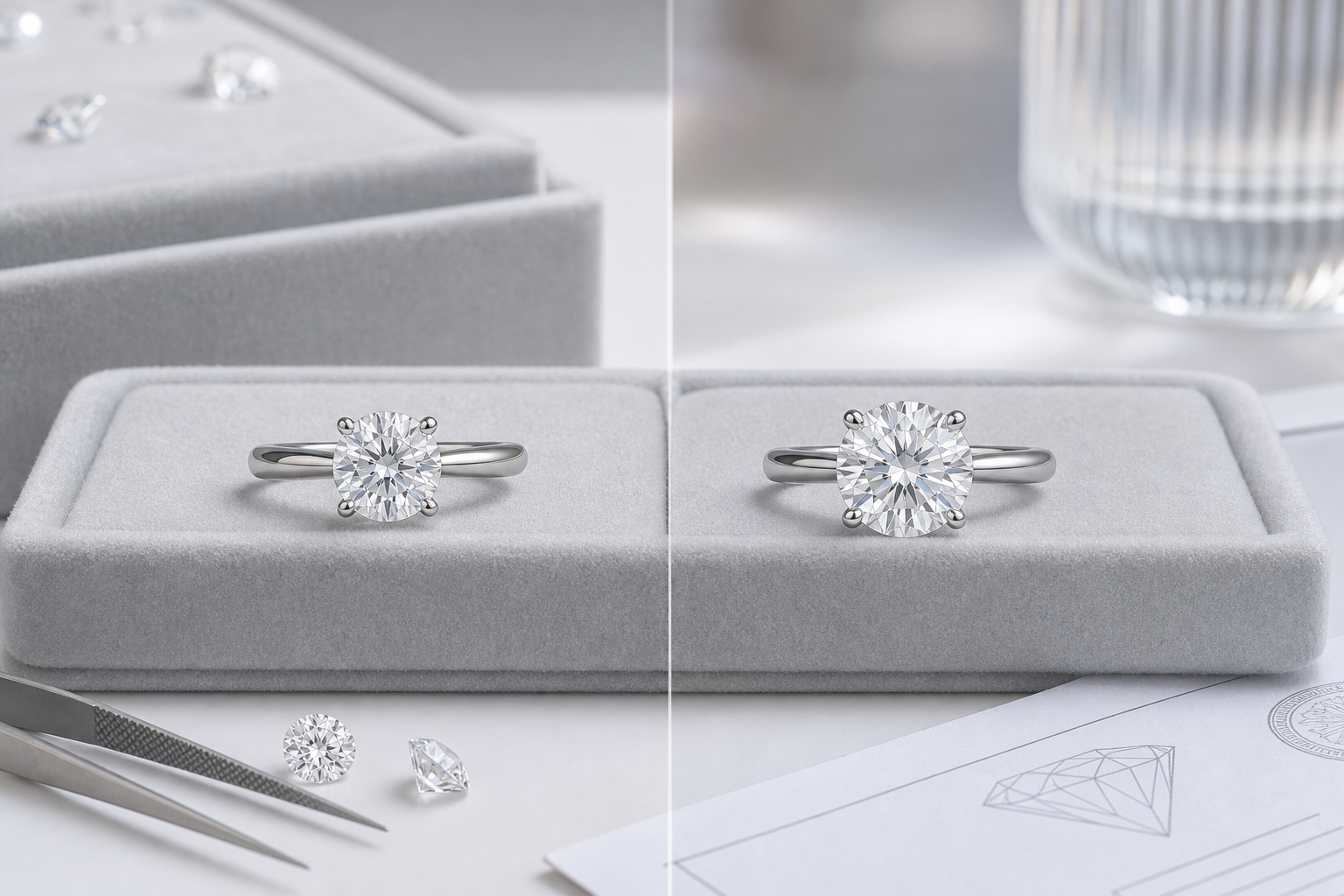
The largest structural price difference between natural and lab-grown diamonds starts with supply. Natural diamonds come from finite geological deposits. Lab-grown diamonds come from repeatable production methods. That does not make lab-grown production effortless, but it does mean the market can respond to demand in a more flexible way than mined diamond supply usually can.
This is where diamond supply and price become closely connected. Natural diamond rarity matters most in specific combinations: larger carat weights, higher color grades, higher clarity grades, and desirable proportions. Small or lower-grade natural diamonds are not rare in the same way as a well-cut, high-quality larger stone. Treating all natural diamonds as equally rare leads to poor price judgment.
Why Natural Diamond Pricing Is Tied to Geological Scarcity
Natural diamonds require exploration, mining, sorting, cutting, and distribution before they become finished stones. Each step narrows the field. A mine may produce a large amount of rough material, but only a portion will cut into diamonds with the size, color, clarity, and proportions that buyers want for fine jewelry.
This is one reason why natural diamonds cost more in certain ranges. A one-carat natural diamond with average characteristics may be available through many channels, while a larger stone with strong color, clarity, and cut parameters is harder to source. As quality and size rise together, the price can increase sharply because the supply of comparable stones becomes thinner.
The practical takeaway is that natural diamond rarity is not just about age or origin. It is about how few finished stones meet a specific buying target. If a shopper wants a larger natural diamond that is bright, well-proportioned, and clean to the eye, they are paying for a narrower supply pool.
Why Lab-Grown Diamond Supply Can Expand More Predictably
Lab-grown diamond production uses controlled methods often described in the trade as CVD and HPHT to grow diamond material that can be cut and graded for jewelry. These processes require equipment, energy, technical control, and skilled cutting. They are not cost-free, and not every grown diamond becomes a desirable finished stone.
The important difference is that production capacity can increase as technology, investment, and supplier participation expand. When more producers enter the market and growth methods become more efficient, price competition can become stronger. This is a major reason lab-grown diamonds usually price lower than comparable natural diamonds.
For buyers, this means lab-grown pricing often reflects production economics and competitive supply rather than geological scarcity. The recommendation changes if the buyer values natural origin as part of the purchase. If the buyer is focused mainly on visible appearance and specifications, scalable supply often works in their favor.
That said, lower cost does not automatically prove better sourcing or better sustainability. If a seller makes environmental or ethical claims, those claims are only as useful as the documentation behind them. Production method, energy use, material handling, and supply-chain transparency are worth asking about, especially when a listing tries to turn a broad claim into a selling point.
Traceability in a price comparison is not only about knowing whether a diamond is lab-grown or natural. It is also about connecting each claim to a document, listing detail, or seller explanation that can be checked. For a lab-grown diamond, that may mean confirming the report’s origin disclosure, growth method notes when provided, measurements, and any treatment comments. For a natural diamond, it may mean confirming the report identifies the stone as natural and understanding what the available paperwork does and does not say about source or origin.
How to read sustainability language in a price discussion: A lower lab-grown diamond price should not be treated as evidence that the stone is automatically sustainable, low-impact, or carbon-neutral. Those are separate claims that require separate support. In a buying comparison, it is safer to ask for specific information: what claim is being made, what part of production or sourcing it covers, whether third-party documentation is available, and whether the claim applies to the exact diamond or only to the seller’s broader messaging.
This distinction protects the buyer from mixing two different questions. “Why does this diamond cost less?” is mainly a supply, production, grading, and retail-channel question. “What is the environmental profile of this diamond?” is a documentation question. A seller can offer a competitively priced diamond and still need to substantiate any responsible-sourcing or environmental claims separately.
Why Rarity Affects Price More Than Appearance Alone
Two diamonds can look very similar in everyday wear and still carry very different prices. One may be priced partly for natural origin and limited geological supply, while the other is priced through a production-based market. That difference can be rational even when the visible result is close.
This is where many buyers get stuck. They expect price to track only what the eye can see. In diamonds, price also reflects origin, sourcing difficulty, market tradition, and supply constraints. A natural diamond does not have to look dramatically different from a lab-grown diamond to cost more; the premium may be attached to the fact that it is natural.
The better question is not whether rarity is “worth it” in general. It is whether rarity is worth it to you. If natural origin carries personal meaning, the premium may make sense. If your priority is size, brightness, and specification flexibility within a fixed budget, lab-grown supply usually gives you more room to work.
Buyer Verification Checklist
Before comparing prices, confirm the diamond’s origin on both the product page and the grading report. The listing should clearly state whether the diamond is natural or laboratory-grown. This detail should be obvious before purchase, not discovered later in fine print.
Also check that the grading report matches the exact stone being sold. The report number, carat weight, measurements, shape, and origin disclosure should align with the listing. If a seller cannot provide clear documentation, the price comparison is not reliable enough to guide a purchase.
When a grading report is available, buyers should verify the report details through the issuing laboratory’s official report-check tool where available, then compare those details with the seller’s listing and visual evidence.
Production Cost vs Mining Cost: What Actually Sits Behind the Price
The price difference between lab-grown and natural diamonds is not explained by one simple cost. It comes from different cost structures. Natural diamonds carry the costs of locating, extracting, sorting, and distributing mined rough. Lab-grown diamonds carry the costs of controlled growth, equipment, energy, monitoring, cutting, grading, and retail handling.
No buyer should assume that a lower production cost automatically turns into a fair retail price. The final listing still depends on supplier channel, grading, imagery, inventory model, brand positioning, and service. The smarter approach is to compare the finished retail offer, not make assumptions based only on how the diamond originated.
Natural Diamond Cost Layers
Natural diamond mining cost begins before a sellable diamond exists. Companies may spend heavily on exploration, site development, equipment, labor, environmental management, extraction, and rough sorting. Much of the recovered material will not become high-value jewelry-grade diamonds.
After mining, rough diamonds typically move through additional steps: sorting, transport, cutting, polishing, grading, wholesale distribution, and retail presentation. Each stage adds cost, and each party involved may need margin for risk, labor, expertise, and inventory holding. By the time the stone reaches a consumer, the price reflects far more than the material itself.
The point is not that every natural diamond is overpriced. The point is that natural diamond pricing carries a long chain of cost and scarcity factors. This matters most when you compare stones in desirable size and quality ranges, where fewer suitable natural diamonds are available.
Lab-Grown Diamond Cost Layers
Lab-grown diamond production cost is built differently. A producer must account for the growth method, reactor equipment, energy use, seed material, technical monitoring, labor, and quality control. CVD diamonds and HPHT diamonds can both require careful management during and after growth, and some stones may need post-growth treatment before cutting.
Once the rough material is ready, the diamond still has to be planned, cut, polished, graded, photographed, listed, and sold. A lab-grown diamond with poor cutting or weak documentation is not automatically a good value just because it came from a lower-cost supply model.
This is an important distinction for shoppers. In comparisons of lab-grown vs natural diamonds, lab-grown diamonds can offer strong price advantages, but the better buys are not simply the cheapest listings. They are the stones where the price, grading report, proportions, visual performance, and seller transparency line up.
Growth method and treatment clarification: HPHT and CVD are commonly discussed as laboratory-grown diamond growth methods. In some contexts, HPHT may also refer to a post-growth treatment, but buyers should not assume treatment status unless it is stated in the grading report or seller documentation.
When growth method or post-growth treatment is relevant, buyers should look for clear disclosure in the grading report or seller documentation. This is especially important when two stones appear similar in price but differ in comments, growth-method notes, color characteristics, or treatment disclosures.
Why Scale and Competition Push Lab-Grown Prices Down
As lab-grown production technology matures and more suppliers participate, the market tends to become more competitive. Production can expand, processes can become more efficient, and retailers may have access to a wider range of comparable stones. That combination often pushes lab-grown diamond prices down relative to natural diamonds with similar visible specifications.
This should be understood as a market tendency, not a universal guarantee. Energy costs, growth quality, cutting outcomes, report type, seller channel, and service model can all affect the final price. A well-presented lab-grown diamond with strong documentation and support may cost more than a poorly documented option with similar headline specs.
The useful judgment is this: scale helps explain why lab-grown diamonds usually cost less, but it does not remove the need to evaluate the individual stone. Production economics can create better buying opportunities, but only careful comparison shows whether a specific listing is actually good value.
How to Verify This Before Buying
Compare the final retail listing instead of assuming the lowest price is the best deal. Check the report number, origin disclosure, carat weight, millimeter measurements, cut information, images, videos, and seller terms. If those details are missing, the discount may be hiding uncertainty rather than offering value.
For a fair comparison, place similar diamonds side by side with the same shape, size range, color range, clarity range, and cut expectations. Then look at the total purchase context: documentation, visual evidence, setting compatibility, and support. A low price only matters if the diamond can be verified and makes sense for the ring you are actually buying.
Grading Still Matters: Why Similar Specs Can Have Different Prices
A lab-grown vs natural diamond price comparison only works if the diamonds being compared are truly similar. A well-cut natural diamond should not be compared against a poorly cut lab-grown diamond and treated as proof that one category is always better value. The same applies to shape, carat weight, color, clarity, measurements, and documentation. Small differences on paper can create large differences in price, and some of those differences matter more to the final look than others.
The most common mistake is treating the headline grade as the full story. Two diamonds may both be listed as 1.50 ct, G color, VS2 clarity, yet look different in real life because one has better proportions, a more flattering face-up size, stronger light return, or cleaner clarity characteristics under the table. A diamond grading report helps narrow the comparison, but it should not replace visual judgment.
Carat Weight: Why Size Changes Price Quickly
Diamond pricing usually rises as carat weight increases, but not in a smooth, straight line. Certain size points carry more buyer demand, especially 1.00 ct, 1.50 ct, 2.00 ct, and 3.00 ct. These are psychological milestones as much as weight measurements, and prices can respond when many buyers are trying to reach the same visible size category.
This matters because a diamond just under a major size point can sometimes offer better value than one that barely crosses it. For example, a 1.90 ct diamond may face up very close to a 2.00 ct diamond if the measurements are strong, while avoiding some of the price pressure attached to the 2.00 ct label. The same logic can apply around 1.00 ct and 1.50 ct. The number on the grading report matters, but the millimeter spread tells you how large the stone will actually appear.
Color and Clarity: Higher Grades Are Not Always Better Value
Diamond color clarity price differences can be meaningful, but higher grades are not automatically the smarter place to spend money. Moving from near-colorless to colorless may increase the price without creating a visible improvement for every buyer, especially in a well-cut round brilliant diamond set in yellow or rose gold. In white metal settings or step-cut shapes such as emerald and Asscher, color may be easier to notice, so the recommendation can change.
Clarity works the same way. Paying more for a very high clarity grade can make sense for certain buyers, but many shoppers are better served by looking for an eye-clean diamond rather than chasing a grade that looks impressive on paper. A VS2 or even a carefully selected SI1 in a natural diamond may be visually clean in normal wear, while some lab-grown diamonds with high clarity grades can still require review for the type and location of inclusions. The practical question is not “What is the highest grade I can afford?” It is “Will this grade change what I actually see?”
Cut Quality and Measurements: The Overlooked Price Factor
Diamond cut quality price differences are often more important than small jumps in color or clarity. Cut affects brightness, fire, contrast, and face-up appearance. A larger diamond with weak proportions can look flat, dark, or smaller than expected, while a slightly smaller diamond with better cut quality can appear brighter and more balanced.
Measurements deserve close attention because carat weight measures weight, not visible diameter. A deep diamond can hide weight in the bottom of the stone, giving the buyer less face-up size for the price. Table percentage, depth percentage, symmetry, polish, and overall proportions all influence whether the diamond uses its weight well. If two stones have the same carat weight but one has stronger spread and better light performance, the cheaper stone may not be the better value.
Reports and Lab Differences: Useful, but Not the Whole Story
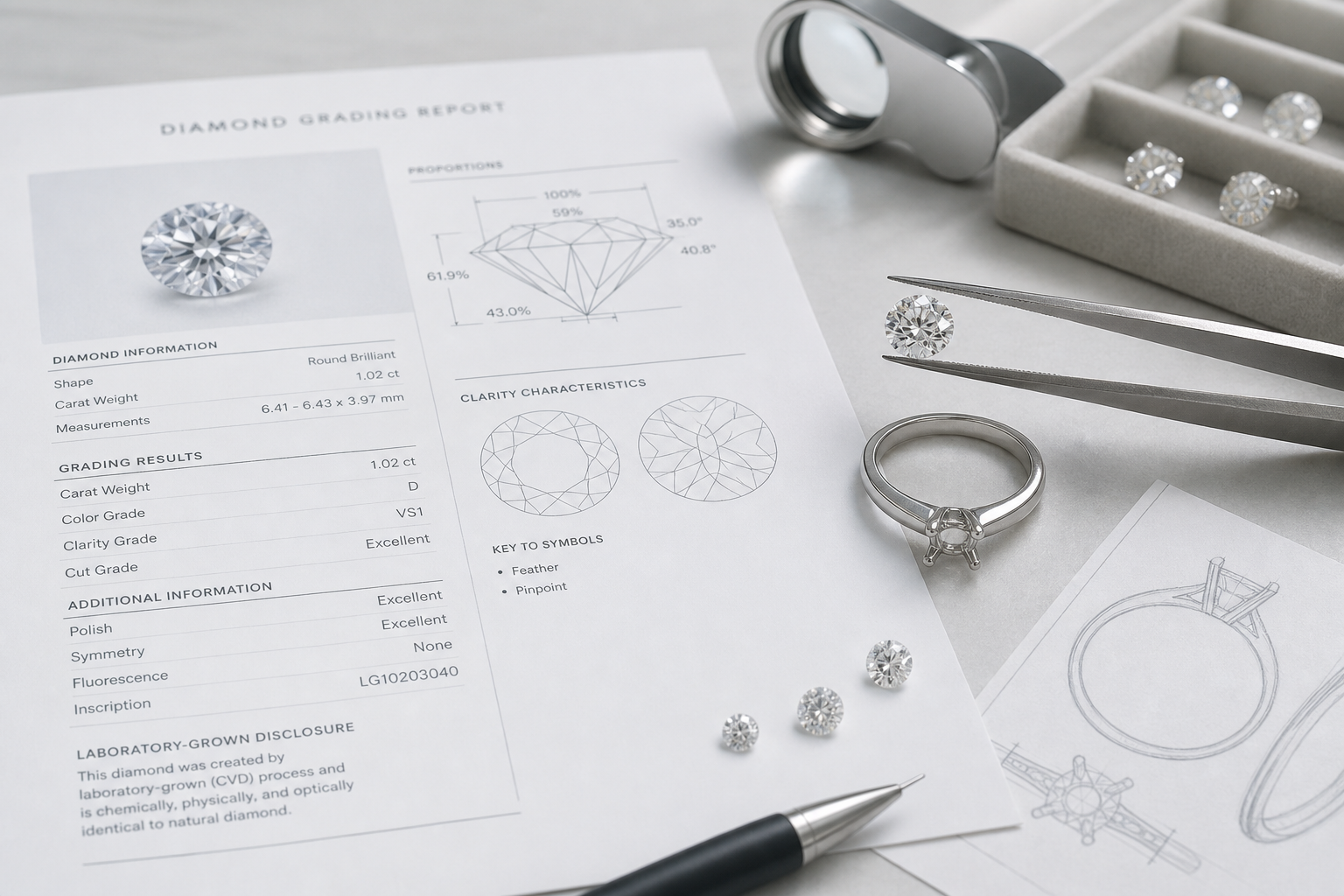
A diamond grading report gives buyers a common language for comparison. It should identify the diamond’s carat weight, color, clarity, measurements, cut information where applicable, and whether the stone is natural or laboratory-grown. For a lab-grown diamond report, the origin disclosure is not a minor detail; it is essential to comparing price honestly.
Reports are useful, but they do not show everything. They may not fully capture how lively the diamond looks in motion, how visible an inclusion is from normal viewing distance, or whether the stone’s proportions suit a specific ring design. Different grading organizations may also present information differently, so buyers should avoid treating the report as the only decision tool. It is the starting point for verification, not the final proof of beauty.
In practical buying, this is where many comparisons become misleading: a report can look strong while the stone still feels underwhelming once it is viewed in normal light. That is why the most reliable process is to use the report to narrow the shortlist, then use images, measurements, and setting context to judge whether the stone actually fits the purchase goal.
A report-aware comparison should also look for consistency across documents and listings. The report number, stone type, shape, carat weight, measurements, color, clarity, and any listed comments should not conflict with the seller’s description. If a listing uses a broad phrase such as “certified diamond” without showing the report details or making the origin clear, the buyer should ask for clarification before treating the price as comparable.
Report comparison note: Avoid using a report as a broad ranking of value by itself. A report can document key characteristics, but it does not automatically settle questions about beauty, price fairness, setting fit, or personal preference. When comparing lab-grown and natural diamonds, the most defensible use of the report is narrow: confirm the exact stone, confirm origin disclosure, compare the listed 4Cs and measurements, and check whether any comments or clarity details change how you should evaluate the visuals.
If two reports come from different grading organizations, compare what each report actually records rather than assuming the formats are identical. One report may include more cut-related detail, one may present lab-grown disclosure differently, and one may provide comments that matter to the buying decision. The safest approach is not to declare one lab universally better, but to ask whether the available report gives enough information for the specific comparison being made.
What a grading report does not prove: A grading report helps document key characteristics, but it should not be treated as a guarantee of beauty, value, future resale outcome, responsible sourcing, or environmental impact. It is one part of the evidence set, not the whole buying decision.
For price comparison, the report is most useful when it is connected to the exact stone through matching measurements, report number, origin disclosure, and visual evidence. Buyers should be cautious when a seller relies on the word “certified” without making the actual report details available for review.
Certificate and Visual Review Check
Before treating two diamonds as comparable, verify the report number on the issuing lab’s website when possible. Confirm the origin, review the clarity characteristics, compare the actual millimeter measurements against the carat weight, and look at images or video under consistent lighting. If a listing does not provide enough visual information, the lower price is harder to judge.
At NUVU, we generally treat the report as a filter, not the full decision. A report can confirm important facts, but the stone still needs to make sense visually, physically, and financially for the ring or jewelry piece being considered.
Retail Markup and Selling Channel: Why the Same Diamond Type Can Still Vary in Price
The price a shopper sees is not only the cost of the diamond itself. It also reflects the selling channel, brand positioning, inventory model, photography, grading support, setting work, consultation, and service structure behind the purchase. This is why two similar lab-grown diamonds can be priced differently, and why two similar natural diamonds can show a spread even when their grading reports look close.
Diamond retail markup is not automatically unreasonable. A higher price may reflect better visual assets, stronger documentation, custom design support, careful stone matching, or more responsive guidance. It can also reflect brand premium or convenience without adding much value to the actual diamond. The buyer’s job is to separate useful service from cost that does not improve the purchase.
Why Two Similar Lab-Grown Diamonds May Not Cost the Same
Lab-grown diamonds often move through competitive retail channels, but that does not mean every listing is priced the same way. One seller may provide detailed video, clear measurements, a recognized grading report, and consultation around setting fit. Another may offer a lower price with limited imagery, sparse details, or less support after selection. The first option may cost more for reasons that matter; the second may still be a good deal if the documentation and visuals are strong enough.
Report type, sourcing model, inventory ownership, and custom design support can all affect the final price. Online diamond prices may look simple at first, but the better comparison is not just “Which stone is cheaper?” It is “Which listing gives me enough evidence to know what I am buying?” A low price is more useful when the seller makes verification easy.
Why Two Similar Natural Diamonds May Not Cost the Same
Natural diamonds can vary in price because their value is influenced by more than the 4Cs. Origin story, rarity within a specific grade range, supplier network, inventory age, brand positioning, and subtle grading details can all affect pricing. Even two diamonds with the same carat, color, and clarity may differ because one has more desirable proportions, cleaner inclusion placement, or a stronger overall appearance.
Natural diamond pricing also tends to preserve more emphasis on scarcity and market perception. A stone that fits a highly desired size and grade combination may carry a stronger premium than a similar-looking diamond outside that exact range. This is why a loose diamond price comparison should control the obvious specifications first, then examine the less obvious details that influence demand.
Service Value vs Stone Price
Paying more can be reasonable when the added cost reduces the chance of a bad decision. Better images, clear video, complete documentation, responsive answers, custom setting guidance, and careful stone matching can all create real value. This is especially true when the diamond will be used in an engagement ring, matched with side stones, or built into a custom piece where proportions and setting compatibility matter.
A higher price becomes harder to justify when it does not add clarity, service, documentation, or design support. If two diamonds are equally well documented and visually comparable, a large price difference may simply reflect seller positioning. Diamond seller transparency matters most when the buyer is choosing between similar stones and needs to know whether the higher price is buying confidence or only branding.
What This Means in a Real Purchase
Compare the total package, not only the listed diamond price. Look at the stone price, setting price, grading report, images, video, consultation quality, customization support, resizing or service terms if available, and written confirmation of the exact diamond being purchased. A lower stone price can become less attractive if the setting, service, or uncertainty raises the total project cost.
The better value is not always the cheapest listing. It is the option where the diamond, documentation, seller support, and final ring cost make sense together.
Why the Same Budget Often Buys a Larger or Higher-Spec Lab-Grown Diamond
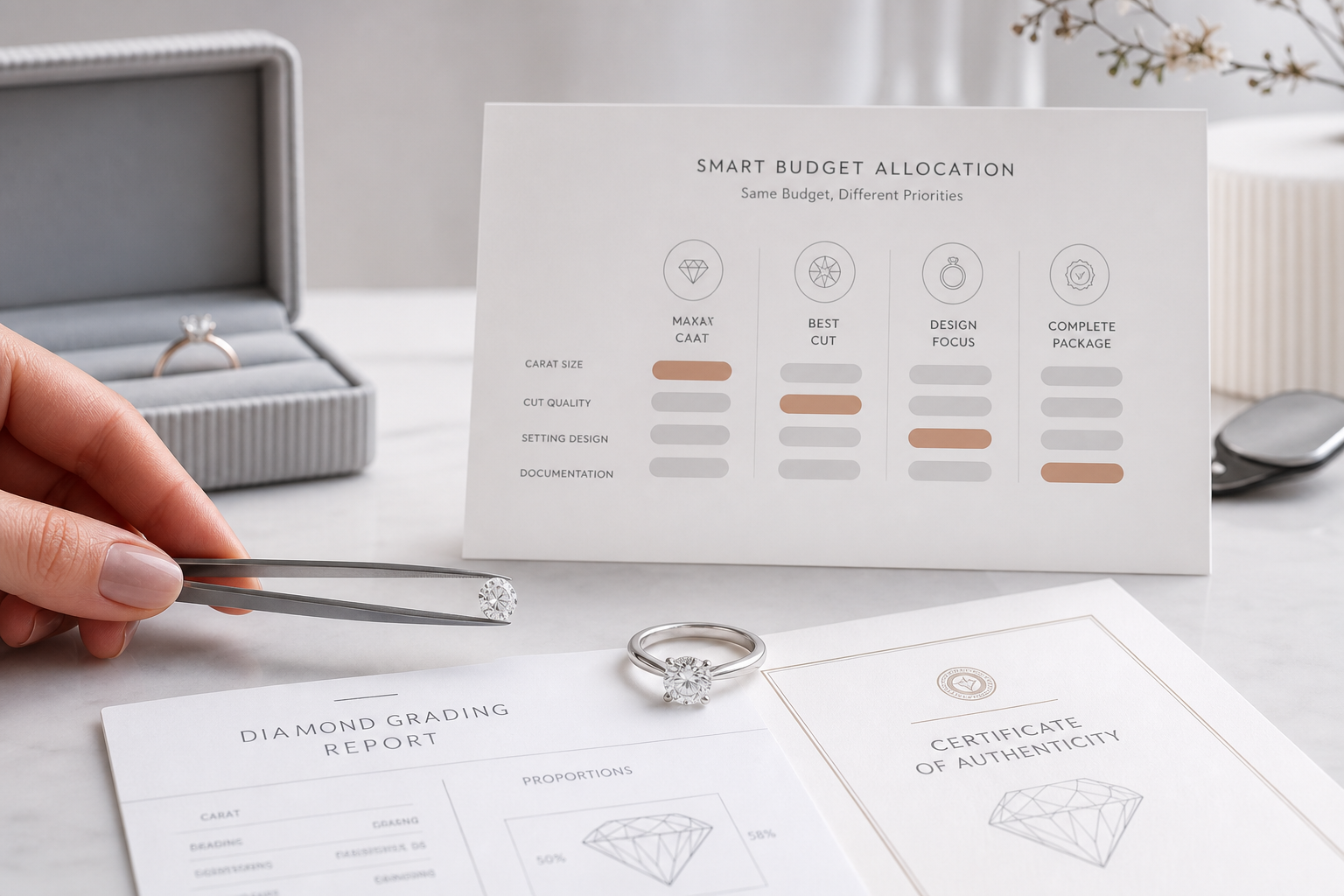
The structural price gap between lab-grown and natural diamonds changes what a fixed budget can do. For many shoppers, the same budget may allow a larger center stone, a higher color or clarity grade, a stronger cut selection, a more detailed setting, or more room for custom design. This is where lab-grown diamond value becomes practical rather than theoretical.
The key is not to assume that bigger is automatically better. A same budget bigger lab diamond can be a strong choice when the added size still comes with good cut quality, clear documentation, and a setting that supports the stone properly. If the size increase forces compromises in proportions, comfort, or everyday wearability, the better decision may be a smaller but better-balanced diamond.
Budget Scenario: Choosing Between Size and Origin
Maya and Daniel have a fixed engagement ring budget. They are comparing a near-colorless natural diamond around 1.00 ct with a lab-grown diamond that may allow them to consider a larger face-up size or a higher color and clarity grade. Both options can be beautiful, but they answer different priorities.
If natural origin and geological rarity carry emotional weight for them, the 1.00 ct natural diamond may feel more meaningful even if it is smaller. If their priority is visible size, specification flexibility, or leaving room for a more personalized setting, the lab-grown option may make the budget work harder. Their real decision is not simply natural vs lab diamond budget. It is whether origin rarity matters more than what they can see and customize in the finished ring.
Where the Extra Budget Flexibility Usually Goes
When buyers choose a lab-grown diamond, the extra budget flexibility often goes in one of several directions. Some choose more carat weight because they want a stronger visual presence. Others keep the size moderate and prioritize cut quality, since brightness and balance affect daily enjoyment more than a grading report grade alone.
Color and clarity upgrades can also be appealing, but they should be chosen carefully. Moving from H to F color or from VS2 to VVS2 clarity may feel satisfying on paper, yet it may not change the way the diamond looks in normal wear. For many buyers, the better use of the budget is improving the setting, adding side stones, choosing a more durable design, or keeping money available for wedding costs. A bigger diamond for engagement ring use should still fit the wearer’s hand, lifestyle, and design preferences.
Useful Numerical Comparison Framework
To compare fairly, hold the main variables steady before judging value. A useful framework is to compare round brilliant diamonds at 1.00 ct, 1.50 ct, and 2.00 ct while keeping color in the G-H range, clarity in the VS1-VS2 range or an eye-clean SI1 where appropriate, and cut quality at Excellent or Ideal where available. Current retail prices should be checked at the time of shopping, because market pricing changes by supplier, grading report, and seller channel.
| Comparison Point | Keep Constant | What to Evaluate |
|---|---|---|
| 1.00 ct round brilliant | G-H color, VS1-VS2 or eye-clean clarity, Excellent or Ideal cut where available | Baseline cost, face-up size, report quality, and visible brightness |
| 1.50 ct round brilliant | Same shape, similar color and clarity band, comparable cut quality | Whether the size increase still preserves strong proportions and visual performance |
| 2.00 ct round brilliant | Same grading range and documentation standard | Whether the larger stone fits the setting, hand, lifestyle, and total ring budget |
This kind of comparison prevents a misleading conclusion. If a buyer compares a well-cut 1.00 ct natural diamond with a poorly proportioned 2.00 ct lab-grown diamond, the price gap does not tell the whole story. The better test is to compare stones that are close in shape, grade range, documentation, and cut quality, then decide which tradeoff feels right.
Stone-to-Setting Fit Check
A larger lab-grown diamond may require changes to the setting. Check the millimeter measurements, prong style, ring width, setting height, and how the ring will be worn day to day. A taller setting may show off the stone, but it can also catch more easily. A very large center diamond may look impressive in photos but feel less practical for someone who uses their hands constantly.
For custom design, the stone and setting should be evaluated together. The right diamond is not only the one that fits the budget; it also needs to fit the design, the wearer, and the way the ring will be used.
For NUVU, the buyer-first approach is to make this fit question clearer before the stone is finalized: what the report shows, what the visuals reveal, how the measurements affect the setting, and whether the final design suits daily wear. That process is especially important when a lower lab-grown diamond price tempts the buyer to move up in size without checking comfort and structure.
When a Lower Lab-Grown Diamond Price Is Not Automatically Better Value
A lower price can be a real advantage, but it should not be treated as proof of value by itself. Some cheap lab-grown diamonds are simply well-priced because the seller has competitive sourcing, lower overhead, or a more efficient channel. Others are inexpensive because the stone has a weakness that will matter once it is set and worn: poor cut, a visible tint, distracting inclusions, shallow documentation, or a mismatch with the ring design.
The practical test is simple: does the lower price come with enough visual performance, documentation, and seller transparency to make the comparison meaningful? If the listing does not give you enough information to judge the stone, the discount may be hiding uncertainty rather than offering better value.
Poor Cut Can Cancel Out a Good Price
Cut is often where a low-priced diamond becomes less attractive in real life. A diamond can have a desirable carat weight and still look flat if the proportions do not return light well. Brightness, fire, contrast, and face-up size are shaped by details such as depth, table, angles, symmetry, polish, and the overall relationship between the stone’s measurements.
This matters even more when a buyer is tempted by a larger lab-grown diamond. A 2.00 ct stone that looks dark in the center, leaks light, or faces up smaller than expected may be weaker value than a slightly smaller stone with stronger performance. Size is visible, but so is dullness. In a diamond value comparison, cut quality should usually outrank a small gain in carat weight.
The mistake is assuming that “bigger for less” automatically means smarter. It only works when the larger stone still has good proportions, strong light return, and measurements that make sense for its weight.
Color, Tint, and Clarity Still Need Visual Review
Lab diamond quality still varies from stone to stone. Some lab-grown diamonds may show a color nuance, such as a warm, gray, brown, or blue-leaning tint, depending on the individual diamond and growth characteristics. A grading report can help narrow the field, but it may not fully show how the diamond appears in everyday lighting or against a particular metal color.
Clarity also needs context. An eye-clean diamond can be a better buy than a higher-clarity stone if the inclusions are not visible without magnification. But if a lower-priced diamond has a visible crystal, cloudiness, strain, or an inclusion near the center of the table, the lower price may not be worth the compromise. The grade alone does not tell you whether the inclusion is easy to see, where it sits, or whether it affects transparency.
Images and video matter because they reveal what the report cannot fully communicate. If a seller provides only a report number and no useful visual assets, the buyer is being asked to make a judgment with incomplete information.
Unclear Documentation Makes Comparison Harder
A low price is less useful when the documentation is vague, so any lab grown vs natural diamonds comparison should still require that the listing clearly state whether the diamond is laboratory-grown, show the grading report details, provide actual measurements, and identify the specific stone being sold. If the origin disclosure is buried, inconsistent, or missing, that is a warning sign.
Documentation does not guarantee that a diamond will look beautiful, but it gives you a controlled starting point. Without it, you cannot fairly compare carat weight, color, clarity, cut details, measurements, or origin. The result is not a better bargain; it is a weaker comparison.
Seller transparency matters here. A serious listing should make it easy to connect the price to the exact diamond, not just to a generic description. If two stones appear similar but one has a full report, clear video, precise measurements, and written confirmation while the other has minimal information, the better-documented stone may be the more defensible value even if it costs more.
Buyer Verification Checklist
- Check the grading report. Confirm that the report matches the diamond being sold and includes the key specifications you are comparing.
- Verify the report number when possible. Use the issuing laboratory’s website if a report lookup is available.
- Confirm origin disclosure. The product page and report should clearly state that the diamond is laboratory-grown.
- Review the 360-degree video or detailed imagery. Look for brightness, tint, visible inclusions, transparency issues, and overall face-up appearance.
- Compare actual measurements. A diamond’s millimeter dimensions can reveal whether it faces up appropriately for its carat weight.
- Read return or exchange terms if available. A low price carries more risk if you have limited ability to review the stone after purchase.
- Get written confirmation of the exact stone. The report number, measurements, and listing details should all refer to the same diamond.
Natural Diamonds Still Carry Value for Some Buyers
A fair natural vs lab-grown diamond comparison should not treat the natural diamond premium as irrational. For some buyers, natural diamond value includes more than visible appearance. Geological origin, scarcity, tradition, family expectations, and personal meaning can all be part of the purchase decision.
The key is to be honest about what the premium is buying. In many everyday viewing situations, a well-cut lab-grown diamond and a well-cut natural diamond with similar visible characteristics can look very similar. If a buyer pays more for a natural diamond, the added value is often tied to origin and rarity rather than a dramatic visual advantage.
Origin Can Be Part of the Value
Some buyers want a diamond that formed naturally over geological time. That diamond origin preference can be emotionally important, especially for engagement rings or heirloom-minded purchases. It is not a technical requirement for beauty, but it can be a meaningful part of the story attached to the jewelry.
This is where the recommendation changes from purely budget-based to preference-based. If the wearer strongly values natural formation, choosing a smaller or lower-spec natural diamond may feel more satisfying than choosing a larger lab-grown diamond. If origin does not carry emotional weight, paying a premium for it may reduce the budget available for size, cut quality, or setting design without adding much personal value.
Rarity Can Matter Even When Appearance Is Similar
Natural diamonds are priced partly around limited geological supply, especially as carat weight, color, clarity, and desirable cutting characteristics become harder to find together. That rarity can matter to buyers who care about owning something finite, even if a lab-grown diamond offers a similar look in daily wear.
This does not mean every natural diamond is rare in the same way or worth any premium asked for it. A poorly cut natural diamond with weak documentation should not receive a free pass just because it is natural. The premium is most defensible when the stone also has strong cut quality, attractive measurements, a reliable grading report, and specifications that support the price.
Resale Should Be Treated Carefully
Diamond resale value is often more complicated than shoppers expect. Outcomes can vary by diamond type, current market conditions, documentation, size, quality, brand context, seller channel, and buyer demand. Natural diamonds may have a different resale profile from lab-grown diamonds, but that does not mean every natural diamond will resell well or that resale should be the main reason for purchase.
If resale is a major concern, the buyer should research the current secondary market before buying rather than relying on broad assumptions. For most engagement ring shoppers, the more practical question is whether the diamond fits the wearer’s priorities now: origin, appearance, size, budget, and long-term satisfaction.
What to Check Before Paying a Natural Diamond Premium
- Confirm the grading report. Make sure the report clearly identifies the diamond as natural and lists the specifications you are using for comparison.
- Prioritize cut quality. Natural origin does not compensate for poor light performance or unattractive proportions.
- Review the measurements. Compare millimeter size against carat weight to avoid paying for weight that does not translate into face-up presence.
- Assess seller documentation. The listing should provide enough detail to justify the price, not rely only on broad origin claims.
- Clarify your own priority. If natural origin matters more than size or higher specs, the premium may make sense. If not, a lab-grown option may use the same budget more visibly.
How to Compare Lab-Grown and Natural Diamond Prices Fairly
The only useful way to compare lab-grown vs natural diamond cost is to control the variables. If one diamond is a round 1.50 ct G VS2 with strong cut details and the other is an oval 2.00 ct with different color, different clarity, and limited imagery, the price gap does not tell you much. You are not comparing two versions of the same choice; you are comparing different products.
A fair diamond price comparison checklist should keep the major factors aligned first, then evaluate where the price difference actually comes from. This prevents two common mistakes: overpaying for a natural diamond based only on origin, or choosing a lab-grown diamond based only on size.
Step 1: Match Shape and Carat Before Comparing Price
Start with the same shape and a narrow carat range. Round, oval, emerald, cushion, pear, radiant, and princess cuts do not price the same way, and they do not face up the same way on the hand. A 1.50 ct oval can look physically larger than a 1.50 ct round because of its outline, while an emerald cut may show color and clarity more clearly because of its step-cut structure.
For a clean loose diamond comparison, compare round to round, oval to oval, emerald to emerald, and so on. Then keep carat weight close enough to be meaningful. Comparing a 1.00 ct natural diamond with a 2.00 ct lab-grown diamond may be useful for a same-budget decision, but it is not a controlled price comparison. First learn the like-for-like gap, then decide whether you want to trade origin for size.
Step 2: Keep Color and Clarity in a Practical Range
Do not compare one diamond in a practical grade range with another at the top of the grading scale and assume the price difference is only about origin. For many shoppers, near-colorless grades such as G-H are a useful starting point, especially in white gold or platinum settings. Some buyers may prefer higher color grades for certain shapes or personal sensitivity, but the jump from near-colorless to colorless is not always visible enough to justify the added cost.
Clarity works the same way. An eye-clean diamond can offer better practical value than a higher-clarity grade that looks the same without magnification. This is especially important when comparing same-budget options, because money spent chasing invisible clarity may be better used on cut quality, setting design, or a more balanced center stone.
Step 3: Compare Cut, Measurements, and Visual Assets
Two diamonds with the same carat weight can look noticeably different. One may face up larger because its millimeter dimensions are spread well; another may carry extra depth that adds weight without adding visible size. Table, depth, symmetry, polish, and overall proportions all affect how the diamond looks, and the importance of each detail depends on shape.
Visual assets are not optional if you are trying to compare diamond prices fairly. A report gives the grade; video shows how the stone behaves. Look for brightness, contrast, windowing, bow-tie effect in elongated shapes, visible inclusions, and any tint that becomes obvious as the diamond moves. If one diamond has strong documentation and clear video while another has only a basic listing, the better-supported option deserves more weight in the decision.
Step 4: Compare Total Ring Cost, Not Only Stone Cost
The center stone is only part of the final purchase. Setting style, metal choice, side stones, customization, taxes, shipping, resizing, and service terms can all change the total cost. A diamond that looks cheaper on its own may not produce the lower final project cost if the setting requires changes, the stone dimensions are unusual, or the seller’s service model is limited.
This matters most for engagement rings and custom designs. A larger lab-grown diamond may require a different head, stronger prongs, a wider band, or a lower-profile design for daily wear. A natural diamond may leave less room in the budget for the setting details the wearer actually wants. Compare the complete ring, not just the loose stone price.
Custom design boundary check: For custom jewelry, stone measurements and setting compatibility should be confirmed before finalizing a purchase. A diamond that appears attractive in a price comparison can still require design changes if its depth, length-to-width ratio, girdle, or face-up spread does not suit the intended setting.
Buyers should also confirm metal choice, prong style, side-stone matching, ring height, and written design details before treating a loose diamond price as the total project cost. The lower-priced center stone may still be a good choice, but the final value depends on how well the entire piece comes together.
Evidence Checklist for a Defensible Price Decision
Before calling one diamond the better value, make sure the comparison is supported by enough information. The evidence should include the grading report or report details, actual millimeter measurements, clear origin disclosure, still images or video, and seller terms that identify the exact stone being purchased. If one option has strong documentation and another has only a headline grade, the lower price may not be a fair comparison.
| Evidence Item | What It Helps Confirm | Why It Affects Price Judgment |
|---|---|---|
| Origin disclosure | Whether the diamond is natural or laboratory-grown | Prevents comparing two different value categories as if they are the same |
| Grading report details | Carat weight, color, clarity, measurements, and other listed characteristics | Creates a shared baseline for comparison |
| Images or video | Brightness, tint, inclusion visibility, and face-up appearance | Shows what the report cannot fully communicate |
| Seller terms | Return, exchange, service, and confirmation of the exact stone | Changes the risk attached to a low-price listing |
| Setting compatibility | Whether the stone fits the intended ring design | Prevents a cheap center stone from increasing the final project cost |
This checklist is especially useful when two listings appear close on paper. A small price difference may be justified if one diamond has better visual evidence, clearer reporting, easier verification, or stronger support. A large price difference deserves more scrutiny: identify what the higher price is actually buying before assuming it reflects better beauty or better value.
For wholesale, private-label, or multi-stone sourcing conversations, the same logic applies at a larger scale. Buyers should ask how stones are matched, what documentation will accompany each stone or parcel, how substitutions are communicated, and what level of consistency is expected across shape, size, color, clarity, and measurements. In sourcing discussions, traceability is less about a slogan and more about whether the paperwork and communication make the order easy to audit.
Decision Framework for Same-Budget Shopping
Use the budget question to clarify priorities, not just to find the biggest discount. Ask whether natural origin matters more than visible size and specification flexibility. If it does, a well-chosen natural diamond may be the more satisfying purchase even at a smaller carat weight. If it does not, a lab-grown diamond may allow more room for size, cut quality, or a more considered setting.
Then ask where the budget creates the most visible benefit. Some buyers should put more into the center stone. Others will get a better overall result by choosing a balanced diamond and investing in a setting that fits their style and daily use. The better choice is the one that still looks strong under real viewing conditions, has clear documentation, fits the design properly, and reflects what the wearer actually values.
Frequently Asked Price Questions
Are Lab-Grown Diamonds Cheaper Because They Are Lower Quality?
Not necessarily. Lab-grown diamonds usually cost less because their supply and production economics are different from mined diamonds, not because they are automatically poor quality or visually fake.
The real risk is assuming every lower-priced lab-grown diamond is a good buy. Cut quality, color, clarity, measurements, grading report details, and seller transparency still separate a strong value from a weak listing. A lower price is useful only when the diamond still performs well visually and can be compared clearly against similar stones.
Do Natural Diamonds Always Cost More Than Lab-Grown Diamonds?
Usually, natural diamonds cost more than lab-grown diamonds when comparing similar shape, carat weight, color, clarity, and cut quality. The difference is often most noticeable at larger carat weights or higher color and clarity grades.
There are exceptions. A poorly cut natural diamond, an older listing, a promotional price, or a lab-grown diamond with unusually strong specifications can narrow the gap. The only fair comparison is stone by stone, with the same basic variables controlled.
Will Lab-Grown Diamond Prices Keep Going Down?
Lab-grown diamond prices can change as production capacity, technology, competition, consumer demand, and retail strategy change. It is reasonable to expect market movement, but no buyer should treat future price drops as guaranteed.
If you are buying for an engagement ring or a piece of jewelry you plan to wear, the better question is whether the diamond fits your budget, design, and quality standards now. Waiting only makes sense if timing is flexible and the purchase is driven mainly by price rather than a specific occasion or design goal.
Are Lab-Grown Diamonds Worth It?
Lab-grown diamonds are worth it for buyers who want more visible size, stronger specifications, or more room in the budget for the setting without paying a premium for natural origin. They can be especially practical when the priority is how the diamond looks in daily wear.
They may be less satisfying for buyers who place high personal value on geological formation, natural scarcity, or tradition. The wrong move is choosing lab-grown only because it is cheaper, or choosing natural only because it is more expensive. Value depends on what the buyer actually cares about after the price difference is understood.
Do Lab Diamonds Look the Same as Natural Diamonds?
In normal jewelry viewing, a well-cut lab-grown diamond and a well-cut natural diamond with similar grades can look very similar. The visible difference is usually driven more by cut, proportions, shape, color, and clarity than by origin alone.
That does not mean every diamond will look equally good. A larger lab-grown diamond with weak proportions can look less lively than a smaller natural diamond with better cut quality. Visual comparison still matters, especially through video, measurements, and real setting context.
Which Is Better Value for an Engagement Ring?
Lab-grown is often the better value if the goal is a larger center stone, higher visible specifications, or more flexibility for the ring design within a fixed budget. This is why many same-budget comparisons favor lab-grown diamonds on size and grade.
Natural may be the better value for a buyer who genuinely wants natural origin and is comfortable allocating more of the budget to rarity rather than visible size. The decision should come down to priority: origin significance, face-up appearance, setting design, documentation, and total ring cost.
Where to Go Deeper
Price questions often lead into more specific buying questions. If the uncertainty is about documentation, a diamond grading report guide is the better next step. If the concern is beauty, cut quality deserves closer attention. If the question is broader than price, a full lab-grown vs natural diamond comparison can cover origin, symbolism, sustainability claims, resale considerations, and long-term ownership in more detail.
From Price Research to Diamond Comparison
Price is a useful starting point, but it should not be the final decision-maker. A diamond that looks inexpensive on a listing can become less attractive if the cut is weak, the measurements are poor, the report is unclear, or the setting cost changes the total budget. A more expensive option can also be reasonable if it brings stronger documentation, better visual assets, thoughtful design support, or a stone that fits the ring more cleanly.
The practical next step is to compare lab-grown diamonds and natural diamonds under the same conditions: same shape, similar carat weight, similar color and clarity range, comparable cut information, clear grading documentation, and actual measurements. Once those variables are controlled, the price difference becomes more meaningful.
Further Reading for a Fair Comparison
Readers who are still comparing options should continue with a lab-grown diamond buying guide for broader selection advice, a diamond grading report guide for report details, and a loose diamond selection guide for stone-level comparison. A diamond cut quality guide can help explain why two diamonds with similar grades may not look equally bright.
For ring shoppers, a custom engagement ring guide is useful once the center stone budget starts affecting setting choices. A broader lab-grown vs natural diamond comparison can also help if the decision is no longer only about price and has shifted toward origin, symbolism, sustainability claims, or long-term ownership preferences.
Compare the Stone and the Total Ring Budget
NUVU’s buyer-first approach is to make lab-grown diamond comparison clearer: specifications, visual performance, documentation, and design fit should be evaluated together. If you are shopping for loose lab-grown diamonds, start by narrowing the comparison to stones with similar shape, size, color, clarity, cut information, and grading reports.
If the diamond is part of a ring project, the better question is not simply “How large can I go?” but “Which stone fits the design, the wearer, and the total budget?” For a custom lab diamond ring, that means checking the center stone’s millimeter measurements, setting style, ring proportions, and daily wear needs before committing to size alone.
NUVU’s role in buyer education is to make comparison clearer, especially around grading reports, visual evidence, design fit, and documentation. Buyers should still verify available report details through the issuing laboratory’s official tools where possible and confirm seller policies in writing before purchase.
Pre-Checkout Trust Checklist
Before finalizing a diamond purchase, it helps to confirm a few practical details one more time. Make sure the stone type is clearly stated, the report number matches the listing, the measurements support the face-up size you expect, and any seller return or exchange terms are easy to understand before purchase. These simple checks often matter more than a small price difference because they reduce the chance of buying a diamond that looks good on paper but does not fit the real project.
For buyers comparing lab-grown and natural diamonds side by side, a calm, document-based review is usually the most reliable path. A more defensible purchase is not the one with the loudest claim; it is the one with clear origin disclosure, consistent report information, understandable seller terms, and enough visual evidence to support the price.
Before purchase, buyers should confirm the seller’s documentation, return policy, resizing terms, and after-sales support in writing. These details should be reviewed as part of the total buying decision, not assumed from a price, a report label, or a general product description.
Keep the Price Decision Focused
Compare stones on similar specifications, visual evidence, and seller terms before comparing the total ring cost. Use your budget to weigh the features you will notice and the origin you prefer.
If the remaining question concerns a grading report, sourcing claim, resale expectation, or setting design, review that evidence separately. A lower price alone does not answer those questions.
Reader Value Check
By this point, the useful takeaway is simple: lab-grown diamonds usually cost less because their market is shaped by scalable production and stronger price competition, while natural diamond pricing is tied more closely to geological origin, mining supply, rarity, and market perception. That lower price can create real budget advantages, but it is only better value when the diamond still has strong cut quality, clear documentation, suitable measurements, and a setting plan that fits the wearer’s needs.
Disclosure: This article is for general educational purposes only. Diamond grading, pricing, availability, specifications, and seller policies can change, and readers should verify important details through grading reports, official laboratory tools, seller documentation, or qualified professionals before making a purchase decision. Laboratory-grown diamonds should be clearly distinguished from natural diamonds, and environmental or sourcing claims should be supported by specific documentation.