
Choosing between a lab-grown and a natural diamond for an engagement ring is rarely just a question of which stone is “better.” The real decision is about what should carry the most weight: visible size, cut quality, design freedom, origin, tradition, daily wear, or long-term emotional meaning. A lab-grown diamond can often help a fixed budget go further, especially when diamond sustainability verification is considered alongside the goal of a larger-looking ring or stronger visible specifications. A natural diamond may feel more appropriate when earth-formed origin, rarity, or heirloom symbolism matters deeply.
For the full framework, read Lab-Grown Diamond Engagement Rings Guide.
This article helps you judge the complete ring rather than the category label alone. It looks at how carat weight, measurements, shape, cut, reports, setting style, comfort, durability, and resale expectations affect the final choice, so you can compare options in a way that fits the wearer’s values and lifestyle.
Laboratory-grown diamonds should be clearly identified as laboratory-grown, and they should not be presented as mined diamonds. Both laboratory-grown diamonds and natural diamonds are diamonds, but they have different origins, and that origin should be clear in the grading report, product description, and buying conversation.
| Buying Priority | Lab-Grown May Fit Better When | Natural May Fit Better When |
|---|---|---|
| Visible size | You want more spread or carat weight within budget | You accept a smaller stone for earth-formed origin |
| Emotional meaning | The proposal focuses on design, value, or modern preference | Tradition, rarity, or heirloom symbolism is central |
| Ring design | Larger solitaires, elongated shapes, halos, or three-stone styles appeal | Classic, restrained settings feel more aligned with the stone choice |
| Quality check | Compare reports, photos, measurements, and cut performance | Do the same; origin does not replace visual evaluation |
| Daily wear | A bigger stone still needs a secure, comfortable setting | A smaller stone can still fail if the setting is impractical |
| Budget tradeoff | Spend more on cut, setting quality, or design details | Reserve more budget for origin and rarity |
Quick Questions Before You Read
Q: Is a lab-grown diamond automatically the smarter engagement ring choice?
No. It often offers more size or stronger specs for the money, but the right choice depends on the wearer’s values and the full ring design.
Q: Should carat weight be the main comparison point?
No. Measurements, cut quality, shape, and how the stone sits in the setting can matter more than the number on the report.
Q: Does a natural diamond make sense if it means choosing a smaller stone?
Yes, if earth-formed origin, tradition, or rarity is genuinely important to the couple.
Q: What is the biggest mistake buyers make in this decision?
Comparing categories instead of comparing finished rings, including comfort, durability, setting quality, and total cost.
The Fast Answer: Which Diamond Type Makes More Sense for an Engagement Ring?
For many engagement ring buyers, lab-grown makes more sense if the goal is a larger-looking diamond, stronger visual specs, or more flexibility within a fixed budget. Natural makes more sense if the diamond’s earth-formed origin, traditional symbolism, or heirloom feeling is central to the proposal. Neither choice is automatically better; the better choice is the one that fits the ring, the budget, and the meaning you want the ring to carry.
The wrong way to compare lab-grown vs natural diamonds for engagement rings is to treat origin as the only factor. A proposal ring is not just a loose stone purchase. It has to look right on the hand, work with the setting, suit everyday wear, and feel emotionally right years later. A larger lab-grown diamond that feels wrong symbolically is not a win. A smaller natural diamond that strains the budget or limits the ring design may not be the wiser choice either.
For buyers, the practical point is not just what the report or category name says, but how the stone performs visually and fits the intended design. Two diamonds with similar grades can look different once set, and two rings with the same center-stone weight can feel very different on the hand. Treat the origin decision as one part of the evaluation, not as a shortcut that replaces checking cut, measurements, setting compatibility, and the wearer’s expectations.
Evidence boundaries for this comparison
A useful comparison should separate documented facts from preference-based judgments. A grading report can document measurable characteristics and identify whether a diamond is laboratory-grown or natural, but it does not prove that one ring will feel more romantic, more beautiful, easier to wear, or more emotionally satisfying. Those judgments depend on the wearer, the setting, the proposal context, and the buyer’s priorities.
When a seller makes a specific claim, match the claim to the right kind of evidence. Diamond type, carat weight, measurements, color, clarity, and some treatment disclosures should be checked against the grading report. Setting details should be checked against the ring specification, CAD, invoice, or written order summary. Broad claims about responsibility, sustainability, rarity, or long-term value should be treated carefully unless the seller provides documentation that supports that exact statement.
A grading report helps document key characteristics, but it should not be treated as a guarantee of beauty, value, or sourcing ethics. It is one part of a buying file, alongside visual evidence, seller documentation, setting specifications, and the buyer’s intended use for the ring.
How to read origin language without confusion
Origin language should be direct. “Lab-grown,” “laboratory-grown,” and “laboratory-created” describe diamonds grown in a controlled production environment. “Natural” or “mined” describes diamonds formed in the earth. Diamond simulants, such as non-diamond lookalikes, are a separate category and should not be confused with either laboratory-grown or natural diamonds.
If a product listing, invoice, or sales conversation uses unclear language, ask for clarification before comparing price or design options. The buyer should be able to tell whether the center stone is laboratory-grown or natural, which laboratory issued any report, what measurements are documented, and whether any growth method or post-growth treatment information is disclosed when relevant.
The real decision behind the question
Most buyers are not really asking whether lab-grown or natural diamonds are better in a scientific or abstract sense. They are asking a more personal question: Which diamond will feel right in this actual engagement ring, for this actual person, with this actual budget?
That distinction matters because the engagement ring decision blends practical and emotional priorities. One buyer may care most about a visible center stone that feels impressive without overspending. Another may want the proposal to follow a traditional path where natural origin is part of the ring’s meaning. A third may care less about origin and more about choosing a setting that fits the wearer’s style and daily routine.
The strongest decision usually comes from ranking priorities before comparing stones. If size and design flexibility are first, lab-grown often has the advantage. If origin and tradition are first, natural may justify the higher cost or smaller carat size. If both matter equally, the decision becomes less about the category and more about finding the specific stone and setting combination that feels balanced.
When lab-grown is the smarter fit
Lab-grown is often the smarter fit when the buyer wants more visible impact for the engagement ring budget. Because lab-grown diamonds are often listed at lower prices than similar natural diamonds, the same budget can often move into a larger carat size, a higher color grade, a cleaner clarity grade, or a more refined setting. For buyers who care about how the ring looks on the hand, that difference can be meaningful.
This matters most when the desired ring style depends on proportion. A solitaire with a very small center stone can feel minimal, while the same design with a larger center stone can feel intentional and balanced. A three-stone ring may need enough center-stone presence to avoid looking crowded. A custom design may require a specific measurement range, not just a carat number. In these cases, lab-grown can give the buyer more room to build the ring around the look they actually want.
Lab-grown is not the smarter choice simply because it costs less. It becomes the smarter choice when the savings improve the finished ring in a way the wearer will notice every day. If the lower price only leads to overbuying size, choosing an impractical setting, or ignoring cut and proportions, the advantage can disappear quickly.
When natural is the smarter fit
Natural is often the smarter fit when the origin of the diamond is part of the emotional value. For some couples, a natural diamond carries a sense of tradition, rarity, or continuity that matters more than size. That does not make it objectively more romantic, but it can make it more emotionally appropriate for that proposal.
This choice can be especially important when family expectations, heirloom thinking, or personal symbolism are part of the purchase. A buyer may prefer a smaller natural diamond because the story behind the stone feels more aligned with the relationship. In that case, choosing lab-grown only to increase carat size may solve the wrong problem.
The practical tradeoff is clear: with natural, the same budget usually buys less size or more modest specs than lab-grown. That tradeoff is acceptable when origin matters enough to outweigh visible size. It becomes a poor tradeoff when the buyer is choosing natural mainly out of pressure, habit, or fear that lab-grown will not be “real enough” to feel meaningful.
What to Check Before You Decide
Before choosing between a lab-grown and natural diamond for an engagement ring, check four things in order: the total budget, the preferred visual size, the emotional meaning of origin, and the ring style the wearer will actually enjoy every day.
- Budget: Decide what the full ring should cost, not just the center stone.
- Size: Know whether the wearer wants a subtle ring, a balanced everyday ring, or a noticeably larger center stone.
- Meaning: Be honest about whether natural origin matters emotionally or whether the look and intention matter more.
- Wearability: Consider the setting height, lifestyle, hand shape, and whether the ring needs to be practical for daily use.
If the main question is “should I buy a lab-grown or natural diamond for an engagement ring,” start by removing the idea that one answer has to be universally correct. Lab-grown makes more sense when it helps you build the ring you want without stretching the budget. Natural makes more sense when the origin itself is part of the commitment you want the ring to represent.
Budget and Stone Size: How the Two Options Change What You Can Afford
Budget is where the lab-grown vs natural comparison becomes most visible. A lab-grown diamond usually lets the buyer choose a larger center stone or stronger visible specs for the same engagement ring budget, while a natural diamond usually asks the buyer to accept a smaller stone, lower specs, or a simpler setting to stay within the same price range.
The key is not just which diamond costs less. The better question is what the price difference allows you to improve. If choosing lab-grown lets you move from a center stone that feels undersized to one that looks balanced in the setting, that is a meaningful upgrade. If choosing natural gives the proposal the symbolic weight the wearer genuinely wants, then a smaller stone may still feel like the better purchase.
When comparing prices, make sure the comparison is like-for-like enough to be useful. A low listing price may reflect more than origin: grading report type, cut quality, measurements, fluorescence, growth method, post-growth treatment disclosure, seller margin, availability, or setting package can all affect the final number. In practical buying, this is where many comparisons become misleading because one stone is judged by headline carat weight while another is judged by full visual and report details.
Prices can change with market conditions, report type, seller channel, and stone-specific details, so exact comparisons should be verified at the time of purchase. Buyers should compare like-for-like specifications before treating one stone as a better value.
Why lab-grown often stretches the visual size of the ring
Lab-grown often stretches the visual size of the ring because more of the budget can go toward carat size, face-up spread, and a cleaner overall appearance. This is especially noticeable in common engagement ring searches where buyers compare similar shapes and grades across both categories.
For a representative buying mindset, compare diamonds with grading reports in the same shape, similar measurements, similar color and clarity ranges, and comparable visual documentation from the same shopping session. In many retail searches, a natural diamond in one size range may sit near lab-grown options with noticeably larger face-up measurements, though the exact difference changes by grade, report, seller, inventory, and timing. These are not fixed prices, and current market numbers change, but the practical pattern many buyers encounter is that lab-grown usually gives more size for the same budget.
The warning is that carat weight alone can mislead. A poorly cut larger stone may look dull or heavy compared with a well-cut smaller stone. Measurements matter too. Two diamonds with the same carat weight can face up differently depending on depth and proportions, so a buyer should compare millimeter dimensions, not just the number on the listing.
Where a smaller natural diamond can still feel like the better choice
A smaller natural diamond can still feel like the better choice when the wearer values origin more than maximum visual size. If the engagement ring is meant to feel traditional, rare, or connected to a long-standing idea of diamond symbolism, a natural stone may deliver something that a larger lab-grown diamond does not replace for that buyer.
This is where budget logic and emotional logic can point in different directions. On paper, lab-grown may look like the more efficient purchase. In the actual proposal, however, a natural diamond may feel more aligned with what the couple wants the ring to say. That preference is valid as long as the buyer is not compromising so far that the finished ring feels underwhelming, poorly made, or financially uncomfortable.
A natural diamond becomes a weaker choice when the buyer stretches too hard for the origin label and sacrifices the parts of the ring the wearer will notice every day: cut quality, secure setting construction, comfortable proportions, and a design that fits their style. A smaller natural stone can be beautiful and intentional. A poorly balanced ring chosen only to preserve the “natural” label is harder to justify.
Why the setting budget should be counted with the center stone
The center stone is usually the most expensive part of an engagement ring, but it is not the whole ring. The setting affects comfort, durability, visual balance, and the way the diamond is presented. Treating the setting as an afterthought is one of the easiest ways to weaken an otherwise smart diamond choice.
Metal choice, prong style, band width, side stones, pavé work, finishing quality, and setting height all affect the final cost. A simple solitaire may leave more room for the center diamond, while a detailed halo or three-stone design may shift more of the budget into craftsmanship and smaller accent stones. If the buyer spends too much on the center stone and leaves too little for the setting, the ring can feel unfinished or less secure than it should.
This is especially important with larger lab-grown stones. A bigger center diamond may need a stronger setting, better proportioned prongs, or a band width that visually supports the stone. If the setting is too delicate for the diamond’s size, the ring may look top-heavy or feel less practical for daily wear. A better budget plan is not the one that buys the largest stone; it is the one that produces the most balanced finished ring.
What This Means in a Real Purchase
Imagine a couple with a fixed engagement ring budget choosing between two options. The first is a smaller natural center stone in a clean, simple setting. The second is a larger lab-grown center stone with stronger visual presence and enough budget left for a more refined setting. If the wearer wants a ring that looks substantial on the hand, the lab-grown option may deliver more of what they will enjoy every day.
Now change the priority. If the wearer has always imagined a natural diamond because the origin feels tied to tradition or family meaning, the smaller natural ring may be the better emotional fit. The point is not that one option is more responsible or more romantic. The point is that the buyer should know exactly what they are trading: visible size and design flexibility on one side, origin symbolism on the other.
For most buyers, the clearest budget decision comes from pricing the complete ring before falling in love with a stone. Compare the center diamond, setting, metal, side stones, sizing needs, and any custom details together. A diamond that looks like the strongest loose-stone deal may not be the best choice once the full ring is built around it.
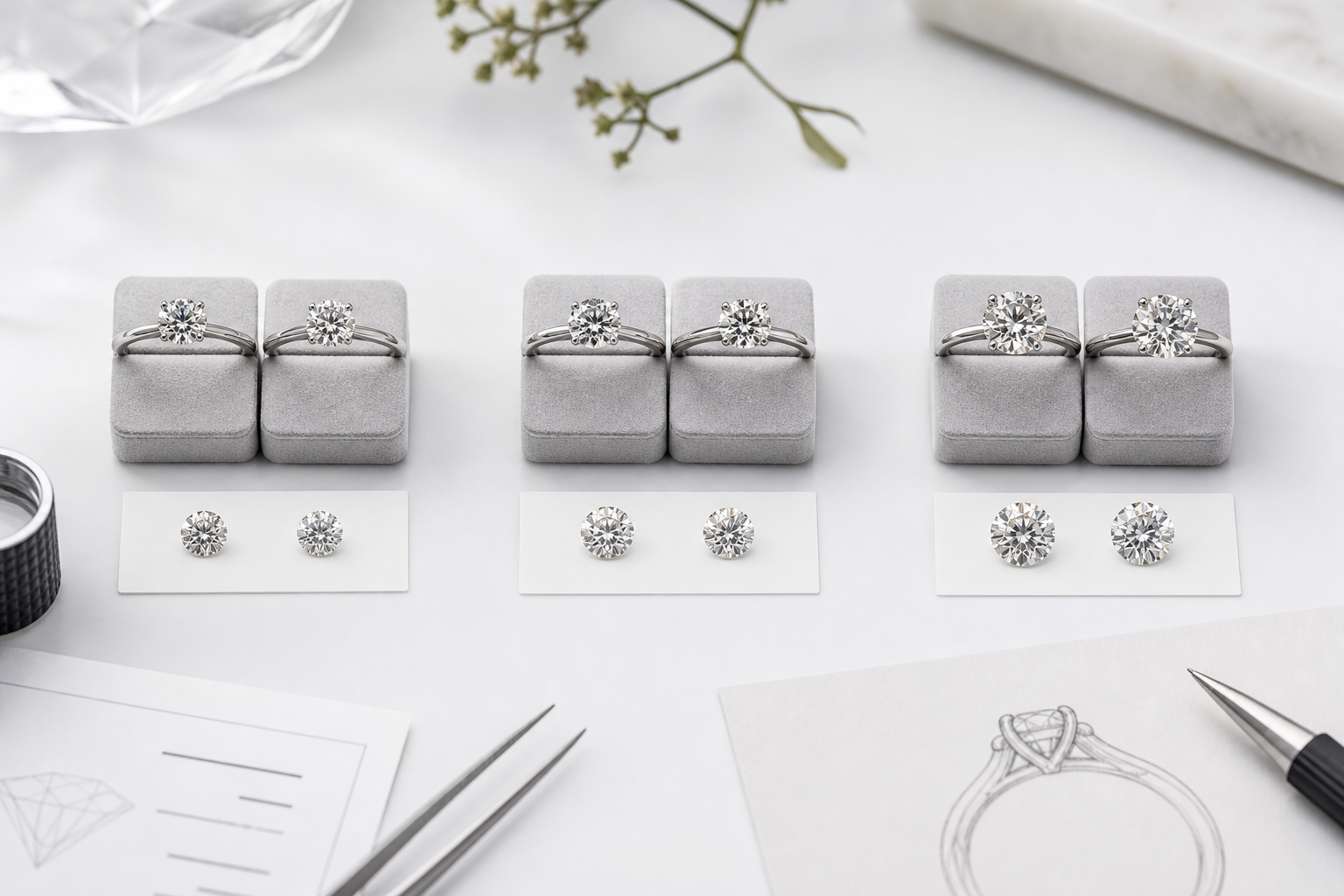
Symbolism and Emotional Expectations: What Buyers Are Really Choosing
Diamond symbolism is personal, not universal. A natural diamond is not automatically more meaningful, and a lab-grown diamond is not automatically less romantic. The meaning comes from what the couple believes the ring represents, how the choice was made, and whether the final ring feels aligned with the relationship.
This is where some buyers make the comparison too narrow. They focus on whether other people will approve of lab-grown or whether natural diamonds are still the “proper” engagement ring choice. Those outside opinions may matter in certain families or social circles, but they should not outweigh the expectations of the person who will wear the ring every day.
It is also worth separating private meaning from marketing language. “Rare,” “modern,” “responsible,” and “traditional” can all be meaningful ideas, but they do not mean the same thing to every couple. If environmental or sourcing concerns are part of the decision, ask what documentation or supply-chain explanation is actually available rather than relying on broad category claims. Lab-grown diamonds can offer a different sourcing path, but that does not automatically prove every stone or seller meets the same sustainability expectations.
Documentation matters when ethics or sustainability enters the conversation
If a buyer is choosing lab-grown partly because of environmental or sourcing concerns, the safest approach is to ask for specific, written support rather than relying on broad phrases. A seller may be able to explain production partners, energy-related claims, origin disclosure, or supply-chain practices, but those claims should be specific enough to evaluate. “Lab-grown” describes how the diamond was created; it does not, by itself, prove a complete environmental profile or a seller’s operating practices.
The same caution applies to natural diamonds. A natural diamond’s origin story may feel important emotionally, but buyers should still review the available report, seller documentation, and written descriptions. If responsible sourcing is a priority, ask what the seller can actually document and what is simply general industry language. A careful buyer does not need to reject symbolism; they just should not confuse symbolism with verification.
Environmental and sustainability claims should be specific, documented, and limited to what can be substantiated. Broad green language is less useful than clear information about production, energy context, sourcing disclosures, and diamond certification reports that help clarify what a seller can verify through grading details, origin-related information, and quality control records. This is especially important when a buyer is comparing lab-grown and natural diamonds for sourcing reasons rather than only for appearance or price.
What “natural” tends to mean in a proposal context
In a proposal context, natural diamonds often carry associations with tradition, rarity, and continuity. For some buyers, the idea that the diamond formed naturally over a long period of time adds emotional weight. It can make the ring feel connected to older engagement customs or to a family’s expectations of what a proposal ring should be.
This symbolism can matter most when the ring is expected to become an heirloom or when the recipient has clearly expressed a preference for natural origin. In that situation, choosing natural is not just about the stone’s physical appearance. It is about preserving a story the wearer already values.
The mistake is assuming every recipient feels this way. Some people care deeply about natural origin; others do not. If the buyer chooses a smaller or less visually appealing natural diamond only because they assume it is the “real” romantic choice, they may be prioritizing a tradition the wearer does not actually share.
What “lab-grown” tends to mean to modern couples
For many modern couples, a lab-grown diamond can represent practicality, transparency, and intentional use of budget. The emotional value is not reduced because the diamond was grown in a laboratory. For these buyers, the meaning may come from choosing a ring that looks beautiful, fits the budget, and reflects how they make decisions together.
Lab-grown can also feel more aligned with couples who would rather put more money toward the setting, wedding plans, a home, travel, or long-term savings. That does not make the ring less serious. In many cases, it makes the decision feel more personal because the couple is choosing based on their own priorities rather than inherited expectations.
The risk with lab-grown is not lack of meaning; it is lack of conversation. If the recipient expects a natural diamond and the buyer chooses lab-grown without understanding that expectation, the issue may not be the diamond itself. The issue is a mismatch between the proposal story and the wearer’s emotional assumptions.
How to align the story with the relationship, not with outside opinions
The strongest engagement ring choice usually reflects the couple more than the market. Family opinions, social media comparisons, and luxury traditions can all influence the decision, but they should not define it. A ring chosen to impress outsiders can become less satisfying than a ring chosen around the wearer’s real taste and values.
If the couple values visible beauty and smart budgeting, lab-grown may tell the right story. If they value natural origin and traditional symbolism, natural may feel more appropriate. If they value design most, the stronger choice may be whichever diamond allows the setting, proportions, and daily wear experience to come together cleanly.
This is also where the proposal context matters. A surprise proposal requires more careful reading of the recipient’s preferences. A shared purchase allows the couple to discuss the tradeoff openly. Neither approach is better, but a surprise carries more risk if the buyer is guessing about symbolism.
What to Ask Before You Decide
Before deciding based on symbolism, ask what the ring needs to mean to the person wearing it. The answer may be practical, traditional, visual, sentimental, or some combination of all four.
- Does natural origin matter to us, or does the finished look matter more?
- Would a larger lab-grown diamond feel exciting, or would it feel like a compromise?
- Would a smaller natural diamond feel meaningful, or would it feel limiting?
- Are we choosing for ourselves, or trying to satisfy outside expectations?
- Does the budget feel comfortable after accounting for the complete ring?
If the ring’s story matches the couple’s values, either diamond type can be meaningful. The better choice is the one the wearer can look at years from now and feel that the decision was made for the right reasons.
Setting Style and Design Flexibility: Which Choice Gives You More Ring Options?
The diamond you choose affects more than the center stone. It changes the proportions of the engagement ring setting, the amount of finger coverage, the profile height, and the way the design feels in daily life. This is where the lab-grown versus natural decision becomes practical rather than philosophical.
Lab-grown diamonds usually give buyers more flexibility if the design depends on a larger center stone, a more dramatic outline, or a custom engagement ring built around specific proportions. Natural diamonds can still be the better fit when the buyer wants a restrained, traditional ring where origin carries more weight than size. The mistake is choosing the diamond first and treating the setting as a container. A strong ring design works the other way around: the stone and setting need to make sense together.
How center-stone size changes the look of solitaire, halo, and three-stone settings
In a solitaire, the center stone does most of the visual work. A larger lab-grown diamond can make a simple solitaire feel more finished without adding extra diamonds, a halo, or a complicated band. This is useful for buyers who want a clean ring with obvious presence. The risk is going too large for the wearer’s hand or lifestyle. A high-set larger stone can look impressive in photos and still feel awkward if it catches on sleeves, gloves, or gym equipment.
A smaller natural diamond can work beautifully in a solitaire when the design is intentional. A modest natural stone in a well-proportioned setting may feel more refined than a larger stone in a setting that looks top-heavy. If the buyer values natural origin and a classic proposal story, a modest solitaire can be the better design choice, not a compromise.
Halo settings change the calculation. A halo can make a smaller center stone appear larger, so it often helps natural diamond buyers stretch visual coverage without moving into a much larger center stone. With lab-grown diamonds, the same halo can sometimes become too much if the center stone is already large. A large elongated center stone with a halo may deliver strong finger coverage, but it can also lose the clean, balanced look some buyers expected. For many modern rings, a larger lab-grown center stone works better in a solitaire, hidden halo, or slim pavé setting than in a full halo.
Three-stone rings require even more proportion control. The side stones should support the center stone, not compete with it. A larger lab-grown center diamond can make a three-stone design feel substantial, but the side stones need to be scaled carefully or the ring can become wide and bulky. A smaller natural center stone may pair well with tapered side stones or slimmer accents, especially if the goal is a timeless ring rather than maximum spread.
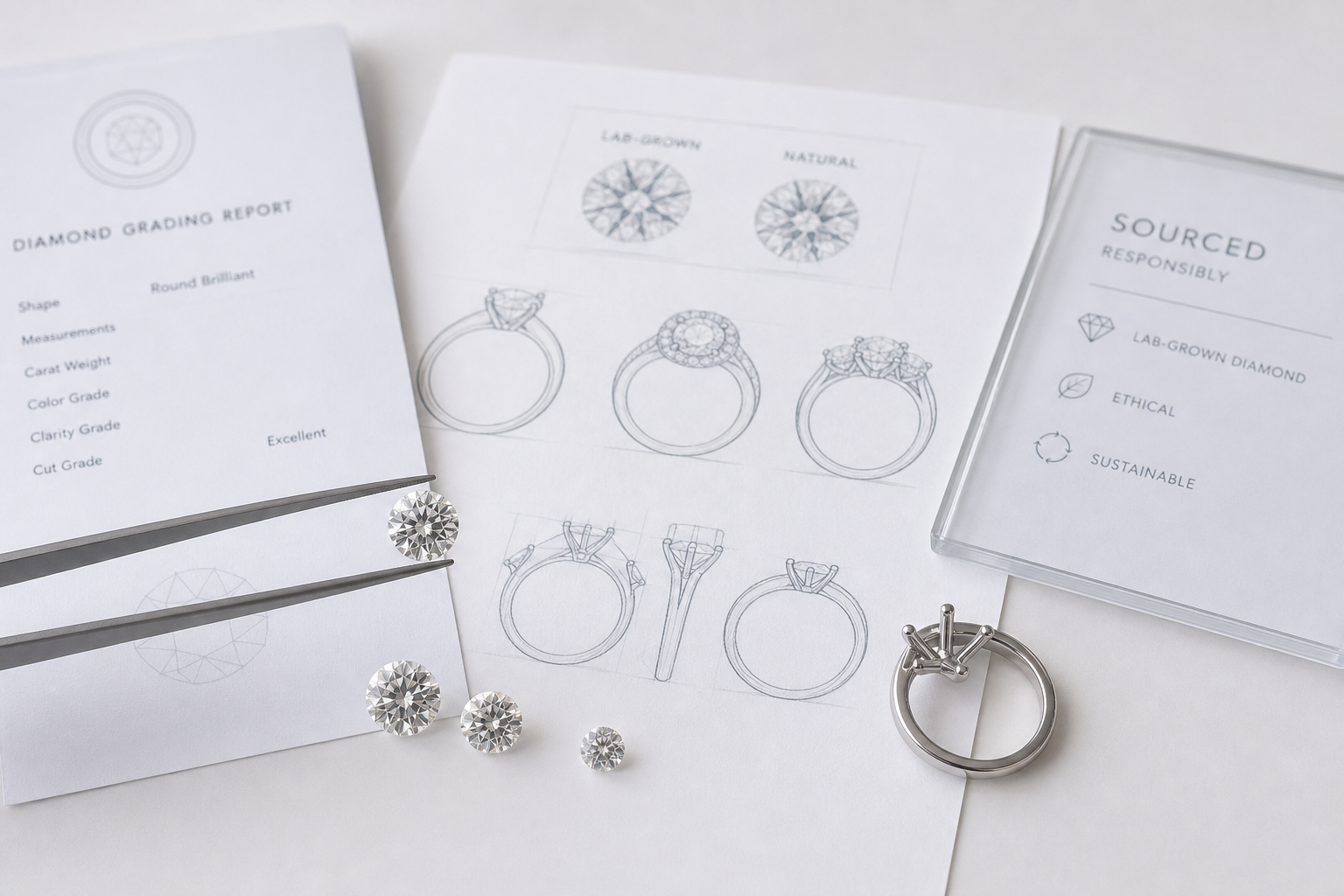
Which shapes and profiles work well in both categories
Shape often matters as much as origin when judging the finished ring. Oval, pear, marquise, and emerald cuts tend to create more finger coverage than a round diamond of the same carat weight because their length spreads across the finger. This matters for both lab-grown and natural stones. A buyer choosing a natural diamond may use an elongated shape to get more presence without increasing carat weight dramatically. A buyer choosing lab-grown may use the same shape to build a bolder ring without needing a halo.
Round brilliants are a familiar choice for sparkle, but not always the most efficient choice for visual size. If the goal is maximum spread for the budget, an oval or elongated cushion may make more sense. If the goal is a classic ring that looks balanced in almost any setting, round remains a strong option. The key is to judge the diamond by millimeter measurements, not only carat weight.
Profile height is another detail buyers often overlook. A taller setting can make the center stone look more prominent, but it also increases snagging risk. A lower-profile bezel or basket setting can be more practical for someone who works with their hands, wears gloves, or wants a ring that feels secure every day. This is not a lab-grown versus natural issue. It is a lifestyle issue.
Bezel settings can make a ring feel modern, secure, and smooth against daily wear, but they slightly reduce the exposed edge of the stone and can make the diamond appear less airy than a prong setting. For a lab-grown diamond, a bezel can create a sleek, design-forward ring. For a natural diamond, it can give a smaller stone stronger presence and protection.
When custom design becomes the smarter path
Custom design becomes the smarter path when the buyer has a specific visual target that standard settings do not handle well. This often happens with elongated stones, larger lab-grown diamonds, low-profile rings, unusual side-stone proportions, or designs that need to balance comfort with presence. If the stone is selected separately as a loose diamond, the setting should be built around its actual measurements rather than a generic carat size.
A custom engagement ring is not only for unusual designs. It can be the better choice when the buyer wants something simple but exact: a lower basket, a narrower band, a specific prong style, a flush-fit wedding band, or a three-stone layout that does not look crowded.
For lab-grown diamonds, custom design can help prevent the most common design mistake: choosing a large stone and placing it into a setting that was not scaled for that size. For natural diamonds, it can help make a smaller center stone feel intentional through proportion, metalwork, and accent placement.
For custom jewelry, the NUVU team usually looks at the diamond and setting together because a strong loose diamond can still be the wrong physical fit for a specific ring design. A stone’s length-to-width ratio, depth, and corner shape can all affect prong placement, height, and how secure the ring feels on the hand.
For custom design, trust comes from matching the stone to the setting, budget, and wearer’s daily use—not from choosing grades in isolation. Before finalizing a loose diamond, buyers should confirm the stone’s measurements, prong plan, profile height, and any CAD or design notes that affect how the finished ring will sit and wear.
For custom jewelry, stone measurements and setting compatibility should be confirmed before finalizing a purchase. This is especially important when the center stone is elongated, unusually deep, very large for the band width, or intended to sit low with a flush wedding band.
Stone-to-Setting Fit Check
Before committing, compare the center stone’s actual millimeter measurements with the setting style. For rounds, diameter gives a clearer sense of face-up size than carat weight alone. For ovals, cushions, emerald cuts, pears, and marquise diamonds, length-to-width ratio affects whether the ring looks elegant, wide, narrow, or stretched. A small difference on paper can change the whole character of the ring.
Check profile height, prong placement, band width, and whether the wedding band will sit flush if that matters to the wearer. A delicate pavé band may look beautiful with a moderate center stone but feel underbuilt with a larger one. A thick band may support a substantial stone well but make a smaller natural diamond look more compact. The setting is not the finishing touch; it is part of the diamond decision.
Quality Specs That Matter Most When Comparing Lab-Grown and Natural Diamonds
Once the ring style is clear, the comparison should move from origin to actual diamond specs. A lab-grown diamond is not automatically more beautiful because it offers a higher grade for the budget, and a natural diamond is not automatically better because it is natural. The better engagement ring stone is the one with the right combination of cut quality, measurements, shape, color, clarity, and visual performance for the ring being made.
For most buyers, the hierarchy should be simple: cut and appearance first, then size and shape, then color and clarity within a sensible range. Chasing very high grades can waste budget if the improvement is not visible in the finished ring. Accepting weak cut or awkward proportions to gain carat weight is usually a worse tradeoff, especially for a ring worn every day and viewed in all kinds of lighting.
Why cut should usually come first
Cut quality has the strongest effect on how lively a diamond looks, especially in round brilliant engagement rings. A round diamond with excellent proportions, polish, and symmetry will usually look brighter and more balanced than a larger stone with weaker cut quality. This matters for both lab-grown and natural diamonds. Origin does not rescue poor light performance.
For round brilliants, buyers should be cautious about choosing only by carat, color, and clarity while ignoring proportions. Two diamonds with the same carat weight and clarity grade can perform very differently if one has better angles and face-up balance.
Fancy shapes are less standardized, so cut judgment becomes more visual. Ovals can show a bow-tie effect, cushions can vary widely in brightness pattern, and emerald cuts rely on clean, even steps rather than sparkle alone. A report can tell you measurements and grades, but it will not fully show whether the stone has the kind of presence you want in an engagement ring.
How shape changes the way you judge color, clarity, and presence
Color and clarity do not matter equally in every shape. Round brilliants often hide color and small inclusions better than many step cuts because their faceting pattern creates more sparkle and contrast. Emerald and Asscher cuts are less forgiving. Their open facets can make inclusions easier to see and can show body color more clearly, especially in larger stones.
This changes the smart buying strategy. A round lab-grown or natural diamond may not need the highest clarity grade if it is eye-clean and well cut. Paying extra for a very high clarity grade that cannot be seen without magnification may not improve the ring. For an emerald cut, clarity deserves more attention because visible inclusions are harder to hide.
Presence is also about measurements, not just carat. An elongated oval may look larger on the finger than a round stone of similar weight, while a deep cushion may face up smaller than expected. This is one reason lab-grown diamonds can be appealing for buyers who want a larger visual footprint, but it also creates a risk: going bigger without checking proportions.
Growth method, treatment disclosure, and what buyers should ask
For laboratory-grown diamonds, HPHT and CVD may describe growth methods. HPHT can also appear in some contexts as a post-growth treatment, but buyers should not assume treatment status unless it is disclosed in the report or seller documentation. The practical point is to read the description carefully and ask what the available documentation actually says.
When growth method or post-growth treatment is relevant, buyers should look for clear disclosure in the grading report or seller documentation. The buyer does not need to become a production expert, but the product description should not blur origin, growth method, treatment disclosure, or diamond type.
What report details and measurements help you compare fairly
A grading report is useful because it gives a shared baseline: carat weight, measurements, color, clarity, polish, symmetry, fluorescence when applicable, and the grading laboratory’s assessment. It helps prevent vague comparisons like “this one looks better” when the stones are not actually similar. But the report should narrow the search, not make the final decision by itself.
A grading report does not guarantee beauty, brilliance, ethics, resale value, or that the stone will suit a particular setting. It documents characteristics that help buyers compare, but it should be read alongside visual media and physical fit. For lab-grown diamonds, also check that the report clearly identifies the diamond as laboratory-grown and review any available information about growth method or treatment disclosure when it is provided.
When a grading report is available, buyers should verify the report details through the issuing laboratory’s official report-check tool where available, then compare those details with the stone’s photos, video, measurements, and intended setting.
When comparing two stones, start with stones of the same shape and similar measurements rather than carat weight alone. For example, a buyer comparing two oval diamonds should look at length, width, depth percentage, table percentage, and length-to-width ratio. If one oval measures close to another larger-carat oval face-up, the larger carat weight may not deliver much visible benefit.
For round diamonds, diameter is especially important because it affects how large the stone looks from above. A well-proportioned round diamond should be reviewed by both weight and face-up measurement, not by carat weight alone. If a listing shows a carat weight that does not match the expected visual spread for that stone type, the proportions deserve closer review.
Report consistency also matters. Comparing a lab-grown diamond graded by one laboratory with a natural diamond graded by another may still be useful, but buyers should avoid assuming every grade is perfectly interchangeable. The safest comparison uses complete reports, clear photos or video, and stones close enough in shape and measurements that the tradeoff is easy to see.
How to avoid over-reading a certificate
A report is strongest when it answers a narrow question: what was examined, what characteristics were documented, and how the diamond is described by that laboratory. It is weaker when buyers use it to answer questions it was not designed to answer, such as whether the ring will feel comfortable, whether the stone will look best in a specific setting, or whether a future buyer will value it the same way.
For engagement rings, use the report as the first filter and the visual review as the second filter. If a diamond has attractive grades but shows a distracting bow-tie, windowing, dark center, visible tint, or poor fit for the setting, the report should not override what the buyer can see. If a diamond has slightly less impressive paper grades but looks bright, balanced, eye-clean, and well-proportioned in the intended ring, it may be the stronger practical choice.
Certificate and Visual Review Check
Before assuming one diamond is the better choice, compare the grading report with high-quality photos, 360-degree video, and actual measurements. Look for brightness pattern, dark areas, bow-tie effect in elongated shapes, visible inclusions, and whether the stone faces up the way its carat weight suggests it should.
The strongest choice is rarely the diamond with the most impressive single grade. For an engagement ring, a balanced stone with strong cut, pleasing proportions, and a clean appearance in the chosen setting will usually outperform a stone that wins only on paper.
Long-Term Wear and Everyday Practicality: What Actually Holds Up
For daily wear, lab-grown and natural diamonds should be judged more alike than many buyers expect. Both are diamonds, and both are suitable for engagement rings when properly set. The bigger practical question is not whether one origin is tougher. It is whether the ring design fits the wearer’s routine, hands, work, and maintenance expectations.
A diamond engagement ring is not worn like a necklace kept safely under clothing. It meets countertops, door handles, bags, towels, clothing, hand lotion, soap, and occasional impact. Over time, the parts most likely to create problems are usually the setting, prongs, band, and fit, not the diamond’s origin.
Why durability is mostly a setting and lifestyle issue, not an origin issue
Diamond durability is not the same as ring durability. The center stone may be very hard, but the setting still has vulnerable points, which is why any lab-grown vs natural diamonds guide should distinguish gemstone hardness from everyday wear risks. Prongs can loosen, pavé stones can be knocked out, thin bands can bend, and high-profile settings can catch on things. A natural diamond in a fragile setting is not more practical than a lab-grown diamond in a secure one.
For someone with a hands-on lifestyle, a lower-profile setting, sturdy prongs, or a bezel may make more sense than a tall, delicate ring. This is especially true for nurses, teachers, fitness-focused wearers, parents of young children, and anyone who uses their hands constantly.
Larger center stones need extra attention. A bigger lab-grown diamond can be a smart choice for visual impact, but it also creates more height, more surface area, and more leverage against the setting if it is hit. The setting must be built to support the size, especially with elongated shapes, high baskets, or delicate bands.
What maintenance looks like over years of daily wear
Normal engagement ring maintenance is not a sign of poor quality. Rings need cleaning, prong checks, and occasional adjustments because they are worn on the hand every day. Lotions, sunscreen, soap, and dust can dull the appearance of any diamond, lab-grown or natural.
Buyers should plan for periodic professional checks, especially if the ring has pavé, a halo, claw prongs, or a high-set center stone. Prongs are small by design, and they do real work. If one wears down or shifts, the risk is not theoretical.
The more intricate the setting, the more maintenance it may require. A plain solitaire is generally easier to clean and inspect than a halo or pavé-heavy design. A bezel may be protective and smooth, but it can be harder to clean around certain edges.
How buyers should think about repair, replacement, and future upgrades
Some engagement rings are chosen as forever pieces. Others are chosen as the right ring for this stage of life, with the possibility of a future upgrade. This affects the lab-grown versus natural decision. A buyer who wants the strongest possible visual ring now may prefer lab-grown because it can allow more size or design flexibility within the budget.
Repair and replacement thinking should be practical, not fear-based. Accent stones can be replaced. Prongs can be rebuilt. Bands can sometimes be resized or reinforced. But not every design is equally easy to modify. Very delicate pavé bands, unusual custom settings, and rings built around exact stone dimensions may require more careful service later.
If the buyer already expects a future upgrade, a practical move is to choose a setting that does not trap the decision. A classic solitaire or simple three-stone design may be easier to adapt than a highly specific halo built around one exact center stone.
What to Check Before You Buy for Everyday Wear
Check the ring’s height from the finger, the security of the prongs, the thickness of the band, and whether the setting protects exposed corners or points. Princess, pear, marquise, and emerald-cut diamonds can need thoughtful prong or bezel protection at corners and tips. Elongated stones should sit securely without twisting or feeling top-heavy.
Ask whether the ring suits the wearer’s daily routine. If the wearer wants low-maintenance comfort, a lower-profile solitaire, bezel, or sturdy basket setting may be better than a tall, delicate design. If the wearer wants maximum sparkle and does not mind more upkeep, pavé or halo details can make sense. A strong engagement ring is not only the one that looks right at the proposal; it is the one the wearer can live with comfortably for years.
Common Buying Mistakes When Comparing Lab-Grown and Natural Diamonds
The biggest engagement ring buying mistakes usually happen when buyers compare lab-grown and natural diamonds as categories instead of comparing the actual rings in front of them. A low price, a familiar origin story, or an impressive grade can all be useful signals, but none of them should make the decision by itself.
A better comparison looks at the complete purchase: the center stone, the setting, the proportions, the grading report, the visual presentation, and the way the ring will be worn. Most bad decisions come from overvaluing one detail while ignoring the parts that shape the everyday experience of the ring.
Letting price alone drive the decision
Price is a real factor, especially for buyers working with a fixed engagement ring budget. Lab-grown diamonds often make it possible to choose a larger center stone or stronger visible specs at a lower cost than a similar natural diamond. That can be a smart move when the goal is visual impact, design flexibility, or keeping more of the budget available for the setting.
The mistake is treating the lowest price as the best value. A lower-priced stone can still be the wrong choice if it has weak cut performance, awkward proportions, a shape that does not suit the setting, or a visual appearance that does not match the listing. This is one of the most common mistakes when buying a lab-grown diamond ring.
The same problem happens in reverse with natural diamonds. A higher price does not automatically make a ring more meaningful, more beautiful, or better suited to daily wear. Price should narrow the options, not replace judgment.
Ignoring the full ring cost, including setting and finishing details
The center stone gets most of the attention, but the finished ring is what the wearer actually lives with. Setting cost, metal choice, prong style, band thickness, sizing, polishing, and finishing quality can all change the final result. A buyer who spends the entire budget on the diamond may end up with a setting that feels too light, too plain, too high, or not secure enough for everyday wear.
This matters more when comparing lab-grown and natural diamonds because the budget pressure is different. With lab-grown, buyers may be tempted to go larger than planned and then underfund the ring architecture around it. With natural, buyers may spend more on origin and then choose the simplest possible setting just to stay within budget.
Hidden costs are often the details buyers notice later. Resizing, engraving, upgraded prongs, a sturdier basket, a better-finished band, or a lower-profile custom setting can affect both comfort and durability. Buyers should confirm the seller’s return, resizing, service, and after-sales terms before purchase rather than assuming they are included.
Confusing resale expectations with engagement-ring value
Resale expectations can distort the decision if they become the main reason for choosing one diamond type over the other. Natural diamonds may be perceived by some buyers as stronger from a long-term value perspective, while lab-grown diamonds are often chosen for upfront value and visual size. Both points can be relevant, but an engagement ring is usually not bought like a short-term investment asset.
The more useful question is how the ring will function in the relationship. If the wearer wants a natural diamond because the origin carries emotional weight, that preference matters even if the stone is smaller. If the couple would rather have a larger, brighter-looking ring and use the remaining budget elsewhere, lab-grown can make more sense even if future resale is not the priority.
Resale should only lead the decision if the buyer is genuinely planning around that outcome. For most engagement rings, emotional value, wearability, design satisfaction, and daily comfort matter more than a hypothetical future sale.
Accepting vague claims instead of written specifics
Another common mistake is letting broad sales language stand in for evidence. Phrases such as “premium quality,” “ethically sourced,” “investment grade,” “sustainable,” or “best value” can sound reassuring, but they are not all the same kind of claim. Some are opinions, some are marketing descriptions, and some would require specific documentation to evaluate properly.
Before buying, translate each important claim into a checkable question. If the claim is about the diamond’s characteristics, ask where it appears on the report. If the claim is about the setting, ask for the metal, width, prong style, and construction details in writing. If the claim is about origin, environmental impact, or sourcing practices, ask what document supports that exact statement. This keeps the purchase grounded in information rather than assumptions.
Policy and documentation questions to confirm before purchase
Seller policies can affect the buying experience, but they should not be assumed from general advertising language. Before purchase, buyers should confirm documentation, return terms, resizing policies, repair support, shipping expectations, and any after-sales services directly with the seller and keep those details in writing.
This is especially important for custom engagement rings because custom work may have different approval steps or limitations than ready-made jewelry. A careful buyer should know when the stone is approved, when the setting design is approved, what details are final, and what happens if a measurement, fit, or design issue needs review before completion.
Buyer Verification Checklist
Before committing, confirm that the comparison is based on real ring value, not assumptions. Review the grading report, but do not stop there. Check the diamond’s measurements, proportions, shape, and visual media so the listed specs match the appearance you expect.
- Confirm the grading report number, diamond type, carat weight, color, clarity, cut details where applicable, and measurements.
- Compare the stone’s actual dimensions, not just carat weight, especially for oval, emerald, radiant, pear, and elongated cushion cuts.
- Review photos or video for brightness, windowing, bow-tie effect, tint, visible inclusions, or proportion issues.
- Ask for setting dimensions, including band width, prong style, profile height, and whether the design suits the center stone’s size.
- Confirm what is included in the final ring cost, such as sizing, finishing, engraving, upgraded metal, or custom adjustments.
- Make sure the final ring matches the buying conversation, not just the diamond listing.
If one option looks better only because a key detail is missing, the comparison is not finished yet. A strong purchase should still make sense after the full ring, not just the loose diamond, has been reviewed.
For documentation, keep the grading report, invoice details, and any written description of the stone and setting together. This does not create a guarantee of future value, but it does make the purchase easier to understand, insure, service, or compare later. If a seller gives a broad claim about origin, sustainability, or quality, ask what document or report supports that specific claim.
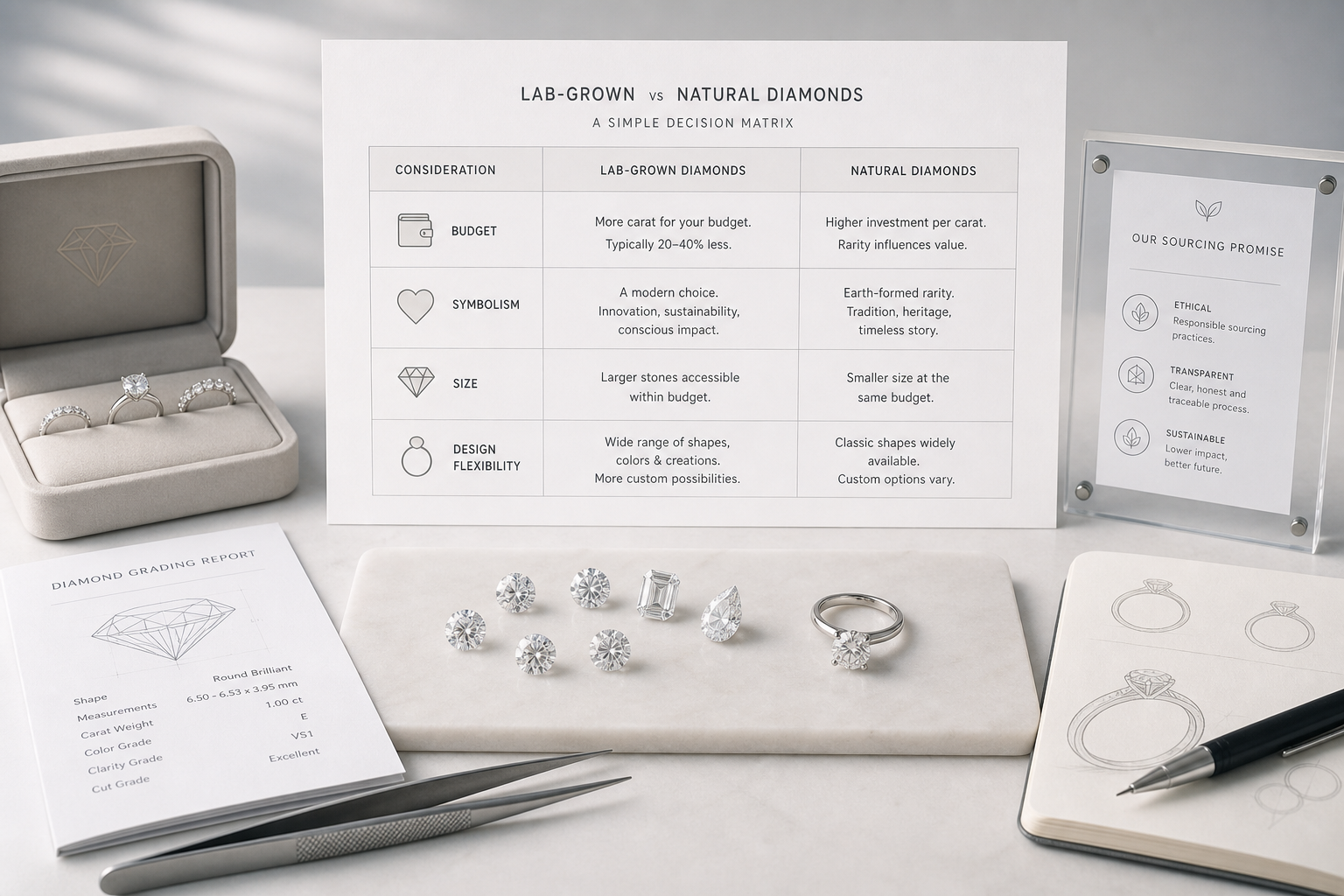
A Simple Decision Matrix: Which Option Makes More Sense for Your Situation?
The right answer depends on which priority you are least willing to compromise. Lab-grown and natural diamonds can both work beautifully in engagement rings, but they solve different buying problems. The decision gets easier when you stop asking which is better in general and start asking which one protects the part of the purchase that matters most to you.
Use this decision matrix as a final check before buying:
- Budget-first: Lab-grown usually makes more sense if you want stronger visible specs or a larger center stone without stretching the total ring budget.
- Symbolism-first: Natural usually makes more sense if origin, tradition, rarity, or family expectations are central to the ring’s meaning.
- Size-first: Lab-grown is usually the better fit if finger coverage and visual presence are major priorities.
- Design-first: Lab-grown often gives more flexibility for custom settings, larger shapes, or more detailed ring architecture within the same budget.
- Origin-first: Natural is the better fit when the emotional value of a mined diamond matters more than maximizing size or specifications.
- Daily-wear-first: Either can work; the setting, profile height, prong protection, and lifestyle fit matter more than origin.
At NUVU, this kind of comparison is best treated as a practical selection question rather than a single-grade decision. The report helps narrow the field, but the stone still needs to make sense visually, physically, and financially within the ring design. That is especially important when comparing loose lab-grown diamonds for a custom engagement ring, where small measurement differences can change the setting proportions.
When a grading report is provided, buyers should compare the report details with the issuing laboratory’s verification tools where available, rather than relying only on a screenshot, listing title, or verbal description.
For buyers who want a documented selection process, the most useful support is usually practical rather than promotional: matching the report number to the stone, confirming whether the diamond is lab-grown or natural, reviewing the millimeter measurements against the intended setting, and making sure any custom design notes are written clearly before production begins. This protects the buyer from relying only on memory, screenshots, or broad verbal descriptions.
When NUVU helps with a lab-grown engagement ring, the goal is not to push the highest grade or largest possible stone by default. The more reliable approach is to compare the diamond’s report, visual appearance, and physical fit against the wearer’s priorities. A slightly smaller diamond with better proportions or a more secure setting can be the better recommendation if it creates a ring that is easier to wear and more balanced on the hand.
NUVU’s role in buyer education is to make comparison clearer, especially around grading reports, visual evidence, design fit, and documentation. NUVU should not be treated as a grading authority; the most useful process is to align the report, the visible stone, and the finished ring requirements before the buyer commits.
This also matters for wholesale or custom orders, where consistency and communication are part of trust. A buyer should be able to ask which details are fixed, which details can be adjusted, and which parts of the design depend on the final stone measurements. Clear communication about CAD review, stone approval, setting specifications, and final documentation reduces surprises and makes the finished ring easier to evaluate when it arrives.
In wholesale or repeat custom conversations, documentation, consistency, and communication often matter as much as the headline specification. Buyers should ask how stones are matched, which grading documents or measurements are shared, how setting specifications are recorded, and what approval steps are expected before committing to a design or order.
Choose lab-grown if your top priority is size, budget efficiency, or design flexibility
Lab-grown is usually the more practical choice when the buyer wants the ring to look substantial, stay within a defined budget, or support a more ambitious setting. It can be especially strong for buyers considering elongated shapes, larger solitaires, hidden halos, three-stone designs, or custom rings where center-stone dimensions affect the entire design.
The main risk is overbuying size just because the price makes it possible. A larger diamond is not automatically better if it overwhelms the hand, sits too high, or forces a setting that feels less secure. Lab-grown makes the most sense when the added size or quality improves the finished ring, not when it simply pushes the purchase toward the biggest stone available.
For buyers comparing loose stones, this is where a transparent selection process matters. The better decision is not just “lab-grown because it costs less,” but “lab-grown because it lets this specific ring achieve the look, quality, and wearability we actually want.”
Choose natural if your top priority is origin, tradition, or emotional significance
Natural makes more sense when the origin of the diamond is part of the proposal story. Some buyers want the ring to carry a traditional sense of rarity, permanence, or family continuity. If that meaning is important to the wearer or the couple, choosing a smaller natural diamond can feel more satisfying than choosing a larger lab-grown stone that does not carry the same emotional weight.
The tradeoff is usually budget pressure. A natural diamond may mean accepting a smaller carat weight, a simpler setting, or more careful compromises across color and clarity. That is not a problem if the buyer understands the exchange. It becomes a problem only when the buyer expects natural origin, larger size, high specs, and an elaborate setting to all fit comfortably inside the same budget.
Natural is the better choice when the story of the diamond would be missed if it were not there. If origin is only a vague assumption and the wearer cares more about the look of the ring, lab-grown deserves a serious comparison.
Recheck the choice against the actual ring style, timeline, and daily-wear needs
The final decision should be tested against the ring itself. A diamond that makes sense on paper can still be the wrong fit if the setting is too delicate, the profile is too tall, the shape does not flatter the hand, or the timeline does not allow for the design work the buyer wants. The ring category matters as much as the diamond category.
If the wearer has an active lifestyle, works with their hands, or prefers low-maintenance jewelry, a lower-profile setting or more protected design may be more important than choosing between lab-grown and natural. If the proposal timeline is tight, a ready-to-set stone and a proven setting style may be more practical than a highly customized design. If the wearer has a clear style preference, that should outrank abstract arguments about which diamond type is “better.”
The strongest choice is the one that survives all three checks: it fits the budget, it matches the meaning, and it works as a ring that will actually be worn.
What This Means in a Real Purchase
Imagine two couples with the same total engagement ring budget. One couple wants a noticeably larger oval diamond in a refined solitaire with a balanced profile. They care about finger coverage, clean brightness, and keeping enough budget for a well-made setting. For them, a lab-grown diamond may be the stronger decision because it supports the look they want without forcing the setting to become an afterthought.
Another couple has a different priority. The wearer has always imagined a natural diamond because the origin feels connected to tradition, family expectations, or the emotional weight of the proposal. They are comfortable choosing a smaller round or cushion cut in a simpler setting because the meaning of the natural stone matters more than visual size. For them, natural may be the better purchase even if the lab-grown option looks larger for the same budget.
Neither couple is making a compromise in the negative sense. They are protecting different values. The wrong decision would be copying someone else’s priority and then paying for a ring that does not match the relationship, the wearer, or the way the ring will be used.
If you are still deciding, compare loose stones by shape, size, measurements, and visual performance before choosing a setting. If the ring needs a specific proportion, profile, or design detail, custom design may be the clearer path because it lets the diamond and setting be selected together instead of forcing one to work around the other.
Disclosure: This article is for general educational purposes only. Diamond grading, pricing, availability, specifications, and seller policies can change, and readers should verify important details through grading reports, official laboratory tools, seller documentation, or qualified professionals before making a purchase decision. Laboratory-grown diamonds should be clearly distinguished from natural diamonds, and environmental or sourcing claims should be supported by specific documentation.