
China lab-grown diamond quotes can look simple on the surface, but two offers with the same carat, color, and clarity may not describe the same product at all. For buyers comparing factories, certification and QC checks provide important context before shipment, because price differences often come from grading evidence, cut quality, exact measurements, growth method, disclosed post-growth treatment where relevant, matching tolerance, report status, order size, timing, and the services included in the quote.
For the full framework, read China Lab-Grown Diamond Supply Chain Guide.
This matters because a lower number is only useful when the stone, documentation, and responsibilities are clearly defined. For jewelry brands, retailers, wholesalers, and custom buyers, the real question is not just who offers the cheapest diamond, but which quote is complete, comparable, and suitable for the intended setting or order. The article helps you separate true savings from missing details, compare suppliers more fairly, and ask the right questions before committing.
Throughout this article, “lab-grown diamond” refers to a diamond grown in a laboratory environment, not a natural diamond mined from the earth and not a diamond simulant. Laboratory-grown diamonds should be clearly identified as laboratory-grown, and they should not be presented as mined diamonds. If a quote, report, invoice, or product description leaves origin unclear, the buyer should ask for written clarification before comparing price.
| Quote Detail | Why It Changes Price | What To Verify |
|---|---|---|
| Grading report | Reports add cost but improve comparability | Lab name, report status, matching stone |
| Cut and measurements | Similar grades can face up differently | Proportions, diameter, depth, actual images |
| Growth method | CVD, HPHT, and disclosed treatment history can affect quote interpretation | Method disclosure and any relevant post-growth treatment |
| Order structure | Samples, bulk lots, and parcels carry different costs | Quantity, tolerance, waste risk, timing |
| Included services | Sorting, QC, packaging, and support may be excluded | What is included beyond the stone price |
Quick Questions Before You Read
Q: Why can two China lab-grown diamond quotes with the same 4Cs be far apart?
They may use different grading evidence, cut standards, measurements, report status, delivery assumptions, or service levels.
Q: Is the lowest quote usually the best choice?
Only if the specs, report status, images, tolerances, timing, and seller terms are clearly comparable.
Q: Do stones with grading reports always look better?
No. A grading report documents key characteristics, but beauty still depends on cut, proportions, light performance, and the actual stone.
Q: What should wholesale buyers check before comparing prices?
Confirm quantity, matching standards, timing, supplier role, documentation, QC process, and what services are included.
Why Two Similar China Lab-Grown Diamond Quotes May Not Be Equivalent
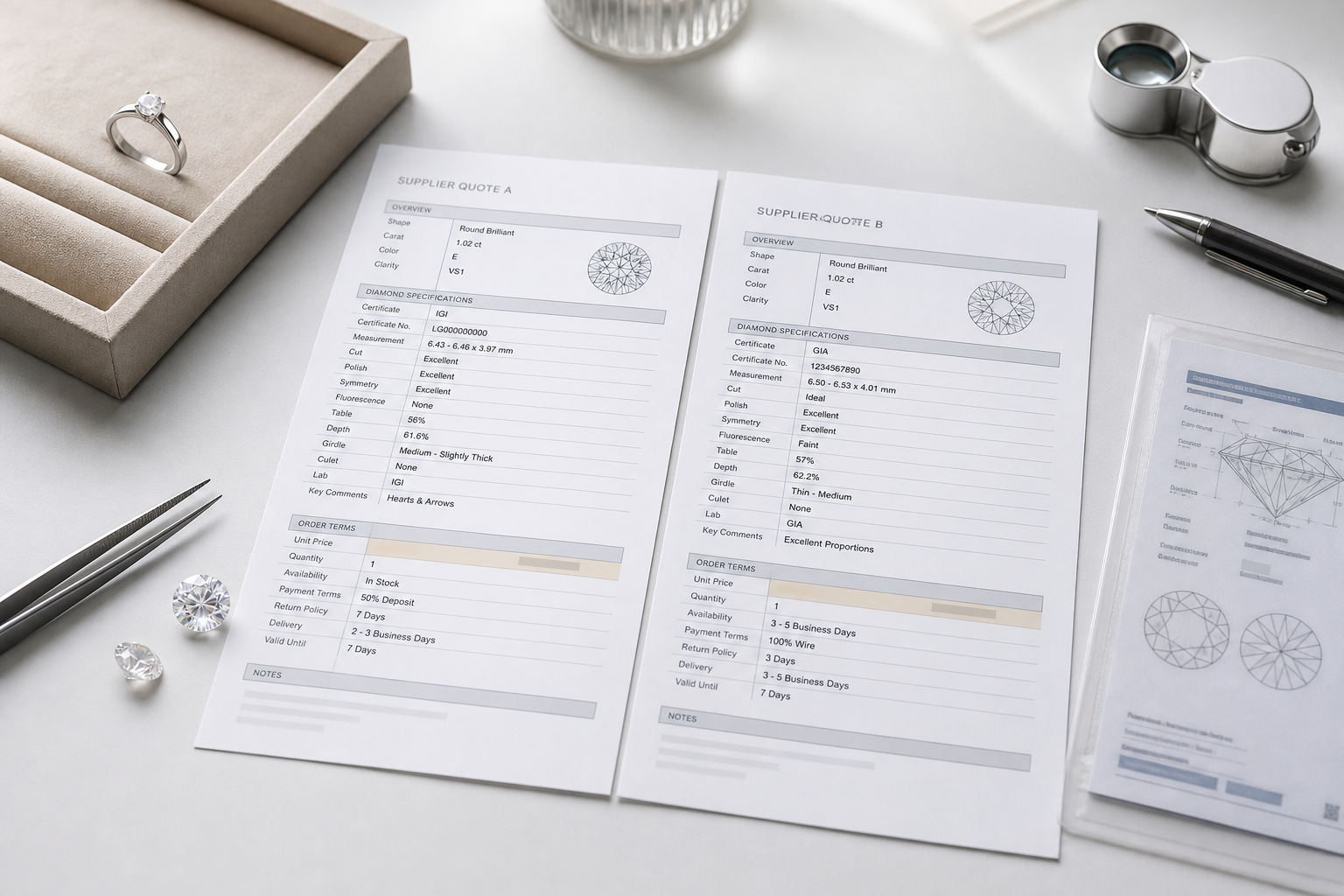
Two quotes can look nearly identical on paper and still reflect very different assumptions. A U.S. buyer comparing China lab-grown diamond prices may see the same 2.00 ct, E color, VS1, round shape, and assume the offers are interchangeable. They usually are not. One China diamond supplier may be quoting a stone with a grading report, tighter measurements, stronger cut details, and clearer written terms. Another may be quoting a looser interpretation of the specs, with less documentation and more room for variation. The headline number is only useful after you understand what is actually included.
For buyers, the practical point is not just what a quote says, but how precisely it defines the stone and the responsibilities around it. A quote that names a grade but does not identify the grading source, measurement range, image status, or matching tolerance leaves important judgment work unfinished. In practical buying, this is where many comparisons become misleading: the buyer thinks they are choosing between two prices, when they are actually choosing between two different levels of evidence.
A more reliable quote comparison starts with a written definition of the product. That definition should make clear whether the supplier is discussing a specific stone, a representative stone, a parcel range, or a future sourcing target. Each option can be valid, but each carries a different level of certainty.
The same headline specs can hide different assumptions
Carat, color, and clarity are often the first filters buyers use, but those labels do not always mean the same thing across suppliers. One lab-grown diamond quote may be based on a stone that sits comfortably inside the grade boundaries, while another may be priced on a stone that is technically close to the label but less consistent in real appearance or dimensions. In wholesale lab-grown diamonds, small differences in how a supplier defines “equivalent quality” can change the quote more than a buyer expects.
This is why quote comparison should start with the assumptions behind the number, not the number itself. If one supplier is including a grading report, exact measurements, and shape consistency, while another is only giving a broad description, those are not equivalent offers. The lower quote may simply be less complete.
Why quote comparison starts before the price line
A quote only becomes meaningful when the buyer knows what has been normalized. That means checking whether the suppliers are quoting the same growth method, the same grading standard, the same cut expectation, and the same level of documentation. Without that, price comparison can be misleading. A lower quote can look attractive while quietly excluding the things that matter most for retail presentation, setting, or brand consistency.
For sourcing teams, the practical question is not “Which quote is cheaper?” but “Which quote is defined tightly enough to compare fairly?” That shift matters because vague quotes often create extra work later. A buyer may save money up front and lose it later through sorting, rejection, delayed production, or added verification.
In sourcing or wholesale conversations, documentation, consistency, and communication often matter as much as the headline specification. A supplier that answers clarification questions precisely is giving the buyer a stronger basis for comparison than a supplier that relies on broad labels alone.
A realistic sourcing scenario: same carat, different quote quality
Consider a small U.S. jewelry brand requesting two quotes for a 2.00 ct E VS1 round lab-grown diamond from two China-based suppliers. Both suppliers use similar headline specs. One quote is lower. On closer review, the lower quote does not clearly confirm a grading report, provides limited cut detail, and gives broad measurement tolerance. The higher quote includes a grading report, fuller proportion data, and clearer expectations for what will be delivered.
Those are not minor differences. If the stone is going into a branded engagement ring, the buyer may care more about consistency and documentation than about the smallest possible purchase price. A quote that looks expensive at first can become the better business choice if it reduces uncertainty and aligns more closely with the intended use.
Evidence should be ranked before price is ranked
Before choosing the lower offer, it helps to rank the evidence behind each quote. A fixed stone with a named report, exact measurements, current media, and written terms carries more decision value than a broad quote that only lists carat, color, and clarity. This does not mean the documented stone is always the better purchase. It means the buyer has more reliable information to judge whether the price fits the risk.
A practical evidence hierarchy starts with verifiable identification, then moves to grading details, visual confirmation, and commercial terms. If two suppliers are far apart on price, compare the evidence side by side before asking for a discount. Sometimes the gap is a real pricing difference. Other times, one quote simply includes proof, handling, or accountability that the other quote leaves out.
What to Check Before Comparing Prices
- Whether the quote includes a grading report or only supplier grading
- Exact measurements, not just carat weight
- Cut information, especially for round stones
- Growth method disclosure if it matters to the buyer
- Matching or calibration requirements if the stones are for a set
- Order terms, timing, and any support expectations
The 4Cs Still Matter, But They Do Not Explain the Whole Quote
The 4Cs still shape China lab-grown diamond prices, but they are only the starting point. Carat, color, clarity, and cut help define the baseline, yet two loose lab-grown diamonds with the same broad grades can still sit at very different price points because they do not perform the same way in real life. One may face up larger, look brighter, or be better balanced in a setting. Another may technically match the grade but feel less refined once it is seen in person or in video.
For buyers comparing lab-grown diamond quotes, the mistake is assuming that the same grade always means the same value. It does not. The grade categories tell you where a stone sits in the market. They do not tell you whether the stone is optimized for visual performance, consistent inventory, or a specific jewelry use.
A useful way to read the 4Cs is to treat them as decision filters rather than a full value judgment. Carat, color, clarity, and cut help narrow the shortlist, but they do not replace checking the report details, actual dimensions, and visual media. A buyer who only upgrades color or clarity may spend more without improving the finished piece if the cut, spread, or setting fit is not also aligned.
For custom design, trust comes from matching the stone to the setting, budget, and wearer’s daily use, not from choosing grades in isolation. A stone that looks stronger on a spec sheet may not be the better choice if it creates fit, height, proportion, or durability concerns in the finished piece. For custom jewelry, stone measurements and setting compatibility should be confirmed before finalizing a purchase.
Carat weight jumps can create price breaks
Carat weight is one of the clearest drivers of price, but the jump is not always smooth. A stone at 1.90 to 1.99 ct may be priced differently from one at 2.00 ct and above because the larger size crosses a commercial threshold. Buyers often overfocus on the number itself and ignore the fact that a well-cut 1.95 ct stone may offer a stronger fit for the budget and design than a weakly cut 2.00 ct stone.
This is a useful place to be cautious. If the buyer’s setting or budget does not require a full 2.00 ct, paying for the threshold alone may not be the smartest move. The size jump matters, but only if it improves the actual result.
Color and clarity grades are priced in bands, not just labels
Color and clarity are usually discussed as individual letters or grades, but suppliers often price them in bands. D-F stones typically sit in one pricing zone, G-H in another, and I-J in a more accessible range. The same pattern applies to clarity, where VVS, VS, and SI stones are not interchangeable simply because the labels sound close. The market is not paying for the letter alone; it is paying for how much visible difference that letter usually represents.
For many buyers, the practical question is how much precision is actually needed. A stone used in a highly visible center position may justify tighter color and clarity. A side stone, bracelet stone, or volume order may not. The wrong decision is often not buying “too low” or “too high,” but buying outside the visual requirement of the actual piece.
Cut quality can change value even when other grades match
Cut quality is often the most underrated part of the quote. Two round stones with the same carat, color, and clarity can still look different because one has better proportions, stronger symmetry, or more controlled polish. That difference shows up in brightness, face-up size, and overall presence. In many real buying situations, cut quality matters more to the final look than an incremental change in color or clarity.
For round stones, many buyers compare whether the report supports an Excellent or Ideal-equivalent cut assessment, along with the basic proportion data. That does not guarantee beauty, but it does help separate a well-optimized stone from one that simply checks the grade boxes. If a quote is unusually low, weak cut quality is one possible place to look for the reason.
Useful Specification Ranges to Normalize First
- Carat range: compare like-for-like, especially near thresholds such as 1.90 to 1.99 ct versus 2.00 ct and above
- Color band: separate D-F, G-H, and I-J instead of treating all near-colorless stones as equal
- Clarity band: compare VVS, VS, and SI separately
- Cut for rounds: confirm whether the stone supports an Excellent or Ideal-equivalent standard
- Measurements: check diameter and depth, not just carat weight
Growth Method Can Affect Cost, Appearance, and Supplier Positioning
The growth method can shift China lab-grown diamond prices in ways buyers do not always expect. CVD lab-grown diamonds and HPHT lab-grown diamonds are not priced the same simply because one method is better. Pricing moves with production availability, size range, color outcome, disclosed post-growth treatment where relevant, and the supplier’s own specialization. A quote that looks high may reflect tighter control over a specific growth type. A quote that looks low may reflect easier access to inventory in that method.
For diamond sourcing, the important point is not to rank one process above the other in the abstract. It is to understand how the growth method interacts with the stone you actually need. Some buyers care about method disclosure for brand messaging, documentation, or customer education. Others care because one method is more readily available in the exact size and quality band they want. The quote should reflect that reality, not a generic assumption.
Growth method should also be separated from broad sustainability or ethics claims. Lab-grown diamonds can offer a different sourcing path from mined diamonds, but that does not automatically prove a specific environmental or production claim for every stone. If sustainability language is part of the buying decision, it is worth asking what documentation, production information, or supplier transparency supports that claim instead of relying on the growth method alone.
Sustainability claims should be specific and documented. Broad green language is less useful than clear information about production practices, energy context, disclosure standards, and seller transparency. This is especially important when a sourcing statement will later be repeated in retail descriptions or customer-facing education.
Why CVD and HPHT quotes may be priced differently
CVD and HPHT stones can end up in different pricing positions because the production path is different. Certain suppliers specialize in one method and may have stronger access to specific sizes or grades. Some stone categories are easier to source consistently in one method than the other. Post-growth processing can also affect the final quote when it is relevant to the documented appearance or commercial description of the stone.
A buyer should not assume the lower price always means the same result at a better cost. If one method is being quoted cheaply because the supplier has abundant stock in that category, the price can be perfectly reasonable. If it is low because the supplier is vague about what has been treated or how the stone was selected, the quote deserves more scrutiny.
When growth method disclosure matters to the buyer
Not every buyer needs the growth method spelled out in a quote, but many do. Brands that educate customers on loose lab-grown diamonds often want method disclosure because it helps them explain what they are selling. Wholesale buyers may also need it for catalog consistency or internal tracking. When the buyer has a specific positioning or documentation standard, an unlabeled quote is harder to evaluate.
This is where clarity from the supplier becomes part of value. A quote that clearly states the growth method is easier to compare and easier to use downstream. A quote that leaves it implicit may still be valid, but it increases the chance of confusion later.
How post-growth treatment can affect quote interpretation
Post-growth treatment can change both the look of the stone and the way the quote should be read. Treatment status should not be guessed from growth method alone. HPHT and CVD may refer to diamond growth methods, while post-growth treatment is a separate disclosure question when it is relevant to the stone being sold.
A quote without treatment disclosure can be hard to judge fairly. If the stone is priced lower because the supplier has not clarified the treatment history, the buyer may be comparing two different product definitions without realizing it. When growth method or post-growth treatment is relevant, buyers should look for clear disclosure in the grading report or seller documentation.
How to handle sustainability language in sourcing discussions
Sustainability claims should be treated as a separate evidence question, not as an automatic conclusion from the words “lab-grown.” If a supplier describes a diamond as eco-friendly, low-impact, carbon-neutral, or otherwise environmentally superior, the buyer should ask what exact practice or documentation supports that wording. Broad statements are less useful than specific information about production energy, facility practices, disclosures, or any documented program the supplier can actually substantiate.
This matters for brands because marketing language travels downstream. A sourcing team may accept a casual phrase during negotiation, but a retailer later has to decide what can be responsibly repeated to customers. The safest approach is to keep sustainability wording specific, limited, and documented. If the supplier cannot support a claim, the quote can still be considered, but the buyer should avoid building customer-facing messaging around that unsupported claim.
What to Confirm in Writing
- Whether the stone is CVD or HPHT
- Whether any post-growth treatment has been disclosed
- Whether the quote price reflects treated or untreated inventory when that distinction is relevant
- Whether the supplier can document the method consistently across the order
Certification Changes the Quote Because It Changes the Evidence
Stones with grading reports usually include more comparable information
A quote with a grading report may be higher because the supplier is not just selling a diamond; they are selling a diamond with a record that can be checked against documented characteristics. For buyers comparing IGI report-backed lab-grown diamonds or other loose diamonds from China diamond suppliers, that difference matters more than it first appears. A grading report makes the quote easier to compare because it reduces the chance that two stones with similar headline specs are being described in different ways.
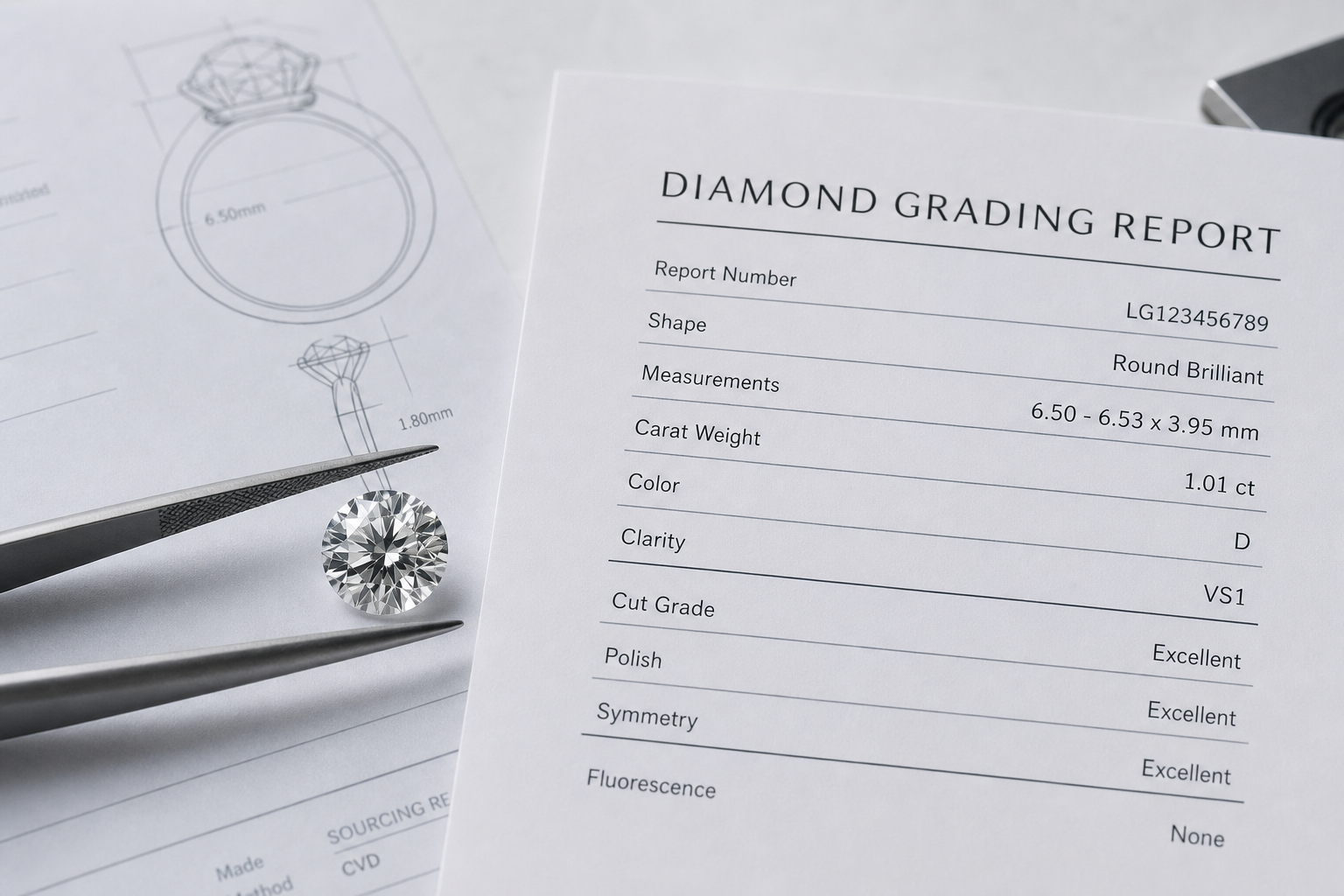
The practical advantage is not prestige. It is comparability. A report can document carat weight, exact measurements, color, clarity, laboratory-grown origin where stated, polish, symmetry, fluorescence if listed, and the report number tied to that stone. That gives the buyer a way to verify that the stone being quoted is the stone being offered. Without that document, the buyer is relying more heavily on the supplier’s description, which may be accurate, but is harder to audit.
The added cost may come from grading fees, sorting time, paperwork, and the extra handling needed to prepare stones for reporting. That cost may be worth it when the buyer needs clear records for retail presentation, customer education, or brand consistency. If the buying situation is casual or highly flexible, a report premium may be harder to justify.
A grading report can narrow the comparison, but it should be read alongside the stone’s proportions, visual evidence, and intended jewelry use. It is a tool for verification and comparison, not a substitute for judging whether the stone is appropriate for the buyer’s actual project.
When a grading report is available, buyers should verify the report details through the issuing laboratory’s official report-check tool where available and compare those details with the exact stone, images, and measurements being offered.
Quotes without grading reports may be cheaper but harder to evaluate
A quote without a third-party grading report can look attractive because it removes some of the cost and delay built into the report-backed route. That is not automatically a bad deal. If the buyer is working with a supplier they understand, has documented China supplier verification steps, has flexible expectations, or is buying a lower-risk stone for internal use, a non-report quote may be workable.
The problem is not that stones without reports are always weaker. The problem is that comparison becomes less precise. Two quotes can both say “2.00 ct, E, VS1,” but one may be based on a formal report while the other is a supplier estimate. Those are not equivalent claims. If the buyer does not confirm measurements, origin, or how the grades were assigned, the lower number may simply reflect a looser definition of the stone.
For that reason, a quote without a grading report should be treated as incomplete rather than automatically better value. It may be cheaper because less evidence is included, not because the stone is more efficient to buy. The buyer should ask what has been left out before deciding that the price is truly lower.
What a grading report can and cannot prove
A grading report helps verify identity and key specifications, but it does not prove that a diamond is visually better, better priced, or better suited to a particular setting. That limit matters. A stone can be correctly graded and still look mediocre if the proportions, spread, or overall make are unbalanced. A report also does not tell the whole story on matching, brightness, or how the stone will appear next to a specific mounting.
At NUVU, we treat the report as the starting point, not the final answer. It tells you what the stone is on paper. It does not tell you whether the stone is the right choice for the buyer’s purpose.
NUVU’s buyer-first approach is to make the comparison clearer: what the report shows, what the visuals reveal, and whether the stone fits the intended piece. That perspective keeps the discussion practical rather than treating a report, a single grade, or a low quote as the whole answer.
A practical way to read a grading report is to separate what it verifies from what it leaves open:
- It verifies: carat weight, measurements, color, clarity, laboratory-grown origin if shown, and the identifying report number.
- It may help with: checking polish, symmetry, and fluorescence if those fields are included.
- It does not prove: ideal beauty, superior light performance, sourcing ethics, environmental impact, or compatibility with every setting.
A buyer who understands that difference is less likely to overpay for paperwork alone, and less likely to dismiss a lower-priced quote that simply omits evidence the buyer actually needs.
How to compare report-backed quotes without overranking the lab name
When two stones with grading reports are being compared, the buyer should avoid reducing the decision to the laboratory name alone. The report is useful because it documents characteristics, but the quote still needs to be checked against measurements, proportions, media, supplier terms, and the buyer’s intended use. A well-documented stone can still be the wrong choice if it does not fit the design or if the visual review is weak.
It is also important to confirm whether the quoted price includes a report already issued, a report that will be obtained later, or only the possibility of a report for an added cost. Those are different commercial situations. A stone with an existing report can usually be compared more directly, while a stone awaiting a report may still carry timing and result uncertainty. The quote should make that distinction clear before the buyer treats it as final.
Certificate and Visual Review Check
Before accepting a report-backed quote as the better one, confirm that the report number matches the stone, the measurements make sense for the carat weight, and the grading details are complete enough to compare fairly. Then pair the report with photos, video, and clear written approval terms if the purchase is significant. A report without visual review can still leave too much uncertainty.
It is also useful to check whether the media belongs to the exact stone referenced in the report, not only to a similar example. For loose lab-grown diamonds, especially higher-value center stones, the strongest comparison combines three pieces of evidence: the written report, the supplier’s current images or video, and confirmation that the stone’s measurements and identifying details match across both.
Cutting, Measurements, and Visual Performance Can Create Hidden Price Gaps
Why two diamonds with the same grade may not look the same
Two stones can share the same broad grade and still deliver very different results once they are viewed in real light. That is one reason China lab-grown diamond prices can diverge even when the quote appears to match on paper. Cut quality is where this often becomes visible first. A diamond with acceptable grades but weaker proportions may return less light, look less lively, or show a shape that feels less balanced than the report alone suggests.
For round stones, buyers often look beyond the grade and compare table percentage, depth percentage, crown angle, pavilion angle, girdle, polish, symmetry, and diameter spread. None of those numbers should be treated as a universal pass-fail rule by itself, but together they help explain why one stone faces up better than another. A cheaper quote may not be lower because the diamond is flawed. It may be lower because the stone is easier to produce or less demanding to finish to a strong visual standard.
The judgment that matters most here is simple: if the buyer cares about appearance, cut precision should carry more weight than a small discount. A stone that is technically similar but visually weaker can end up being the more expensive mistake.
Face-up size can change the value of a quote
A diamond’s measurements can change how large it looks once set. That is why two stones with the same carat weight can feel different in real use. One may have a slightly wider diameter and face up larger; another may carry more depth and look smaller from above. If the quote is cheaper because the stone hides more weight below the surface, the buyer is not necessarily getting better value.
This issue is easy to miss when comparing supplier quotes line by line. Carat is visible, but face-up spread is often where the visual difference appears. A buyer comparing loose lab-grown diamonds should look at the actual measurements, not just the carat rounded to the nearest tenth. The quote that appears more expensive may be the better stone if it presents more surface area and better proportions for the same stated weight.
For round diamonds, a balanced report is only part of the picture. A stone with strong measurements but poor finish can still disappoint. That is why the price discussion should include the report and the appearance together, not one without the other.
Fancy shapes need different visual checks than rounds
Fancy shapes create a different pricing conversation because the visual factors are different. For ovals, pears, marquises, and cushions, the buyer needs to pay attention to length-to-width ratio, outline symmetry, bow-tie effect, and how evenly the shape presents from the top. A lower quote may simply reflect a stone with less desirable outline behavior or more visible windowing, not a true bargain.
This is where a quote comparison can go wrong fast. A fancy shape may look similar in words, but one supplier’s stone may be significantly better in face-up appeal. If the buyer is only reading carat, color, and clarity, the cheaper option may hide a compromise that becomes obvious once the stone is seen in person or on video.
For shape-driven purchases, visual performance should outweigh a small difference in price. The more the shape matters to the final look, the more the buyer should rely on actual images and measurements rather than the supplier’s summary description.
Photo, Video, and Measurement Review
A serious quote should be supported by more than a short spec line. Ask for front, side, and rotating video, plus exact measurements that can be checked against the report or supplier sheet. If the stone is being bought for a specific design, review how the face-up size will relate to the setting before deciding that the lower quote is the better one.
For custom jewelry, the same diamond can be appropriate in one design and less suitable in another. Basket depth, prong coverage, halo spacing, side-stone proportions, and ring profile can all change how the stone performs visually and physically once mounted.

Calibrated, Matched, and Parcel Orders Are Priced Differently From Single Stones
Why calibrated stones often cost more than flexible inventory
Calibrated stones usually cost more because they are harder to keep consistent. A supplier can often offer a lower price on a single loose stone with flexible dimensions, but the moment the order needs a tight size match, the work changes. Calibrated lab-grown diamonds must fit a setting or production plan with much less variation in diameter, shape, color, and clarity. That extra sorting and rejection of out-of-tolerance stones adds cost.
This is especially relevant for jewelry brands and wholesale lab-grown diamonds buyers who need repeatable results. If the line depends on stones that drop into pre-set mounts or follow a consistent format across multiple pieces, the quote is no longer just about the stone itself. It also reflects how much inventory the supplier must sort through to deliver the right set.
The wrong assumption is that calibration is a minor detail. It is not. Tighter calibration standards narrow the usable inventory and raise the effort required to fulfill the order correctly.
Matched pairs require more sorting than single-stone buying
A single stone can be sold on its own merits. A matched pair cannot. Earrings, side stones, and certain bridal layouts need matched diamonds with similar spread, tone, shape behavior, and overall visual balance. Even when two stones share the same grades, they may not match closely enough to work as a pair.
That is why matched diamonds often carry a pricing premium. The supplier is not only finding two stones that are both acceptable. They are finding two stones that look like they belong together. The more visible the pair will be in the finished piece, the more important this matching becomes.
A buyer should not treat the premium as automatically too high. Matching has real labor behind it. But the buyer should also be careful not to overpay for a pairing claim that is vague. If the supplier cannot explain the matching tolerance, the quote is harder to trust.
Melee and parcel quotes depend on tolerance standards
Melee and parcel buying introduces another layer of pricing variation because the quote depends heavily on tolerance standards. A parcel of small stones may look straightforward on paper, but the actual value changes with allowable variation in color, clarity, diameter, and overall make. Tighter tolerances mean more sorting, more rejected stones, and a higher quote.
This is where buyers sometimes compare apples to oranges. One supplier may quote a loose parcel with broad tolerance, while another may be pricing a more tightly controlled set that is ready for production with less rework. The second quote may look expensive, but it may save time and reduce setting problems later.
For a buyer planning a product line, the question is not just how cheap the parcel is. It is whether the parcel is consistent enough to avoid interruptions in assembly, quality checks, and final presentation. Consistency often matters more than a small unit-price difference.
Stone-to-Setting Fit Check
Before accepting a calibrated, matched, or parcel quote, confirm the acceptable size range, matching tolerance, and whether the stones are intended for immediate setting or further sorting. If the quote does not state what level of consistency is included, the price is not fully defined yet.
For custom design, the stone cannot be evaluated separately from the setting. Prong placement, halo spacing, basket depth, and side-stone layout can all change which measurements are workable. A quote that looks attractive for a loose stone may need revision if the stone’s spread, depth, or outline does not fit the intended mounting without design changes.
Order Volume, MOQ, and Timing Can Move the Wholesale Price
Wholesale lab-grown diamond pricing is not only about the stone itself. The order structure matters just as much. A supplier may quote one price for a small sample order, another for a repeat purchase, and a different rate again for a larger parcel because each version creates a different level of work, risk, and inventory pressure on the supplier side.
A buyer asking for two or three loose lab-grown diamonds is usually buying flexibility. A buyer committing to a larger bulk diamond order is asking for consistency, packaging, sorting, and often more coordination. Those are not the same job. The quote reflects that difference even before you get to the stone details.
Why sample orders and bulk orders are not priced the same way
Small sample orders tend to cost more per stone because they are harder for the supplier to absorb into a normal production or inventory flow. If the order is too small to justify special sorting or allocation, the supplier may build that effort into the quote. A bulk order can lower the unit price because the supplier is spreading handling, selection, and processing across more stones.
That does not mean larger is always better. If the buyer only needs a narrow selection, a bigger commitment can create waste rather than value. The better price is the one that matches the order purpose. A small custom run, a restocking order, and a production parcel for repeated use should not be judged against one another as if they create the same cost structure.
MOQ also shapes the quote. Some China diamond sourcing conversations become more expensive on a per-stone basis when the requested quantity is below the supplier’s normal working threshold. In those cases, the low-volume order is not “badly priced”; it is simply carrying more overhead per stone.
How timing affects sourcing flexibility
Timing changes what the supplier can offer. If the buyer can wait, the supplier has more room to source, sort, obtain reports, and consolidate efficiently. That usually gives the quote more flexibility. If the buyer needs a tight schedule, the supplier may have to pull from a narrower pool of available stones or prioritize the order ahead of others, which can change the price.
Report processing timing is part of this too. A stone that is already graded may be easier to quote cleanly than one that still needs report processing. Sorting time matters as well, especially for calibrated stones or matching parcels. The more the supplier has to organize around the request, the more likely the quote will reflect that added coordination.
For buyers, the key issue is not just speed. It is whether the requested timing allows the supplier to quote from ready inventory or from a future production position. Those are different pricing positions, and treating them as the same often leads to confusion.
When urgent delivery can narrow supplier options
Urgent delivery usually narrows the supplier’s options first and changes the price second. A rush request can limit the available stones, reduce the time for review, and rule out more economical sorting paths. If the supplier has to prioritize speed over selection, the quote may reflect that tradeoff.
This is especially true when the order needs multiple stones to arrive together. A deadline can make it harder to assemble a consistent parcel, which matters in wholesale lab-grown diamond pricing because the supplier may have to choose between speed and close alignment. The faster the request, the more important it becomes to confirm what can realistically be delivered without stretching the spec.
Urgency is not automatically a warning sign. Sometimes the buyer genuinely needs the stones quickly. The mistake is assuming that a fast quote and a flexible quote are the same thing. They usually are not.
What to Ask Before Accepting a Volume Quote
Before accepting a quote tied to order volume, the buyer should confirm the minimum order quantity, whether the price assumes a sample order or repeat purchase, and whether the quote changes at different volume tiers. It also helps to ask whether the price includes sorting, grading reports, and packaging, or whether those items are handled separately.
Timing should be confirmed in writing, not guessed from a general discussion. If the order depends on a specific deadline, the buyer should also ask what happens if the requested schedule changes. A quote that looks attractive can become less useful if the production window is unrealistic for the project.
If the order involves matching stones, the buyer should ask how much tolerance the supplier is using and whether that tolerance is already reflected in the price. A lower unit quote can stop being low once the buyer adds the cost of re-sorting or rejected stones.
The Supplier’s Role Changes What Is Included in the Price
China lab-grown diamond suppliers do not all play the same role, and that is one reason quotes vary so much. A diamond manufacturer, a wholesaler, a trading company, and a sourcing agent are each solving a different problem for the buyer. The price reflects what they actually do, not just what the stone costs to produce.
For a buyer comparing quotes, this is where a lot of confusion starts. Within the broader context of China lab grown diamond manufacturing, one supplier may be quoting a direct production position. Another may be quoting access, selection, or convenience. If those roles are not separated clearly, the cheaper quote can look better on paper even when it includes less usable value.
China-linked supply chains can offer manufacturing depth and scale in some categories, but buyers still need to evaluate consistency, documentation, communication, and quality control. “Factory-direct” and “wholesale” should be treated as supply-channel descriptions, not automatic proof of lower risk, lower cost, or better quality.
Factory-direct does not always mean the lowest usable cost
A factory-direct quote can be strong when the buyer wants access to production or a very specific sourcing lane. But factory-direct does not automatically mean the lowest practical cost for the buyer’s actual job. A factory may be excellent at producing stones, yet less useful for a mixed inventory request, a short list of matched stones, or a buyer who needs hands-on support with selection.
In some cases, the factory quote is lower because it excludes services that matter later. The buyer may still need help with sorting, matching, consolidation, or documentation coordination. Once those pieces are added back in, the original low number may no longer be the best comparison point.
At NUVU, this kind of supplier comparison is treated as a practical selection question rather than a single-price decision. The useful comparison is not whether one channel sounds more direct, but whether the quote clearly defines stone quality, evidence, communication responsibilities, and the level of support needed for the buyer’s project.
Wholesalers may price in availability and sorting
Wholesalers often quote against ready inventory, selection breadth, and faster availability. That can make their price higher than a bare production quote, but not necessarily higher in practical terms. If the buyer needs a tighter mix of sizes, colors, or matching stones, the wholesaler may already be doing part of the sorting work that would otherwise fall on the buyer.
That is one reason a wholesale quote can be easier to use even when it is not the lowest number. The supplier may be pricing in access to more immediately usable stones. For many buyers, that reduces friction and lowers the chance of getting stuck with a bargain quote that does not actually fit the order.
Service, communication, and QC can be part of the quote
Some suppliers are not just selling stones. They are handling communication, quality control, consolidation, and documentation support around the order. Those items may not appear as line items, but they still affect the quote.
That is especially relevant when the buyer is comparing suppliers with different levels of responsiveness. A trading company or sourcing partner may charge more than a direct seller because the quote includes coordination and risk management. If the order is complex, that extra layer can be worth it. If the order is simple and the buyer already knows exactly what to request, the added service may be unnecessary.
Judging supplier pricing only by the unit number can hide those differences. The better question is what role the supplier is actually performing and what the quote assumes will be handled for you.
Supplier Role Verification Questions
Before comparing supplier quotes, ask who is actually supplying the stones, whether the quote is factory-direct or through a trading layer, and what services are included. It is also worth confirming who handles sorting, QC, documentation, consolidation, and issue review if a mismatch appears.
If the supplier says the price includes quality control, ask what that means in practice. If the supplier says the stones are ready, ask whether that means physically in stock, already sorted, or merely available to source. Those distinctions matter because they change both price and reliability.
For a buyer building a repeat sourcing relationship, consistency in communication can be just as important as the headline number. A quote that is slightly higher but much clearer can be the more practical commercial choice.
Because supplier roles and quote inclusions vary, the most useful assurance is documentation that can be checked independently. When a quote includes a grading report, buyers should confirm that the report number, measurements, shape, carat weight, laboratory-grown origin where shown, and identifying details all correspond to the exact stone being offered, not only to a similar inventory item.
When a grading report is provided, buyers should compare the report details with the issuing laboratory’s verification tools where available.
If a GIA report is provided, the report details can usually be checked through GIA’s official report verification system.
For IGI, GIA, HRD Antwerp, or other recognized grading reports, the goal is not to make the diamond sound more expensive; it is to make the quote easier to audit. A report-aware buying process gives the buyer a clearer basis for comparing price, confirming identity, and deciding whether the supplier’s service level fits the order.
Why the Lowest Quote Is Not Always the Safest Quote
The lowest diamond quote is not automatically wrong. A lower price can be completely reasonable if the buyer is flexible on exact specs, does not need a grading report, or is buying from a supplier with inventory pressure. The problem starts when a low number is used to compare quotes that are not defined the same way.
In lab-grown diamond sourcing, a cheaper quote can be a real opportunity or it can be a sign that something important was left vague. The difference usually comes down to quote transparency. If the supplier has clearly stated what is included and what is not, a lower price may be easy to justify. If the quote depends on assumptions that were never written down, the risk rises quickly.
When a low quote may be reasonable
A low quote may make sense when the buyer has a loose spec window, is comfortable with available inventory, and does not require extra services. It can also be reasonable when the supplier is moving stock quickly, the order is straightforward, or the buyer is making a repeat purchase that the supplier already understands.
In that situation, the lower number may simply reflect less handling and less complexity. That is not a red flag by itself. The right way to judge it is to ask whether the quote still meets the buyer’s actual goal without forcing hidden compromises later.
When a low quote should raise follow-up questions
A low quote deserves more scrutiny when the language is vague. Phrases like “same quality,” “near colorless,” “excellent cut,” or “report available” can mean very different things depending on the supplier. If the report status, measurements, matching tolerance, or photo and video review are not clearly stated, the buyer does not yet know what the quote really covers.
The same is true when issue-resolution expectations are unclear. If a supplier cannot explain who is responsible for replacement, re-selection, or issue review, the quote may be cheaper because the buyer is carrying more of the risk. That is not necessarily a bad deal, but it should be a conscious one.
Low price without definition is where sourcing mistakes happen. The buyer thinks the quote is better because it is smaller, but the supplier may have simply excluded the parts that make the order usable.
The difference between cheaper and less defined
Cheaper means the supplier has offered a lower price for a clearly described package. Less defined means the package itself is still fuzzy. Those are not the same thing, and buyers often confuse them.
A well-defined lower quote can be a smart buy. A less defined quote can become expensive after the fact because the buyer has to fix missing documentation, rework mismatched stones, or replace items that were never aligned with the request. In practice, the stronger quote is the one that answers the biggest questions before money changes hands.
Buyer Verification Checklist
Before accepting a low quote, confirm the exact carat range, color and clarity range, cut expectations, report status, and measurements. Ask for images or video where relevant, and verify whether the quote includes matching tolerance, sorting, packaging, and documentation.
Also confirm whether the supplier is quoting a ready stone, a sourced stone, or a future production item. Ask what happens if the stone received does not match the written description, and whether that process is already part of the quote. A cheap price is only useful when the buyer can clearly see what it buys.
How to Normalize China Lab-Grown Diamond Quotes Before Deciding
The fastest way to compare lab-grown diamond quotes is to stop treating them as finished answers. A good China lab-grown diamond price comparison starts by rewriting each quote in the same format: same stone details, same report status, same cut data, same matching requirements, same quantity, same timing, and same included services. If one supplier is quoting a stone and another is quoting a stone plus sorting, report handling, and coordination, the lower number is not actually the cheaper option. It is just the less complete one.
Prices can change with market conditions, report type, seller channel, and stone-specific details, so exact comparisons should be verified at the time of purchase. Buyers should compare like-for-like specifications before treating one stone or supplier as a better value.
Build a like-for-like quote comparison sheet
Start by putting every quote into one working sheet and forcing the fields to match. Carat, shape, color, clarity, cut grade, measurements, growth method, report status, and quantity should all be visible at the same time. For loose diamond sourcing, this step matters more than the headline price because two quotes can look similar only until you compare the details line by line.
A practical comparison sheet should usually include:
- Stone type and shape
- Carat weight and any acceptable range
- Color and clarity grade
- Cut grade, polish, symmetry, and measurements
- Growth method and treatment disclosure where relevant
- Grading report status
- Matching tolerance if more than one stone is involved
- Order quantity and whether the quote is for a single stone or a parcel
- Timing and any schedule constraints
- Services included, such as sorting, QC, photos, video, or document handling
The key judgment is simple: if the fields do not match, the quotes do not match. A quote with more detail is not automatically more expensive in real terms; it may just be more honest about what is being sold.
Separate the stone price from service and documentation costs
One of the biggest mistakes buyers make is treating every line item as part of the stone itself. In reality, China diamond suppliers may bundle different pieces into the quote. A lower stone price can become a higher total cost once you add grading reports, sorting, matching, extra images, rechecking, consolidation, or specific packaging requirements.
For wholesale diamond quote checklist work, the right question is not “What is the price?” but “What is included at that price?” A quote that covers documentation, screening, and communication support may be more usable than a bare number that leaves the buyer to handle every step afterward.
This distinction matters most when the order is being used in a production flow. If the supplier is acting like a source of inventory only, the quote should be judged one way. If the supplier is also taking on selection, QC, or order coordination, the comparison has to account for that work. Otherwise, the buyer ends up comparing a full-service quote against a stripped-down one and calling the lower number the better value.
Ask follow-up questions before judging value
A quote that cannot survive a few direct questions is not ready to buy against. Before deciding, ask the supplier to confirm the details in writing and to explain any part of the quote that is based on availability rather than a fixed stone. This is especially important when comparing wholesale lab-grown diamonds, where inventory can change quickly and descriptions are sometimes broader than they first appear.
A useful rule is to test the quote at the points where ambiguity usually hides. Ask for the exact measurements, the report number if one exists, whether the stone has a third-party grading report or is supplier-graded, whether the laboratory-grown origin and growth method are confirmed, and whether the image or video shown is the exact stone or a reference example. If matching matters, ask what tolerance is being used. If timing matters, ask whether the timing includes report processing or only the stone itself.
You are looking for completeness, not perfection. A strong supplier quote usually becomes clearer when questioned; a weak one becomes vaguer. That difference matters more than a small price gap.
Document the final version of the quote before payment
After the comparison is complete, the buyer should preserve the final quote version in a form that can be checked later. That means saving the agreed specifications, stone identity if applicable, report status, media references, quantity, tolerance, delivery expectation, and any approval terms. A verbal agreement or chat summary may not be enough when the order includes matched stones, grading reports, or custom production requirements.
This final documentation step is not about making the process difficult. It protects both sides by reducing disagreement about what was promised. If the supplier later needs to substitute a stone, adjust timing, or revise a matching plan, the original written quote gives both parties a clear baseline for deciding whether the change is acceptable.
A Practical Quote Comparison Framework
- Confirm that all quotes use the same carat, shape, and grade range.
- Check whether a grading report is included or extra.
- Separate stone cost from service, sorting, and documentation costs.
- Compare cut data and measurements, not just broad grade labels.
- Verify whether matching standards apply to the order.
- Note quantity, timing, and any urgent-request premium.
- Ask what is excluded before deciding which quote is strongest.
The most useful role of this framework is simple: it stops a buyer from reacting to the headline number before the quote has been normalized.
Compliance-Safe Language to Use When Comparing Quotes
Because lab-grown diamond quotes may later appear in invoices, product pages, sales scripts, or customer education, wording matters. A supplier’s casual phrase may sound harmless in a sourcing chat but become risky if it is repeated as a customer-facing claim. Buyers should avoid turning broad claims such as “green,” “conflict-free,” “investment-grade,” “guaranteed quality,” or “certified perfect” into marketing language unless the exact claim is supported by documentation and is appropriate for the stone being sold.
A more careful approach is to describe what can actually be verified. For example, say that a stone is a “laboratory-grown diamond with an IGI grading report” if that is accurate, rather than implying the report proves beauty, sustainability, resale value, or ethical sourcing. Say that a supplier has provided “current video and measurements for the exact stone” rather than claiming the stone is the best option. This type of wording keeps the quote useful while reducing confusion for the buyer and the eventual customer.
For NUVU-style buyer education, the goal is not to make every sentence cautious or vague. The goal is to connect each claim to the right kind of evidence: report details for specifications, images and video for visual review, written terms for commercial expectations, and documented production information for environmental or sourcing claims. When the evidence is narrower, the claim should be narrower too.
The Better Question Is Not “Who Is Cheapest?” But “What Does This Quote Include?”
China lab-grown diamond prices only become meaningful after the quote is defined. A low number can reflect a leaner service model, looser requirements, different reporting, or a stone that is easier for the supplier to place. A higher number can reflect better evidence, tighter matching, stronger cut selection, or simply more work on the supplier’s side. None of those outcomes is automatically right or wrong.
Price only makes sense after the quote is defined
If two suppliers are not quoting the same specs, method, documentation, and service level, the comparison is incomplete. The first step is always to identify what the quote actually covers. The second step is to decide whether those inclusions matter for your use case. A buyer who needs loose lab-grown diamonds with grading reports for a branded line should evaluate differently from a buyer who only needs flexible inventory for internal use.
Clear requirements make supplier comparison easier
The cleaner the request, the easier the comparison. When the buyer specifies shape, carat band, grade range, grading report expectation, matching tolerance, and timing, the supplier’s response becomes much more useful. Unclear requests invite broad quotes, and broad quotes are where price confusion starts. Specific requirements do not guarantee a better number, but they do make the answer honest enough to evaluate.
Value comes from fit, evidence, and reliability
The strongest lab-grown diamond quote is usually the one that fits the real job with the least ambiguity. That means the stone matches the target spec, the evidence is clear, the supplier role is understood, and the risks are visible before payment. In a diamond sourcing decision, the cheapest quote is only attractive when it is also the clearest one.
Disclosure: This article is for general educational purposes only. Diamond grading, pricing, availability, specifications, and seller policies can change, and readers should verify important details through grading reports, official laboratory tools, seller documentation, or qualified professionals before making a purchase decision. Laboratory-grown diamonds should be clearly distinguished from natural diamonds, and environmental or sourcing claims should be supported by specific documentation.