
Lab-grown diamonds are real diamonds, but the way they are made can create confusion for buyers. For buyers comparing HPHT vs CVD diamonds, these terms describe two different growth processes, not a simple sign of quality. A diamond made by either method can be beautiful, poorly cut, fairly priced, overvalued, treated after growth, or well documented. That is why the most useful question is not “Which method is better?” but “Which finished diamond looks better, is properly disclosed, and makes sense for the price?”
For the full framework, read HPHT vs CVD Lab-Grown Diamonds Guide.
This guide helps you understand what HPHT and CVD actually mean, where the growth method matters, and where it should take a back seat to cut, proportions, measurements, color, clarity, transparency, images, video, and grading details. By the end, you should be better prepared to compare stones, read reports with more confidence, ask sharper questions, and avoid choosing a diamond based on an acronym instead of its real appearance and value.
| Buyer Question | What to Check | Best Practical Move |
|---|---|---|
| Is HPHT or CVD better? | Finished cut, visuals, report, price | Choose the better-looking documented stone |
| Does carat show true size? | Millimeter measurements and proportions | Compare face-up spread, not weight alone |
| Can the method affect value? | Treatment disclosure and similar comps | Use method as context, not the main decider |
| Are two stones truly comparable? | Shape, color, clarity, cut data, images | Compare like-for-like before judging price |
| Is the report enough? | Lab-grown disclosure, report number, treatments | Verify the report and review actual media |
| Will it work in the setting? | Measurements, shape profile, proportions | Confirm fit before committing |
Quick Questions Before You Read
Q: Are HPHT and CVD diamonds real diamonds?
Yes. Both are crystallized carbon diamonds, not simulants like cubic zirconia or moissanite.
Q: Should I avoid one growth method?
Not automatically. Either method can produce excellent or weak finished diamonds.
Q: Can I tell HPHT from CVD by looking?
Usually not. Use the grading report and seller disclosure rather than visual guessing.
Q: What matters most when choosing?
Focus on cut, proportions, face-up appearance, documentation, treatment disclosure, and price fit.
The Short Answer: Lab-Grown Diamonds Are Made by HPHT or CVD
Most lab-grown diamonds are made using one of two growth methods: HPHT or CVD. Both methods can create real diamonds with a carbon crystal structure, not diamond lookalikes such as cubic zirconia or moissanite.
For buyers, the most important point is simple: the growth method explains how the diamond was created, but it does not automatically tell you whether the finished stone is beautiful, well-cut, clean to the eye, or fairly priced. HPHT and CVD are useful terms to understand, but they should not become shortcuts for judging quality.
For buyers, the practical point is not just what the report says, but how the stone performs visually and fits the intended design. A grading report can document important characteristics, but it does not replace comparison of actual images, videos, measurements, and setting compatibility. In practical buying, this is where many comparisons become misleading: two diamonds can share the same method and similar grades while looking different once cut and viewed face-up.
A grading report can narrow the comparison, but it should be read alongside the stone’s proportions, visual evidence, and intended jewelry use. The report records important characteristics of the submitted diamond; it does not decide whether a specific buyer will prefer the stone’s brightness, outline, color tone, or fit in a chosen setting.
Laboratory-grown diamonds should be clearly identified as laboratory-grown, and they should not be presented as mined diamonds. Natural diamonds and laboratory-grown diamonds have different origins, while diamond simulants are separate materials that only resemble diamond visually. That origin difference should be clear in product descriptions, grading reports, and seller communication so buyers are comparing the right category of stone.
What “Lab-Grown” Means in Plain English
“Lab-grown” refers to origin. It means the diamond formed in a controlled production environment instead of being mined from the earth. The result can still be a diamond in the material sense: crystallized carbon with the same basic structure that gives diamond its hardness, brilliance potential, and durability.
The confusion usually comes from the word “synthetic.” In gemological language, synthetic means man-made with the same material composition as the natural counterpart. In everyday language, many people hear “synthetic” and think “fake,” which is misleading. A lab-grown diamond is not pretending to be diamond; it is diamond created through a different origin path.
That distinction matters when shopping. If you are comparing a lab-grown diamond to a simulant, you are comparing different materials. If you are comparing HPHT and CVD diamonds, you are comparing two ways of growing the same material category.
Evidence-minded buyer note: the safest wording to look for is clear origin disclosure. A listing should not blur “diamond,” “lab-grown diamond,” and “diamond simulant” into the same idea. If a seller uses vague phrases such as “diamond-like,” “created stone,” or “eco diamond” without plainly stating what the material is, ask for the grading report and direct material disclosure before comparing price or appearance.
The Two Main Growth Methods Buyers Will See
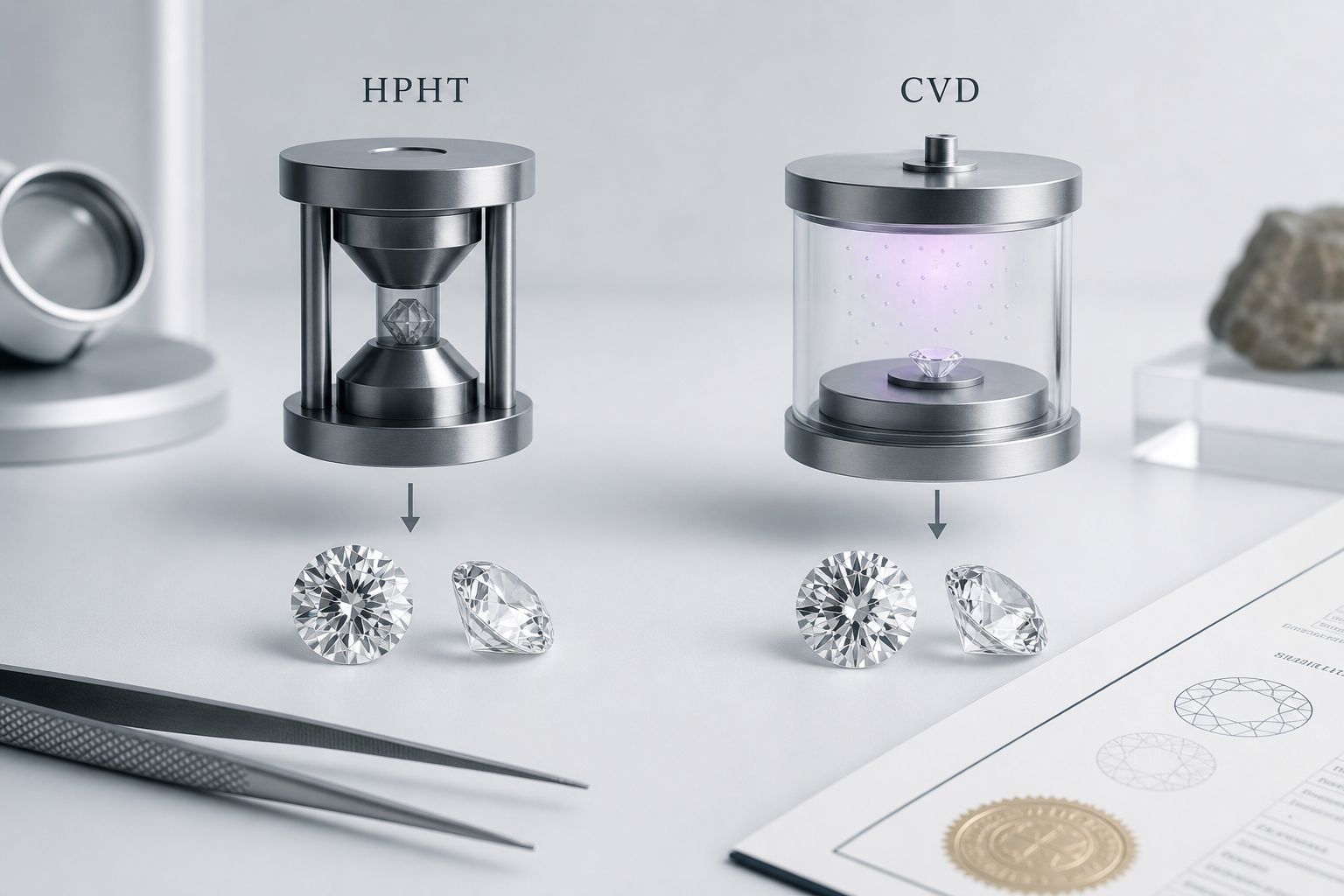
HPHT stands for High Pressure High Temperature. CVD stands for Chemical Vapor Deposition. These are the two main lab diamond growth methods buyers are most likely to see on grading reports, product listings, or educational pages.
HPHT uses extreme pressure and heat to create conditions where diamond crystal growth can occur. CVD grows diamond from carbon-containing gas in a controlled chamber, layer by layer on a diamond seed. Those differences matter to producers and gemological labs, but they are not enough by themselves to decide which stone a buyer should choose.
A strong HPHT diamond can be a better buy than a weak CVD diamond, and a strong CVD diamond can be a better buy than a weak HPHT diamond. The acronym does not replace cut quality, color, clarity, measurements, light performance, or documentation.
Why the Growth Method Is Only the Starting Point
The growth method gives context, not a final verdict. It may help explain certain report notes, treatment disclosures, or production background, but it does not show how lively the diamond looks in a ring, whether the proportions are attractive, or whether the clarity characteristics are easy to see.
This is where many buyers over-focus on the wrong detail. They see HPHT or CVD and try to rank the method before reviewing the stone itself. A better approach is to treat growth method as one piece of the file, then judge the finished diamond the same way a careful buyer should judge any diamond: by its grading report, measurements, proportions, images, video, and how it fits the intended jewelry design.
If two stones are similar in size and price, the one with better cut precision, cleaner visual appearance, and more suitable measurements will often be the stronger choice, even if the other stone has the growth method the buyer thought they preferred.
What This Means Before You Compare Stones
Before comparing lab-grown diamonds, do not start by asking which acronym is “better.” Start by confirming that the diamond is properly disclosed as laboratory-grown, then look at the evidence attached to the finished stone. The growth method can be part of that evidence, but it should not outrank visible beauty or reliable grading details.
A practical rule: use HPHT and CVD to understand the diamond’s origin, not to predict the diamond’s performance. If the report, proportions, images, and visual review do not support the stone, the growth method will not rescue the purchase.
What HPHT Means and How It Creates a Diamond
HPHT Stands for High Pressure High Temperature
HPHT stands for High Pressure High Temperature. In simple terms, the HPHT method creates an environment where carbon can crystallize into diamond under extreme heat and pressure.
Buyers do not need to memorize the engineering behind the process, but the name is useful because it explains the basic idea. HPHT growth depends on intense conditions inside specialized equipment. For shopping purposes, that technical background is not a checklist. It simply helps show that HPHT diamond growth is a controlled production process, not a coating or surface finish applied to another material.
How HPHT Growth Works at a Buyer-Friendly Level
HPHT growth usually begins with a small diamond seed and a carbon source inside a growth chamber. Under the right pressure and temperature conditions, carbon atoms can attach to the seed and build diamond crystal growth over time.
The easiest way to think about it is not that a finished diamond is being “assembled” like a product part. The diamond crystal is grown. After growth, the rough material still needs to be cut and polished before it becomes the loose diamond a buyer sees on a grading report or in a ring.
This distinction matters because the growth process is only one stage. A diamond can come from a legitimate HPHT process and still be poorly cut. It can also be grown well, cut well, and perform beautifully. The buyer’s mistake would be treating “HPHT” as a complete quality grade when it is only a growth description.
What HPHT Can Tell You — and What It Cannot
HPHT can tell you something about how the diamond was made. It may also help explain certain notes on a grading report, especially if the report identifies the growth method or mentions post-growth treatment. That information is worth noticing because clear disclosure reduces uncertainty.
What HPHT cannot tell you is whether the stone faces up bright, whether the table and depth work well together, whether the color is pleasing in the chosen setting, or whether inclusions are visible in normal wear. Those questions belong to the finished diamond, not the manufacturing label.
HPHT also should not be treated as automatically superior or automatically inferior. Some buyers hear that HPHT uses high pressure and assume it is “closer” to mined diamond formation, so it must be better. That assumption is too simple. A diamond’s final beauty depends on the quality of the grown crystal, the cutting decisions, and the specific grades and measurements, not on a broad story about the equipment used.
Another buyer-facing limitation is that “HPHT” on its own does not explain every price difference. Price may reflect carat weight, shape, cut precision, color, clarity, transparency, treatment disclosure, availability, and how closely the stone matches current demand. If a seller uses HPHT as the main reason a diamond should cost more or less, it is worth asking what other evidence supports that comparison.
Buyer Verification Checklist
- Confirm laboratory-grown origin. The report or seller documentation should clearly identify the diamond as lab-grown.
- Look for growth method disclosure if available. If HPHT is listed, treat it as useful context, not a quality guarantee.
- Review the finished grades. Cut, color, clarity, polish, symmetry, measurements, and carat weight matter more in day-to-day buying decisions.
- Check images or video. A report cannot fully show how the diamond handles light or whether clarity features are noticeable to the eye.
- Ask about treatment if the report mentions it. Treatment is not automatically a deal-breaker, but it should be disclosed and understood before purchase.
What CVD Means and How It Creates a Diamond
CVD Stands for Chemical Vapor Deposition
CVD stands for Chemical Vapor Deposition. In a CVD diamond growth process, carbon from a gas environment forms diamond crystal growth on a thin diamond seed plate inside a controlled chamber.
Compared with HPHT, CVD is a different production route rather than a buyer-facing quality grade. For buyers, that difference explains the production path, but it does not prove that a CVD diamond is better, worse, newer, or more advanced in a way that should decide the purchase on its own.
How CVD Growth Works at a Buyer-Friendly Level
CVD growth starts with a diamond seed plate placed inside a chamber. Carbon-rich gas is introduced, and under controlled conditions, carbon atoms separate from the gas and build diamond crystal growth on the seed surface over time.
The process is often described as layer-by-layer growth. That image is helpful as long as it is not taken too literally as a visible stack in the finished stone. Once the rough CVD diamond is grown, it still has to be evaluated, cut, polished, and graded before it becomes a consumer-facing loose diamond.
This is the part buyers should pay attention to: CVD is a growth method, not a final appearance grade. A well-cut CVD diamond with strong proportions and clean visual appearance can be an excellent choice. A poorly proportioned CVD diamond with unattractive light performance is not saved by the fact that it was grown through CVD.
Why CVD Diamonds Still Need Individual Review
CVD diamonds should be reviewed individually because the final stone can vary in ways that matter to the buyer. Color grade, clarity grade, transparency, cut quality, and measurements all affect whether the diamond is a strong fit for an engagement ring or fine jewelry piece.
A common mistake is assuming CVD means “modern,” and modern means better. Production technology may be sophisticated, but the buyer is not purchasing the reactor. The buyer is purchasing a finished diamond. If the stone has weak proportions, visible strain-related effects, undesirable color nuance, or a less attractive face-up size for its carat weight, the CVD label does not solve those issues.
CVD can produce very attractive diamonds, but it still needs the same level of buying discipline as any other lab-grown diamond. The report narrows the facts; visual review and measurement review help decide whether those facts translate into a stone worth choosing.
For CVD diamonds in particular, buyers should pay attention to transparency and overall face-up character, not only the color and clarity grades. A stone may look strong on paper but appear slightly hazy, uneven, or less lively in video, while another with similar grades may look cleaner and brighter. This is not a reason to avoid CVD; it is a reason to compare the exact stone rather than relying on the method label.
Certificate and Visual Review Check
- Confirm the diamond is disclosed as laboratory-grown. The report should make the origin clear.
- Check whether CVD is listed as the growth method. If it appears, use it as background information rather than a ranking tool.
- Review color and clarity in context. The right grades depend on shape, size, setting style, and how sensitive the buyer is to visible details.
- Study video or high-quality images. Look for brightness, contrast, and any visual characteristics that seem distracting.
- Compare measurements, not just carat weight. Two CVD diamonds with the same carat weight can look noticeably different in spread and presence.
HPHT vs. CVD: Is One Better for Buyers?
Why Neither Method Automatically Wins
In an HPHT vs. CVD comparison, the most useful answer is also the least dramatic: neither growth method is automatically better for buyers. Both HPHT and CVD diamonds can be well-grown, beautifully cut, and properly documented. Both can also produce diamonds that are less attractive, poorly cut, or not worth the asking price.
The mistake is treating the growth acronym as if it were a quality grade. It is not. HPHT and CVD describe how the diamond crystal was created, not how well the finished stone was cut, how bright it looks, whether the inclusions are distracting, or whether the price makes sense next to similar options.
For most buyers, the final diamond matters more than the production route. A well-proportioned CVD diamond with clean visuals is often a stronger choice than an HPHT diamond with weak light performance. The reverse can also be true. The method may give useful background, but it should not outrank what the stone actually shows on its report, images, video, and measurements.
Where Growth Method May Still Matter
Growth method is not meaningless. It can matter when it helps explain certain characteristics or when two diamonds are otherwise close in grade, size, and price. Some buyers also want the method documented clearly for transparency, especially if they are comparing several stones from different sellers.
Where buyers need to be careful is with broad claims. “HPHT has better color” or “CVD is always cheaper” are too simplistic to guide a real purchase. Individual stones vary, so even lab grown diamonds vs simulants discussions should not replace stone-by-stone review. A CVD diamond may have strong color and excellent transparency, while an HPHT diamond may still need careful review for visible features, proportions, or value. A diamond should not get a pass just because the method sounds preferable.
Growth method may also matter if a report mentions post-growth treatment, if a seller cannot clearly explain documentation, or if you are buying matched stones for earrings, a three-stone ring, or custom jewelry. In those cases, consistency and disclosure become part of the decision. The goal is not to avoid one method. The goal is to avoid unclear information.
Claim check: be cautious when a seller turns a growth-method fact into a broad promise. “HPHT,” “CVD,” “untreated,” or “post-growth treated” are pieces of product information, not full proof of beauty, rarity, environmental impact, or long-term value. If a claim affects the price or your confidence in the purchase, ask what document, report note, or visual evidence supports it.
How to Compare Two Similar Lab-Grown Diamonds
If two lab-grown diamonds look similar on paper, start with the details that affect daily wear and appearance. Compare cut quality, measurements, color, clarity, polish, symmetry, fluorescence if listed, and the actual face-up look. A diamond with slightly lower carat weight but better spread and stronger proportions may be the better buy than a heavier stone that looks deep, dull, or visually smaller.
Then look at the growth method as supporting context. If both stones have similar grades and pricing, a clearly documented HPHT or CVD origin can help you understand what you are comparing. But it should not override a visible difference in brightness, shape appeal, or transparency. Buyers often over-focus on the method because it feels like a hidden technical clue. In practice, the more costly mistake is ignoring the finished stone’s evidence.
A strong comparison asks, “Which diamond looks better, fits the setting better, and is better documented for the price?” That question is more useful than asking whether HPHT or CVD wins as a category.
Prices can change with market conditions, report type, seller channel, availability, and stone-specific details, so exact comparisons should be verified at the time of purchase. When comparing two lab-grown diamonds, compare like-for-like specifications rather than assuming one is a better value because of a single acronym, carat number, or advertised discount.
What to Check Before You Decide
- Confirm the diamond is identified as laboratory-grown on the grading report or certificate.
- Review cut, proportions, and measurements before giving extra weight to carat size.
- Check color and clarity in context, especially through images or video rather than grade alone.
- Look for any post-growth treatment disclosure and ask for clarification if the wording is unclear.
- Compare price against similar finished stones, not just similar HPHT or CVD labels.
Why Growth Method Does Not Automatically Decide Beauty or Value
Cut Quality Usually Matters More Than the Growth Acronym
Diamond beauty is driven heavily by how the finished stone handles light. Growth method can explain origin, but cut quality determines much of what buyers notice first: brightness, contrast, sparkle, and whether the diamond looks lively or flat. This is why a diamond with a strong report label but poor proportions can still disappoint in person.
For round brilliant diamonds especially, small differences in table size, depth, crown angle, pavilion angle, and overall symmetry can change visual performance. For fancy shapes, outline, length-to-width ratio, bow-tie effect, windowing, and facet pattern often matter more than whether the stone began as HPHT or CVD. A buyer who chooses by acronym first may end up paying for a technical preference instead of a better-looking diamond.
Color and Clarity Still Need Normal Evaluation
Color and clarity do not stop mattering because a diamond is lab-grown. A high color grade can still be more desirable in certain settings, especially white metals such as platinum or white gold. A slightly warmer grade may be perfectly acceptable in yellow gold or rose gold, where the setting softens the visual contrast. The right choice depends on how the stone will be worn, not only on the report line.
Clarity needs the same practical approach. A VS or SI clarity lab-grown diamond may be a smart choice if it is eye-clean and the inclusions are not affecting transparency or durability. A higher clarity grade may be worth paying for in larger stones or step-cut shapes, where inclusions are easier to see. The mistake is assuming that HPHT or CVD alone predicts whether a diamond will look clean. It does not.
Fluorescence, color nuance, and clarity visibility should also be judged in context rather than treated as automatic deal-breakers. A report term may sound important, but the buying question is whether it affects the diamond’s appearance in normal lighting and in the chosen setting. This is why a buyer should compare report details with actual stone media before paying more for a grade that may not change the look in daily wear.
A Realistic Buyer Scenario: Choosing Beyond the Label
Imagine Maya is comparing two oval lab-grown diamonds for an engagement ring. One is a 1.50 ct CVD diamond with balanced proportions, a clean face-up appearance, and a pleasant outline. The other is a 1.70 ct HPHT diamond at a similar price, but it has a more noticeable bow-tie and a slightly awkward length-to-width ratio for the setting she likes.
If Maya chooses only by carat weight and growth method, the 1.70 ct HPHT diamond may look like the stronger option. In actual wear, the 1.50 ct CVD diamond may be the better purchase because it faces up attractively, works better with the ring design, and avoids a visual feature she would notice every day. That is the kind of tradeoff buyers should take seriously.
What This Means in a Real Purchase
Lab diamond value is not just about finding the largest stone or the most preferred acronym. It is about whether the finished diamond gives you a strong combination of appearance, documentation, size, and suitability for the design. A smaller diamond with better visual performance can be a smarter choice than a larger one that only looks better in a filtered search result.
At NUVU, the practical approach is to treat the grading report as a starting point, then compare the actual stone evidence. The report can narrow the field, but images, video, proportions, and setting fit often decide which diamond makes more sense.
When a grading report is available, buyers should verify the report details through the issuing laboratory’s official report-check tool where available, then compare those details with the exact stone’s measurements, media, and disclosure notes.
For buyers, this means the report should not sit separately from the diamond. The report number, shape, measurements, carat weight, color, clarity, and any listed growth or treatment notes should be checked against the exact stone being considered. This kind of verification does not make one diamond automatically preferable, but it does reduce the risk of comparing incomplete or mismatched information.
What Buyers Should Check on a Lab-Grown Diamond Report
Where HPHT or CVD May Appear on the Report
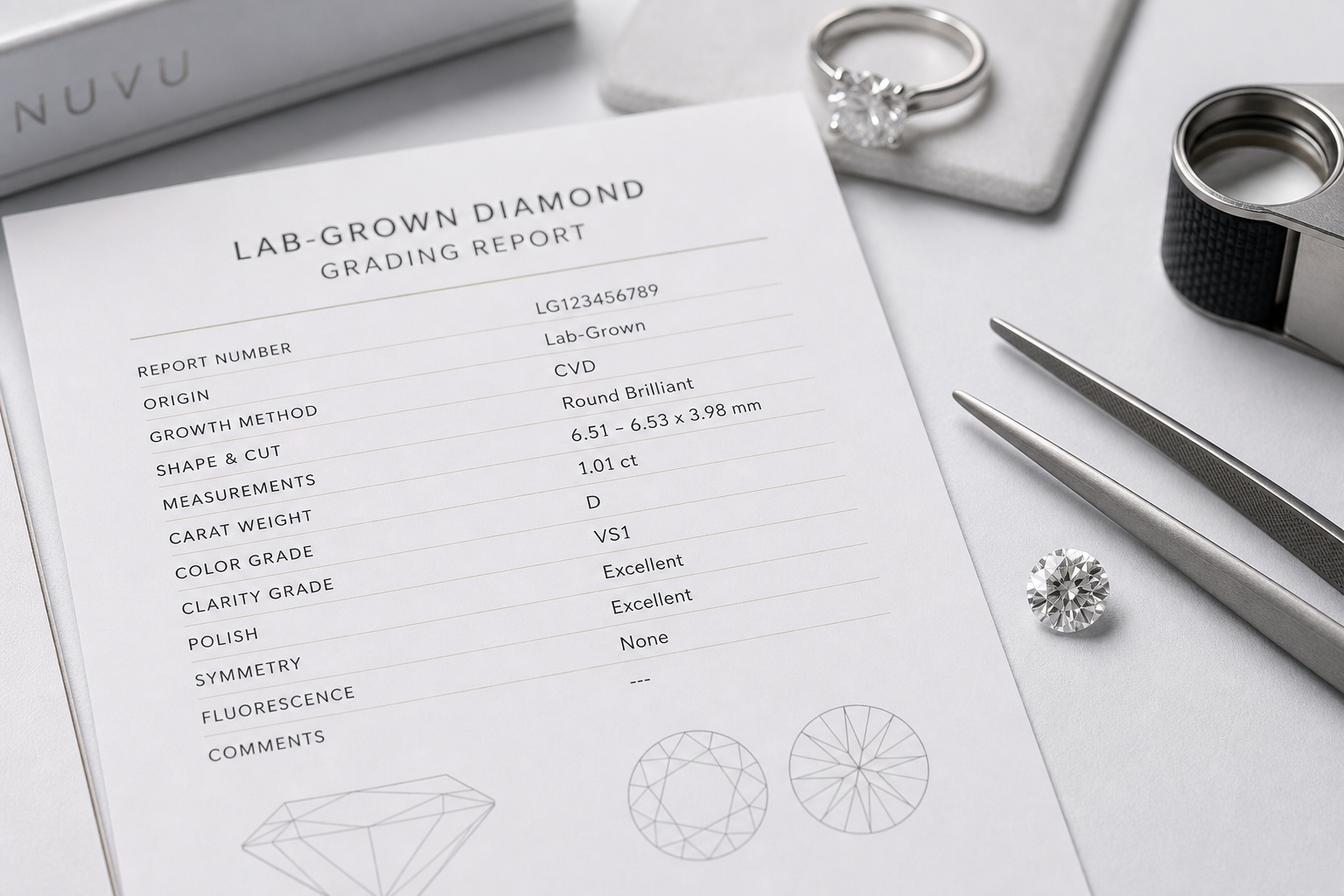
A lab-grown diamond report usually identifies the stone as laboratory-grown and may also list the growth method, such as HPHT or CVD. The exact wording depends on the grading laboratory and report format. Some reports include growth method and treatment information clearly, while others may emphasize origin, grading details, and inscription data.
If you are specifically comparing HPHT vs. CVD diamonds, look for the section that describes laboratory-grown origin, growth method, or additional comments. Do not rely only on a product page label if a grading report is available. Product listings can be shortened, inconsistent, or missing context, while the report gives you a more stable reference point for verification.
A certificate or grading report is most useful when it is treated as a document to verify, not as marketing language to accept without review. Match the report details to the exact stone being offered, including shape, measurements, carat weight, color, clarity, and any inscription or report number. If a seller shows a report but cannot connect it clearly to the diamond in the listing, the paperwork is not giving the buyer enough confidence.
A grading report helps document key characteristics, but it should not be treated as a guarantee of beauty, value, or sourcing ethics. It records information about the submitted stone according to the laboratory’s reporting format; it does not replace a visual review, seller documentation, or confirmation that the diamond is appropriate for the intended jewelry design.
Why Post-Growth Treatment Deserves Context
Post-growth treatment is one of the most misunderstood phrases in lab-grown diamond buying. It does not automatically mean a diamond is poor quality, and it does not automatically make a diamond a bad purchase. It does mean the buyer should understand what is being disclosed and compare the price accordingly.
Some lab-grown diamonds may receive treatment after growth to improve color or appearance. The practical question is not whether the term sounds concerning, but whether it is disclosed, documented, and reflected in the value comparison. A treated diamond with clear reporting and strong visual performance may still be a reasonable choice. An undisclosed or vaguely explained treatment is a warning sign because it weakens the buyer’s ability to compare accurately.
When growth method or post-growth treatment is relevant, buyers should look for clear disclosure in the grading report or seller documentation. HPHT and CVD are growth methods; HPHT may also appear in treatment discussions in some contexts, so the wording on the report matters. Do not assume treatment status from the acronym alone.
Report Details That Matter More Than the Acronym
After confirming origin and growth method, spend more attention on the details that shape the buying decision. Carat weight tells you weight, not face-up size. Measurements tell you how large the diamond may actually appear. Cut, polish, and symmetry help explain how carefully the finished stone was produced. Color and clarity grades give useful comparison points, but they still need visual confirmation.
For many buyers, the most important report details are the ones that expose tradeoffs. A diamond may have an appealing carat weight but face up small because it is cut too deep. Another may have a strong clarity grade but still show a visual issue in video because of transparency, strain, or facet pattern. The report is valuable, but it is not a substitute for reviewing the diamond itself.
Documentation boundary: a grading report can help confirm the recorded characteristics of the submitted stone, but it should not be treated as a promise that the diamond will look perfect to every buyer or fit every setting. Reports are especially useful for narrowing comparisons; visual media, measurement review, and seller transparency help finish the decision.
How to Read a Report Without Over-Relying on It
A report is strongest when it helps you compare facts consistently. Use it to confirm the diamond’s recorded identity, origin disclosure, measurements, grades, and any comments about growth method or treatment. Then ask whether the report information matches the listing, the inscription if shown, the images or video, and the design plan for the jewelry.
The report is less useful when it is treated as a replacement for judgment. Two diamonds with similar reports can differ in transparency, brightness, outline appeal, bow-tie visibility, or setting compatibility. For NUVU, the buyer-first approach is to make that comparison clearer: what the report shows, what the visuals reveal, and whether the stone fits the intended piece.
How to Verify This Before Buying
Before buying, match the report number on the document to the number listed by the seller and, when available, verify it through the grading laboratory’s official database. Confirm that the carat weight, measurements, color, clarity, shape, and inscription details align. If any information does not match, pause before moving forward.
It is also worth asking for clear images or video of the actual diamond, not just a sample image. A grading report can confirm important facts, but it cannot show every lighting condition, every angle, or how the stone will look in a specific ring design. The safest decision uses the report, the visual evidence, and the intended setting together.
Practical Measurements Buyers Can Use When Reviewing a Finished Diamond
Carat Weight vs. Millimeter Size
Carat weight tells you how much a diamond weighs, not how large it will look once set. This matters because two lab-grown diamonds with the same carat weight can face up differently depending on their proportions. A well-cut round diamond may look larger across the top than a heavier stone that carries extra weight in its depth.
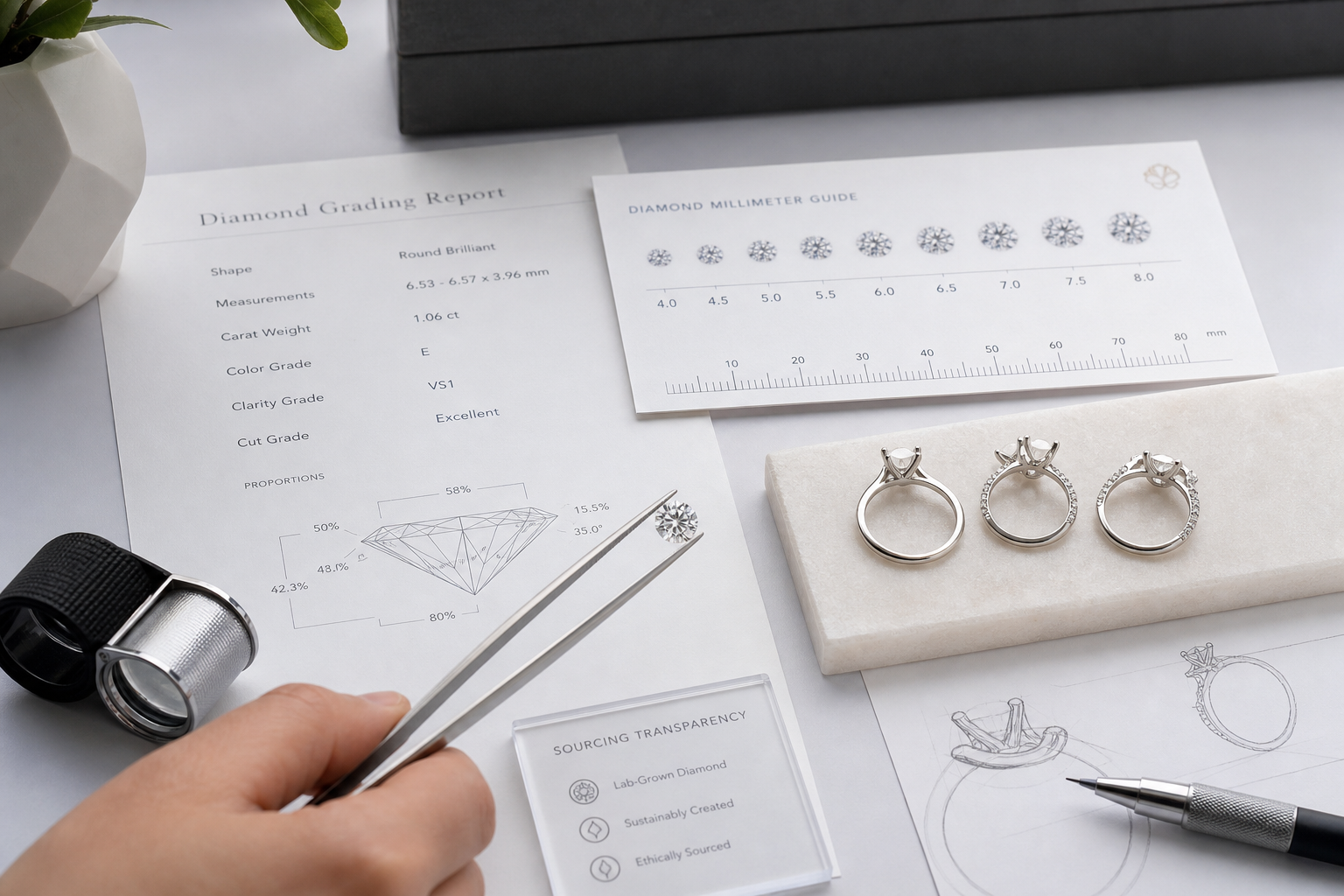
For buyers, millimeter measurements are often more useful than carat weight alone. Instead of relying on carat weight as the main size signal, compare the length, width, diameter, and depth shown on the report. These measurements help you spot a diamond that may be hiding weight where you will not see it.
The warning sign is a stone that costs more because of carat weight but does not give you the expected visual spread. If a diamond is noticeably smaller in millimeters than other stones of the same shape and weight, check the depth percentage and side profile before assuming it is the better value.
Round Diamond Proportions as a Starting Point
For round brilliant lab-grown diamonds, proportion data can help buyers avoid obvious mismatches. Table size, depth percentage, crown angle, pavilion angle, girdle description, polish, symmetry, and cut grade all work together. None of these numbers should be isolated from the rest of the stone.
These details should not replace cut grading, images, or video, but they help you identify stones worth a closer look. A diamond with unusual proportions is not automatically poor, yet it deserves more scrutiny. A very deep round diamond may look smaller from the top. A very large table can sometimes change the balance of fire and brightness, depending on the full cut pattern.
The practical judgment is simple: if two round diamonds have similar color, clarity, and carat weight, the one with stronger proportions and a better face-up size is often the smarter comparison point, even if the other stone looks slightly more appealing on carat weight alone.
Why Fancy Shapes Need Shape-Specific Review
Fancy shapes such as oval, emerald, pear, cushion, radiant, marquise, and princess cuts should not be judged by round diamond proportion habits. Their beauty depends more on shape-specific factors, including outline, symmetry, length-to-width ratio, corner shape, bow-tie visibility, windowing, facet pattern, and how the diamond handles light across the face.
Length-to-width ratio is especially useful for fancy shapes because it affects the personality of the diamond. Some buyers prefer elongated ovals, pears, and emerald cuts, while others prefer a softer or more compact outline. These preferences are starting points, not standards. A stone that technically fits a popular range can still look awkward if the shoulders, corners, or outline are poorly balanced.
The most common mistake is treating fancy-shape numbers as if they guarantee beauty. They do not. For these shapes, images and video become more important because the grading report will not fully show bow-tie effect, windowing, crushed-ice appearance, or whether the shape looks elegant in the intended setting.
Stone Measurement Check
Before comparing price or growth method, check the stone’s measurements against its carat weight and shape. For a round diamond, compare diameter, table, depth, and cut grade together. For a fancy shape, compare length, width, depth, and length-to-width ratio, then confirm the actual face-up appearance through images or video.
A good lab-grown diamond buying checklist should not stop at “Excellent” on the report. The better question is whether the diamond’s weight, spread, proportions, and visual performance work together. If the numbers look strong but the stone appears dark, uneven, overly deep, or visually small for its weight, the report is not enough to justify the choice.
Common Misconceptions About HPHT and CVD Diamonds
Misconception 1: One Method Is Always Higher Quality
One of the most common HPHT and CVD diamond myths is that one method automatically produces better diamonds. That shortcut is unreliable. HPHT and CVD can both produce attractive, well-graded stones, and both can produce diamonds with characteristics that require closer review.
The growth method may provide useful context, but it does not replace the finished diamond’s evidence. Cut quality, color grade, clarity grade, measurements, transparency, and visual appearance matter more in a normal buying decision. A poorly proportioned diamond does not become a better purchase because it was grown by a preferred method, and a well-cut stone should not be dismissed simply because the acronym is unfamiliar.
The better judgment is to treat HPHT or CVD as background information within a broader lab grown diamonds guide, since it can help you ask smarter questions, especially about documentation or treatment, but it should not outrank what the finished diamond actually looks like and how it is graded.
Misconception 2: You Can Judge the Method by Eye
Buyers sometimes assume they can look at a diamond and tell whether it is HPHT or CVD. In normal viewing conditions, that is not realistic. A finished lab-grown diamond’s growth method is not something most people can reliably identify by eye, especially once the diamond is cut, polished, and set in jewelry.
Visible beauty is not the same as growth history. What you can judge by eye is whether the diamond looks bright, clean, well-shaped, and appealing in the lighting where it will be worn. What you cannot reliably judge without documentation is whether it was created by HPHT or CVD, whether treatment occurred, or what the laboratory recorded about its origin.
This is where buyers often focus on the wrong kind of certainty. Trying to guess the method visually is less useful than verifying the grading report, checking the report number, and reviewing the actual diamond through clear media.
Misconception 3: Post-Growth Treatment Automatically Makes a Diamond Bad
Post-growth treatment is often misunderstood. It does not automatically mean a diamond is bad, but it should be disclosed clearly. In lab-grown diamonds, treatment may be used to improve or adjust certain color characteristics after growth. The issue is not that treatment exists; the issue is whether the buyer knows about it and whether the price reflects the full picture.
A treated lab-grown diamond may still be beautiful and appropriate for an engagement ring or jewelry piece. The risk comes when treatment is hidden, minimized, or used to make a diamond appear more comparable to an untreated stone without proper context. If two stones look similar and carry similar grades, disclosure can help explain pricing differences or give the buyer more confidence in the comparison.
The practical rule is not to avoid every treated diamond. It is to avoid unclear documentation. A diamond with transparent disclosure is easier to evaluate than one where the seller cannot explain what the report says.
Misconception 4: Lab-Grown Automatically Means Sustainable
Some buyers also hear lab-grown diamonds described with broad environmental or ethical language. Lab-grown origin is a meaningful sourcing distinction, but it should not automatically be treated as proof that every stone is sustainable, low-impact, carbon-neutral, or ethically superior in every respect. Those claims depend on specific production practices, energy sources, disclosures, and supporting documentation.
A careful buyer should separate origin from broader marketing language. “Laboratory-grown” tells you how the diamond was created. It does not, by itself, prove every environmental or social claim that may appear in an advertisement. If sustainability is important to your purchase, ask the seller to explain the specific basis for the claim rather than relying on HPHT or CVD alone.
Sustainability claims should be specific and documented. Broad green language is less useful than clear information about production context, energy information where available, sourcing disclosures, and how the seller explains the limits of the claim. Responsible language helps buyers compare evidence rather than relying on a single appealing label.
Environmental and sustainability claims should be specific, documented, and limited to what can be substantiated. A laboratory-grown origin can be part of a buyer’s sourcing preference, but it should not be used as a blanket substitute for evidence about production practices, energy use, supply-chain transparency, or seller-provided documentation.
Buyer Verification Checklist
Before accepting claims about HPHT, CVD, or treatment, confirm that the diamond is identified as laboratory-grown on the grading report, check whether the report lists growth method or treatment information, and verify the report number through the grading laboratory when that option is available.
Then bring the decision back to the finished stone. If the diamond has strong proportions, appropriate color and clarity, clean visual performance, and clear documentation, the growth method should be supporting context rather than the deciding factor.
How to Decide Without Over-Focusing on HPHT or CVD
Start With the Finished Diamond, Not the Acronym
Once you understand HPHT and CVD, the next step is to avoid letting either acronym control the purchase. A buyer choosing a loose lab-grown diamond should start with the finished stone: shape, carat weight, measurements, cut quality, color, clarity, and how the diamond looks in real images or video.
This order matters because the final diamond is what will be worn, not the growth method. A CVD diamond with better proportions and a cleaner face-up appearance may be the stronger choice over a larger HPHT diamond with weaker spread. The reverse can also be true. The method may help explain the diamond’s background, but it does not tell you whether the stone is right for the ring, budget, or wearer.
The mistake to avoid is using HPHT or CVD as a shortcut for value. A better shortcut is evidence: report, measurements, visuals, and fit for the intended jewelry.
Use the Report, Images, and Measurements Together
A grading report gives structure to the decision, but it does not show everything a buyer needs to know. Use it to confirm laboratory-grown origin, carat weight, color, clarity, measurements, polish, symmetry, proportions, and any listed growth or treatment information. Then compare that data against images, video, and the diamond’s face-up size.
Images and video help reveal what numbers cannot fully show: whether the diamond appears lively, whether a fancy shape has an obvious bow-tie, whether the outline looks balanced, and whether inclusions are visible in a way that matters. Measurements help prevent overpaying for weight that does not translate into visual size.
At NUVU, we usually treat the grading report as the starting point, not the whole decision, because a report can narrow the field but cannot show how the diamond will look in every lighting condition or setting style.
Before purchase, buyers should confirm the seller’s documentation, return policy, resizing terms, and after-sales support in writing rather than assuming these details from a product page or grading report.
For a buyer comparing HPHT and CVD options, support is most useful when it helps turn technical information into a clear decision. The goal is to confirm the diamond’s identity, explain the report language in plain terms, and make sure the selected stone fits the design, budget, and wearer’s priorities before the purchase is finalized.
Match the Diamond to the Setting and Use Case
The right lab-grown diamond is not just the strongest stone on paper. It also needs to work with the setting and the way the jewelry will be worn. A high-set solitaire can show more of the diamond’s profile, so depth and side appearance may matter more. A halo or bezel setting may change how large the center stone appears. A low-profile engagement ring may require closer attention to stone shape, pavilion depth, and setting compatibility.
For daily wear, practical fit can matter as much as the report grade. A long pear or marquise may look elegant but needs a setting that protects vulnerable tips. An emerald cut can look refined, but its broad facets make clarity characteristics easier to notice. An oval may offer strong finger coverage, but a visible bow-tie can become distracting if the stone is not reviewed carefully.
This is where the decision becomes more personal. A diamond that works beautifully for a classic round solitaire may not be the best fit for a custom east-west setting, a three-stone ring, or a low-profile design. Growth method rarely solves those design questions.
For custom design, the stone cannot be evaluated separately from the setting. Prong placement, bezel thickness, side-stone layout, band width, and ring height can all change how a diamond appears and how securely it can be set. A diamond that looks ideal as a loose stone may need reconsideration if its depth, corners, or outline create practical setting issues.
For custom design, trust comes from matching the stone to the setting, budget, and wearer’s daily use—not from choosing grades in isolation. Measurements, setting compatibility, and clear communication should be confirmed before finalizing the stone, especially for fancy shapes, low-profile rings, and designs with side stones.
For custom jewelry, stone measurements and setting compatibility should be confirmed before finalizing a purchase. This includes checking whether the diamond’s depth, girdle, corners, length-to-width ratio, and face-up size work with the planned prongs, bezel, side stones, or ring profile.
Stone-to-Setting Fit Check
Before choosing between similar lab-grown diamonds, compare the stone against the intended setting. Check the millimeter size, shape outline, depth, length-to-width ratio, and any vulnerable points or corners that need protection. For engagement rings, also consider how the diamond will sit on the finger and whether the setting style changes the way size or shape appears.
If two diamonds are close in grade and price, the better choice is usually the one that fits the design more naturally and looks stronger in actual viewing materials. HPHT or CVD can remain part of the documentation review, but the final decision should come from how the diamond performs as a finished stone in the jewelry it is meant to become.
When the Growth Method Is Worth Asking About
When Two Diamonds Look Similar on Paper
Asking about the lab diamond growth method is most useful when two stones are already close in the areas that matter most: shape, carat weight, color, clarity, cut grade, measurements, and price. If one diamond has stronger proportions, cleaner visuals, and better documentation, the HPHT or CVD label should not override that evidence. But when the comparison is genuinely tight, the growth method can help you understand what you are looking at more clearly.
For example, if two round lab-grown diamonds have the same color and clarity grades but one has a noticeably different price, asking whether each stone is HPHT or CVD may reveal useful context. It may also lead to a follow-up question about post-growth treatment, report details, or visual characteristics that are not obvious from the basic listing. The method is not a tie-breaker by itself, but it can help you ask better questions before assuming two diamonds are equal.
When Report Language Is Unclear
A grading report should clearly identify the diamond as laboratory-grown, and depending on the lab and report format, it may also reference HPHT, CVD, or post-growth treatment. If the report language is vague, missing, or difficult to match with the seller’s listing, it is reasonable to ask for clarification before buying. Transparency matters most when the paperwork and the product page do not seem to say the same thing.
The warning sign is not simply that a diamond is HPHT, CVD, or treated. The bigger issue is unclear disclosure. A buyer should not have to guess whether the stated growth method comes from the grading report, the supplier’s description, or an unverified listing field. If the seller cannot explain where the information comes from, the safer move is to slow down and verify the report number through the grading lab’s official database when available.
When You Want a Matched Pair or Custom Jewelry
Growth method can become more relevant when you are buying diamonds that need to work together, such as earrings, side stones, a three-stone ring, or a custom design with multiple visible diamonds. In those cases, the goal is not to collect matching acronyms. The goal is visual consistency. Color tone, transparency, cut style, measurements, and overall face-up appearance usually matter more than whether every stone was grown the same way.
Still, asking about HPHT or CVD can be useful if you are comparing stones from different sources or trying to match an existing diamond. Two stones with the same color grade can still look slightly different in tone or brightness, especially when placed side by side. For custom jewelry, our team usually treats the growth method as supporting context, while the stronger decision comes from checking whether the stone fits the design, the proportions, and the visual match the piece requires.
For wholesale buyers or multi-stone projects, consistency can matter as much as the headline price. A parcel or matched set should be reviewed for documentation, size tolerance, color harmony, shape outline, and communication clarity, not just for whether the stones share the same growth method. Clear paperwork and consistent descriptions help prevent small differences from becoming visible once the stones are set together.
In sourcing or wholesale conversations, documentation, consistency, and communication often matter as much as the headline specification. Buyers should ask how stones will be described, how matching expectations will be confirmed, what report information is available, and how substitutions or specification changes will be communicated before committing to a group of stones.
Questions to Confirm in Writing
Before buying, ask direct questions that produce clear answers rather than broad reassurance. The most useful questions are simple: Does the grading report identify the diamond as lab-grown? Does it list HPHT or CVD? Is any post-growth treatment disclosed? Does the report number match the grading lab’s database? Are the images, video, and measurements for the exact diamond being offered?
If you are buying a matched pair or custom piece, also ask whether the diamonds have been reviewed together for color, size, and face-up appearance. A pair can look matched on paper and still feel slightly uneven in real jewelry if one stone faces up larger, warmer, or less lively than the other. Written confirmation helps prevent the common mistake of relying on a grading report alone when the finished look depends on how the stones work together.
The Buyer’s Bottom Line on HPHT and CVD
Use HPHT and CVD as Context, Not a Shortcut
HPHT and CVD explain how lab-grown diamonds are made, but they do not automatically tell you which diamond is better. Both methods can produce attractive, well-graded stones, and both can produce diamonds that are less appealing once you review the details. Treat the growth method as context, not as a shortcut for quality.
The practical mistake is choosing the acronym instead of the diamond. A weaker stone does not become a better purchase because it was made by your preferred method, and a strong stone should not be dismissed because of a method you read mixed opinions about online.
Choose Based on the Finished Stone’s Evidence
The better buying decision comes from the finished diamond: its cut quality, proportions, color, clarity, measurements, visual performance, documentation, and fit for the intended jewelry. If those factors are strong, the growth method usually becomes secondary. If those factors are weak, HPHT or CVD will not rescue the purchase.
A grading report is part of that evidence, but it should not be the only piece. Images, video, millimeter spread, setting compatibility, and clear disclosure all help you understand what you are actually buying. The better comparison is not HPHT vs CVD in isolation; it is one complete diamond profile against another.
A Simple Rule for Buyers
If you are deciding between HPHT vs CVD lab diamonds, start with this rule: understand the method, verify the documentation, then choose the better finished stone. The growth method is worth knowing, especially for transparency and comparison, but it should not outrank visible beauty, accurate grading, or practical fit.
Final Buyer Check
Before you decide, confirm that the diamond is clearly identified as lab-grown, review whether HPHT or CVD is disclosed, check for any treatment notes, verify the report number where possible, and compare the stone’s actual measurements and visuals against your setting or jewelry goal. If the diamond looks strong only because of an acronym, keep looking. If the evidence supports the stone from every angle, the growth method has done its job as context rather than confusion.
Disclosure: This article is for general educational purposes only. Diamond grading, pricing, availability, specifications, and seller policies can change, and readers should verify important details through grading reports, official laboratory tools, seller documentation, or qualified professionals before making a purchase decision. Laboratory-grown diamonds should be clearly distinguished from natural diamonds, and environmental or sourcing claims should be supported by specific documentation.