
Lab-grown diamonds are often described with broad sustainability language. A responsible comparison needs more detail: which impact is being discussed, which facility or supplier is in scope, what period was measured, and who checked the data. Lab-grown production may avoid mining at the point of manufacture, but it still uses energy, equipment, materials, transport and supporting services. Sustainability is therefore an evidence question rather than a universal label.
| Dimension | Question for the seller | Evidence to request |
|---|---|---|
| Energy and carbon | Which facility, period, energy sources and calculation boundary are included? | Facility-specific inventory or LCA, method, emission factors and review statement |
| Water and chemicals | How are process water, cooling, gases and waste managed? | Site procedures, permits or verified performance data within the stated scope |
| Materials and yield | What inputs and allocation rules are used for a per-stone or per-carat figure? | Defined functional unit, allocation method and supporting production data |
| Supply chain | Which steps are in-house and which are purchased or subcontracted? | Named legal entities, supplier roles and item or batch records where available |
| Claims and verification | Who checked the claim and when? | Certificate or report number, holder, scope, period, expiry and verification route |
Why the answer depends on the operation
Energy mix, equipment efficiency, facility boundaries, growth method, cutting yield, transport and the accounting method can change the result. An industry average cannot establish the footprint of a particular stone. A comparison with a natural diamond also needs matched boundaries and data; a headline “better” claim is not a substitute for a comparable assessment.
Ask whether a figure is cradle-to-gate or includes later transport, packaging and use. Ask whether it describes the product, the facility, the brand or a selected project. A narrow claim may be useful, but it should not be repeated as a whole-company or whole-lifecycle conclusion.
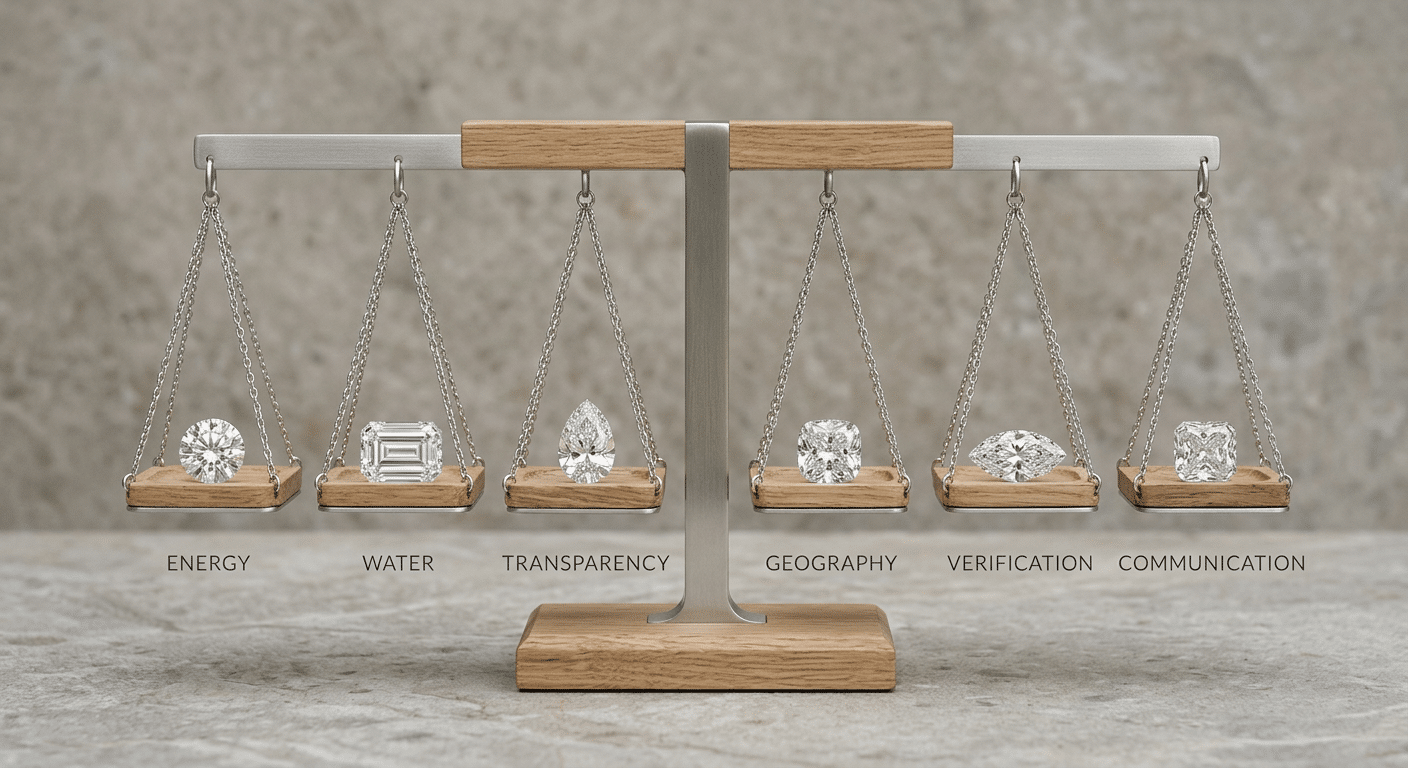
Energy and carbon: request the boundary before the number
A carbon figure is meaningful only when the unit, period, facility, data source and calculation method are clear. Life-cycle work is commonly described using the principles and framework in ISO 14040 and the requirements and guidelines in ISO 14044. Greenhouse-gas inventories may use a separate standard such as ISO 14064-1. The standard name alone does not validate a claim; the report must still show the scope and review.
For example, a supplier may report renewable electricity at one facility. Ask what share of consumption and which dates the statement covers, whether upstream material is included, and whether the claim concerns measured supply or purchased certificates. That facility statement alone does not establish the footprint of your stone.
Water, gases and chemicals belong in the same review
Electricity is one part of the assessment. Ask how cooling water is managed, whether water is reused, how process gases and chemicals are stored and captured, and how waste is transferred. A claimed recycling rate, capture rate or per-carat figure needs a current report identifying the facility and measurement period.
“Renewable energy,” “carbon neutral,” “carbon negative,” “eco-friendly” and “green” are not interchangeable. If a seller uses one of these terms, ask whether it refers to physical electricity, purchased instruments, direct reductions, offsets or a verified lifecycle result. The U.S. Federal Trade Commission’s Green Guides are a useful first-party reference for avoiding broad environmental claims without qualifying evidence; local advertising rules may also apply.
Traceability and responsibility
Environmental evidence is easier to assess when the production route is clear. For a NUVU order, distinguish owned HPHT production from order-specific CVD sourcing. A footprint assessment would need to cover the actual route and relevant suppliers, rather than applying one facility’s result to every item.
For a custom or wholesale order, ask for the legal entity responsible for each step, the source of the external report, the applicable inspection point and the records that connect the item to the order. Read traceability, certification and transparency explained for a fuller documentation framework.
How to test a sustainability claim
- Rewrite the claim as a measurable question: what, where, when, how much and under which boundary?
- Request the underlying report or a verifiable summary, not only a logo.
- Check the legal entity, facility, product line, period and expiry or review date.
- Check the functional unit and allocation method before comparing figures.
- Separate reductions from offsets and separate direct electricity from purchased certificates.
- Record what the evidence does not cover so a narrow result is not reused as a universal promise.
Questions for retail and B2B buyers
- Is the statement about a specific stone, a batch, a facility or the brand?
- What is the assessment boundary and functional unit?
- Which legal entity holds the certificate or report?
- What date and period do the figures cover?
- Was the work reviewed by an independent body, and can the document be checked?
- Which steps are performed in-house and which rely on an external supplier?
A careful decision rule
If environmental impact is central to your purchase, choose the supplier that can define its claim, show the relevant evidence and explain its limits. If the evidence is incomplete, describe the product in narrower terms and keep the unanswered questions visible. That approach gives buyers a more reliable basis for comparing diamonds, metals, design work and delivery than a single sustainability adjective.
For the report side of the decision, use the grading-report guide. For an order-specific path, visit custom design or wholesale and request a written scope before committing.