
Many diamond buyers believe that the choice between HPHT and CVD growth methods, as outlined in HPHT CVD buyer’s decision checklist, is a critical decision—one method must be better, cleaner, or more valuable than the other. This assumption leads to unnecessary filtering, overpaying for “preferred” methods, and missing out on excellent stones. The reality is far more nuanced: both methods produce chemically identical diamonds, and visual quality depends on factors entirely separate from how the stone was grown.
For the full framework, read HPHT vs CVD Lab-Grown Diamonds Guide.
This article clears away the marketing noise and addresses the most persistent myths surrounding lab-grown diamond growth methods. You’ll learn why cut quality matters more than growth technique, when price differences are justified (and when they’re not), and how to evaluate sustainability claims with appropriate skepticism. By the end, you’ll have a practical framework for comparing diamonds based on what actually affects appearance and value.
| Common Belief | Reality | What to Do Instead |
|---|---|---|
| HPHT diamonds look better than CVD | Both methods produce identical visual quality; cut determines appearance | Evaluate each diamond’s cut grade and visual performance individually |
| CVD diamonds have visible lines | Striations are rarely visible and accounted for in clarity grades | Review high-quality photos and videos; trust the certification |
| HPHT is “more natural” or authentic | Both methods create chemically identical diamonds recognized as real | Focus on the 4Cs, not growth origin |
| Higher price means better diamond | Price differences reflect production costs, not inherent quality | Compare cut, color, clarity, and carat across options in your budget |
| One method is more sustainable | Environmental impact varies by facility, not by growth method | Request third-party verification for sustainability claims |
| Growth method should filter my search | Filtering excludes excellent stones unnecessarily | Prioritize certification, cut quality, and seller transparency |
Quick Questions Before You Read
Q: Can I tell which growth method was used by looking at a diamond?
No. Growth method can only be determined through laboratory testing, not visual inspection.
Q: Should I pay more for an HPHT diamond?
Not based on growth method alone. Price premiums should reflect cut quality, color, clarity, and certification—not production technique.
Q: Do I need to ask sellers about growth method?
Only if it matters to you personally. For most buyers, focusing on visual qualities and documentation is more useful than prioritizing growth method.
Q: Are sustainability claims about either method trustworthy?
Not automatically. Environmental impact depends on the specific facility’s energy sources and practices. Ask for third-party verification.
What HPHT and CVD Actually Mean — Without the Marketing Spin
HPHT (High Pressure High Temperature) and CVD (Chemical Vapor Deposition) are the two primary methods for growing diamonds in a laboratory setting. HPHT replicates the extreme conditions found deep within the earth, using temperatures above 1,300°C and pressures exceeding 5 GPa to transform carbon into diamond around a seed crystal. CVD takes a different approach: a carbon-rich gas is introduced into a vacuum chamber, where energy—typically from microwaves—breaks down the gas molecules and deposits carbon layer by layer onto a substrate.[1]
Both methods produce genuine diamonds with the same chemical composition and crystal structure as natural stones. The differences lie in production logistics, characteristic internal features, and market positioning—not in the fundamental nature of the material itself. Understanding these distinctions helps buyers recognize when growth method matters and when it does not.
For buyers, the practical point is that neither method produces a “better” diamond by default. Each method has produced exceptional stones and each has produced lower-quality material. The question is not which method is superior in theory, but whether the specific diamond in front of you meets your standards for cut, color, clarity, and value.
When a grading report is provided, it should clearly identify the stone as laboratory-grown and may specify the growth method if determined during testing. Buyers can verify report details through the issuing laboratory’s official verification tools where available, confirming that the document matches the stone being considered.
Important Distinction: Laboratory-grown diamonds should be clearly identified as laboratory-grown, and they should not be presented as mined diamonds. Both HPHT and CVD produce real diamonds, but their origin is different from natural diamonds formed in the earth. This distinction affects how the stones are documented, priced, and discussed, but it does not affect their validity as genuine diamond material.
Myth #1: One Growth Method Always Looks Better
One of the most persistent claims in the lab-grown diamond market is that HPHT diamonds consistently look better, whiter, or more brilliant than CVD diamonds. Some sellers market HPHT as the premium choice, while others push back with equal confidence in CVD. Both sides often present their preferred method as the superior option for visual quality. The reality is far more nuanced, and buyers who follow this advice risk making decisions based on an unreliable generalization.
Where the “HPHT Looks Better” Claim Comes From
The reputation difference between HPHT and CVD has historical roots. Early CVD production, particularly when the method was still being refined for gem-quality diamonds, sometimes produced stones with brownish or grayish tints. These color issues were real enough that they shaped buyer perceptions and created a lasting impression that CVD diamonds looked “worse” than HPHT alternatives.
That generalization is now outdated. CVD production has improved dramatically, and modern CVD diamonds regularly achieve colorless grades that match or exceed HPHT quality. At the same time, HPHT is not immune to its own issues. HPHT diamonds can carry undesirable tints depending on production specifics, and some show blue or gray undertones from the metallic catalyst used in the process. Neither method has a monopoly on visual quality.
The problem is that old reputations persist long after the technical realities have changed. A buyer hearing that “HPHT looks better” may be receiving advice based on production conditions that no longer apply.
Why Cut Quality Matters More Than Growth Method
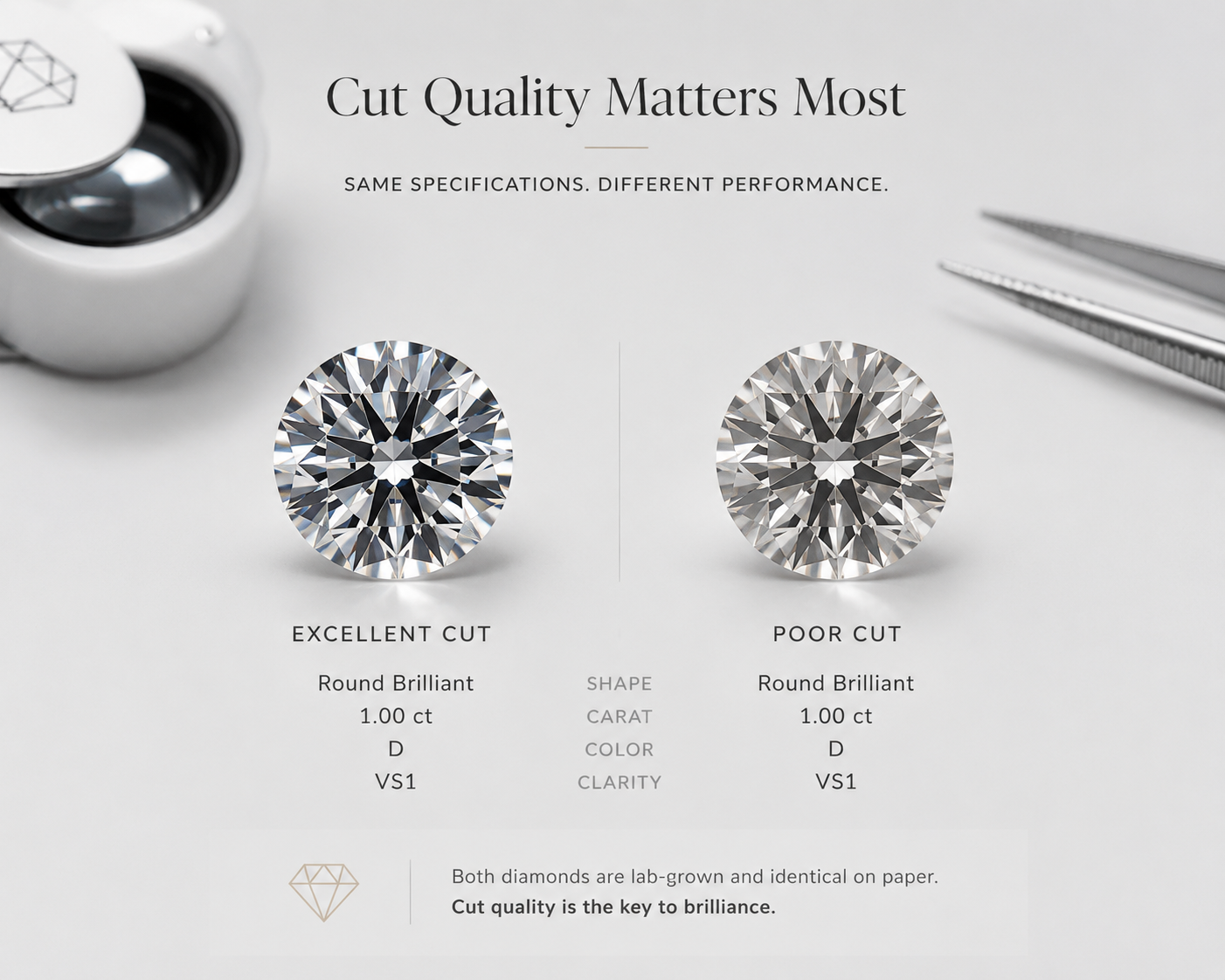
Visual performance — how bright, fiery, and brilliant a diamond appears — is determined primarily by cut quality, proportions, and symmetry, not by whether the stone grew under HPHT or CVD conditions. Cut governs how light travels through the diamond and returns to the viewer’s eye. A well-cut CVD diamond will outperform a poorly cut HPHT diamond every time, and the reverse is equally true.
Growth method tells you nothing about how the diamond was cut, polished, or proportioned. Two diamonds from the same growth method can look entirely different because one was cut with precision and the other was not. Buyers who prioritize growth method over cut quality are filtering by the wrong variable.
In practical buying scenarios, this distinction becomes critical. A buyer who narrows their search to HPHT-only stones may inadvertently exclude CVD diamonds with superior cut grades and visual performance. The opportunity cost of filtering by growth method is invisible until you compare stones side by side.
What Actually Determines Appearance
The factors that genuinely affect how a diamond looks are cut grade, proportions, polish, symmetry, fluorescence, and the specific characteristics of the individual stone. None of these can be reliably predicted from growth method alone. A CVD diamond with excellent cut, ideal proportions, and no fluorescence can look stunning. An HPHT diamond with good cut, deep proportions, and strong blue fluorescence can look dark or hazy.
Each diamond must be evaluated individually. The growth method label is not a shortcut for assessing visual quality, and it should never be treated as one.
Buyer Verification Checklist
Request actual photos, 360-degree video, and ideal scope or ASET images if available. Do not rely on growth method as a proxy for visual quality assessment. Check the certificate for cut grade, but remember that certificates do not capture everything — visual review matters. If a seller cannot provide images or video, consider whether you have enough information to evaluate the stone properly.
A grading report can narrow the comparison, but it should be read alongside the stone’s proportions, visual evidence, and intended jewelry use—not treated as the sole indicator of quality.
Myth #2: CVD Diamonds Always Have Visible Striations or Lines
Another common claim is that CVD diamonds universally show visible growth lines, striations, or “graining” that makes them inferior to HPHT stones. This oversimplification has led some buyers to dismiss CVD entirely, assuming that all CVD diamonds carry a visible defect. The reality is more complicated and far less alarming.
What Striations Actually Are
Striations, sometimes called grain lines, can occur in CVD diamonds because of the layer-by-layer growth process. As carbon deposits build up in the vacuum chamber, variations in growth conditions can create subtle internal features. In some CVD diamonds, these features are present. In many others, they are not.
Visibility is the key question. Striations that are visible to the naked eye are rare. Many CVD diamonds show no visible striations even under magnification, and those that do have internal features often have them at a level that only a trained grader with a microscope would notice. The presence of striations is not automatic, and their visibility is not guaranteed.
It is worth noting that grading reports already account for internal characteristics. If a diamond receives a clarity grade of VS1 or VVS2, the grader has already evaluated any striations present and determined they do not significantly impact the stone’s clarity. Buyers who reject CVD diamonds on the theoretical possibility of striations are ignoring the actual grading outcome in front of them.
When Striations Matter — and When They Do Not
Striations become relevant only when they affect clarity grade or visible appearance. If striations are significant enough to impact clarity, they will be reflected in the diamond’s grading report. A VS1 or VVS2 clarity grade already accounts for whatever internal characteristics are present, including graining.
If a diamond is graded as eye-clean and the clarity grade is acceptable, minor internal graining that does not affect face-up appearance is not a reason to reject the stone. Buyers should focus on what they can actually see, not on theoretical concerns about growth method.
HPHT Is Not Immune to Growth Characteristics
HPHT diamonds have their own characteristic internal features. Because HPHT uses metallic catalysts to facilitate growth, HPHT diamonds can contain metallic inclusions — small traces of the iron, nickel, or cobalt used in the press. These inclusions can sometimes be visible, and in certain cases, they can affect the diamond’s appearance or even its response to magnets.[2]
Neither growth method is universally cleaner or more included. Each has characteristic features that can appear, but neither guarantees them. The relevant question is whether the specific diamond in front of you has visible issues, not whether its growth method has a reputation for them.
What to Check Before You Decide
Review magnified photos or videos for any visible lines, inclusions, or graining. If the diamond is eye-clean and the clarity grade is acceptable, minor internal characteristics that do not affect face-up appearance are not a valid reason to reject an otherwise strong candidate. Do not filter out CVD diamonds based on a generalization about striations.
When a grading report is available, buyers should verify the report details through the issuing laboratory’s official report-check tool where available, and compare those details against the stone’s visual evidence and the seller’s description.
Myth #3: HPHT Diamonds Are Always More Expensive or Premium
Some buyers encounter pricing that suggests HPHT diamonds carry a premium, leading to the assumption that HPHT is inherently more valuable or higher quality. This belief is reinforced when sellers market HPHT as the “original” or “more natural” method, implying that the higher price reflects genuine superiority. The pricing story is more complicated.
Why Price Differences Exist — and What They Actually Reflect
Pricing differences between HPHT and CVD diamonds are driven by production costs, availability, market positioning, and seller strategy — not by inherent quality superiority. HPHT equipment is expensive to operate and maintain. The method requires high-pressure presses and significant energy input. In some markets, HPHT production volume is lower than CVD, which can create scarcity pricing.
None of this means HPHT diamonds are better. It means they can be more expensive to produce, and those costs are sometimes passed to buyers. A higher price tag reflects supply and production dynamics, not a guarantee of superior visual quality or durability.
Market Shifts Have Changed the Equation
CVD has become the dominant production method for many large growers. The method scales more efficiently for larger stones, and production capacity has expanded significantly. As supply has increased, CVD pricing has become highly competitive. In many cases, CVD diamonds now offer equal or better value for identical specifications.
Buyers comparing prices today are often seeing the result of market dynamics, not quality tiers. A price difference between HPHT and CVD diamonds with the same carat, cut, color, and clarity usually reflects production scale and seller positioning, not a meaningful difference in what you actually get.
For buyers evaluating specific stones, the question should be: does this diamond offer better value than alternatives with similar specifications? The growth method label does not answer that question. Two diamonds with identical 4Cs and comparable cut quality should be evaluated on price, visual documentation, and seller reliability—not on which growth chamber produced them.
Price Comparison Guidance: Prices can vary because of cut precision, lab grown diamond supply chains, report type, seller channel, size, shape, availability, and documentation. Buyers should compare like-for-like specifications before treating one stone as a better value. Growth method alone does not justify price differences when all other specifications are comparable.
When Paying More for a Specific Method Makes No Sense
If two diamonds have identical specifications — same carat weight, cut grade, color, clarity, and certificate — but different growth methods, paying a premium solely for the HPHT label is not justified by any objective quality difference. The buyer should compare the actual stones, not the method labels. If the HPHT diamond costs more and offers no measurable advantage in appearance or documentation, the premium is difficult to defend.
How to Verify This Before Buying
Compare diamonds with similar specifications across both growth methods. Ask sellers to explain any price premium tied to growth method. If the explanation is vague — “HPHT is just better” or “HPHT is more premium” — treat it with skepticism. If the explanation relates to specific stone qualities, such as exceptional cut or rare color, evaluate those claims on their merits. Do not assume that a higher price means a better diamond.
Myth #4: One Method Is Always “More Natural” or “More Real”
Both Methods Produce Real Diamonds
Some buyers encounter claims that HPHT diamonds are “more natural” because the process mimics the extreme heat and pressure found deep within the earth. The implication is that CVD diamonds, grown through a different process, are somehow less authentic or further removed from what a diamond “should” be.
This is misleading. Both HPHT and CVD produce diamonds that are chemically and physically identical to natural diamonds. They share the same carbon crystal structure, the same hardness, and the same optical properties. The Federal Trade Commission recognizes both as real diamonds, and major gemological laboratories grade them using the same standards applied to natural stones.[3]
Neither method produces a “fake” or “synthetic” diamond in the sense of an imitation like cubic zirconia or moissanite. The distinction between lab-grown and natural refers to origin, not material authenticity. Once formed, a lab-grown diamond is a diamond.
Clarification on Terminology: Diamond simulants such as cubic zirconia and moissanite are not the same as laboratory-grown diamonds. Simulants are materials that look similar to diamond but have different chemical compositions and physical properties. Laboratory-grown diamonds, whether HPHT or CVD, are genuine diamonds with the same chemical composition and crystal structure as natural diamonds. Buyers should verify that any stone described as “lab-grown diamond” is properly documented as such on its grading report.
Why “Closer to Natural Process” Is Misleading Marketing
It is true that HPHT more closely replicates the conditions under which natural diamonds form. High pressure and high temperature are indeed what the earth uses over millions of years. But this similarity in process does not translate into a difference in the final product’s legitimacy, quality, or value.
A diamond’s value to a buyer depends on its appearance, durability, documentation, and price — not on whether the formation process resembled geological conditions. The “closer to nature” argument is marketing framing, not a meaningful distinction that affects how the stone looks, wears, or performs.
If two diamonds are visually identical, equally well-cut, and identically certified, the fact that one was grown under pressure and the other through gas deposition does not make one more “real” than the other. Both are real. Both are diamonds. The difference in process is a technical detail, not a value hierarchy.
What Actually Matters for Authenticity Concerns
If your concern is owning a genuine diamond — a stone with diamond’s characteristic hardness, brilliance, and durability — then both HPHT and CVD satisfy that requirement. There is no authenticity advantage to either method.
If your concern is specifically natural origin — the idea that the diamond formed in the earth over geological time — then neither HPHT nor CVD applies. In that case, you should be considering natural diamonds, not debating between lab-grown methods. The meaningful choice is between natural and lab-grown, not between one lab method and another.
For buyers who value natural origin for sentimental or philosophical reasons, that preference is entirely valid. But the decision should be made consciously: natural diamond or lab-grown diamond. Once you have chosen lab-grown, the HPHT-versus-CVD distinction does not make one stone more authentic than the other.
What This Means in a Real Purchase
If a seller emphasizes that HPHT diamonds are “more natural,” “closer to earth-formed,” or “more real,” recognize this as positioning language. It does not reflect a difference you can see, measure, or experience in the stone itself. Both growth methods produce genuine diamonds. Your decision should rest on the specific stone’s cut, color, clarity, documentation, and value — not on a narrative about which process sounds more natural.
Myth #5: You Should Filter Your Search by Growth Method
Why Filtering by Method Limits Your Options Unnecessarily
Some buying guides and forum discussions suggest filtering specifically for HPHT or CVD when searching for lab-grown diamonds. The logic is that one method is inherently better, so you should exclude the other from your search entirely.
This approach excludes excellent stones for no valid reason. A buyer who filters for “HPHT only” might miss a CVD diamond with better cut, better color, or a lower price. A buyer who filters for “CVD only” might overlook an HPHT stone that is visually superior. The growth method label is not a reliable indicator of quality, so using it as a primary filter narrows your options without improving your outcome.
The right question is not “HPHT or CVD?” but “which specific diamond offers the best combination of cut, color, clarity, carat, certificate, and price for my needs?”
What Filters Actually Matter
When searching for a lab-grown diamond, the filters that genuinely affect appearance and value are:
- Carat range — determines size relative to your budget
- Cut grade — the primary driver of brilliance and visual performance
- Color grade — affects how white or warm the stone appears
- Clarity grade — relates to inclusions and eye-cleanliness
- Shape — determines overall silhouette and style
- Certification — ensures reliable, independent grading
- Budget — sets realistic boundaries for your search
These factors directly influence what you see and what you pay. Growth method does not. If you filter by method first, you may overlook better stones that happen to be grown the “wrong” way.
When Growth Method Information Is Useful
There are limited situations where growth method becomes relevant. If you have previously encountered visible striations in a CVD diamond and want to reduce the chance of that specific characteristic, you might lean toward HPHT. If you are working with a jeweler who has strong preferences based on their experience, you might consider their input.
But for most buyers, growth method should be a minor data point — something you notice on the certificate — not a primary search criterion. It is far more important to evaluate each diamond on its individual merits than to make decisions based on how it was grown.
In practical terms, the cost of filtering by growth method is invisible until you compare what you excluded. A buyer who narrows their search to one method may never realize that a better stone was available just outside their filter. The diamond market rewards open-minded comparison, not rigid pre-selection.
Buyer Verification Checklist
Set your search filters based on the 4Cs, shape, certification, and budget. Review actual photos, videos, and certificate details for stones that meet your criteria. Notice growth method if it appears, but do not treat it as a deciding factor unless you have a specific reason. Let the stone’s visual and documented qualities drive your decision, not the process label.
For custom design projects, trust comes from matching the stone to the setting, budget, and wearer’s daily use—not from choosing grades or growth methods in isolation. The right diamond fits the complete design, not just a specification sheet.
Myth #6: Sellers Always Disclose Growth Method Accurately
Disclosure Practices Vary
Buyers sometimes assume that if a growth method is important, sellers will always disclose it clearly and accurately. In practice, disclosure is inconsistent. Some sellers prominently feature HPHT or CVD in their listings. Others omit the information entirely. Some may default to one label without verifying, or misidentify the method based on assumption rather than testing.
The absence of growth method information does not indicate a problem with the diamond. It simply means the seller does not emphasize that detail. Conversely, a seller who highlights growth method is not necessarily providing more reliable information — they may be using it as a marketing angle rather than a verified fact.
Certificate Reliability
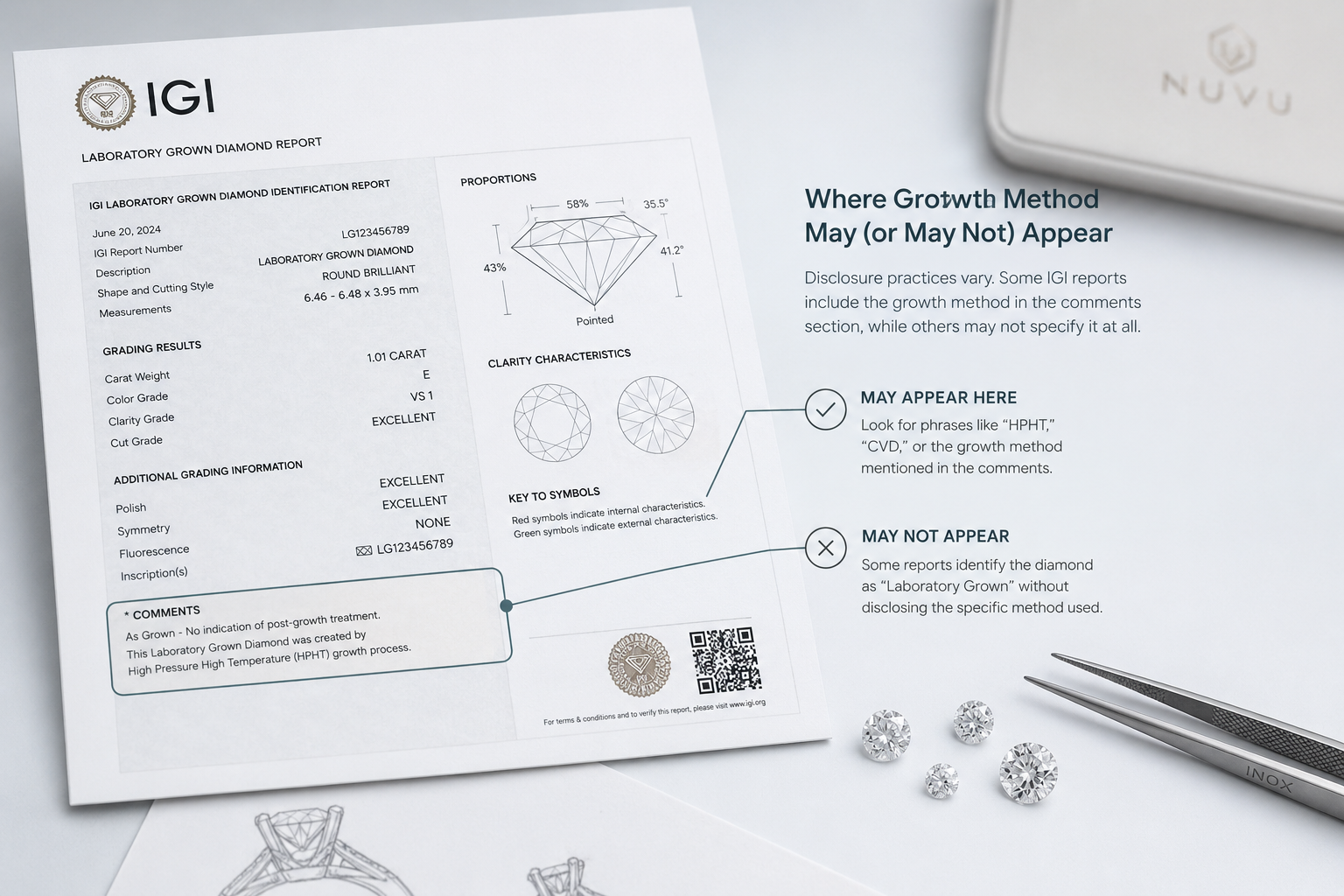
Major grading laboratories like IGI and GIA may list growth method on their reports when it can be determined, but practices vary. Some certificates explicitly state “HPHT” or “CVD.” Others simply identify the stone as laboratory-grown without specifying the method. A certificate that omits the method is not incomplete or suspicious — it reflects the laboratory’s standard reporting practice at the time.[4]
If growth method matters to you, the certificate is a useful reference but not a guarantee. The most reliable approach is to ask the seller directly and request written confirmation if the method is a deciding factor.
When a grading report is available, the report number, stone specifications, and issuing laboratory should be verified through the laboratory’s official channels. This confirms that the document matches the stone and that the grading information is accurately recorded.
Why This Matters Less Than You Might Think
For most buyers, the specific stone’s qualities matter far more than the growth method label. A well-cut, eye-clean, properly certified diamond is a good choice regardless of whether the certificate says HPHT, CVD, or nothing at all. The method label is a minor data point compared to cut, color, clarity, carat, and visual inspection.
If the certificate confirms that the diamond is lab-grown and provides accurate grading, the absence of a method label should not derail your decision. Focus on what you can verify: the stone’s appearance, its documentation, and the seller’s transparency about those factors.
For buyers who specifically want to know the growth method, the key is to ask before purchasing. A transparent seller will either provide the information or explain why it is not available. If the answer is vague or evasive, that tells you something about the seller’s communication style—regardless of the growth method itself.
What to Check Before You Decide
If growth method is important to you, ask the seller directly before purchasing. Request confirmation in writing, and verify that it matches what appears on the certificate if the method is listed. If the certificate does not specify the method and the seller cannot confirm, decide whether that uncertainty is acceptable given the stone’s other qualities. In most cases, the method label should not override factors like cut, visual performance, and value.
Myth #7: One Method Is Always More Sustainable or Ethical
Some sellers market HPHT or CVD as the “greener” choice, implying that one growth method is inherently more environmentally responsible. This is misleading. Sustainability in lab-grown diamonds depends on how each facility operates, not which method it uses.
Why Sustainability Claims Are Complicated
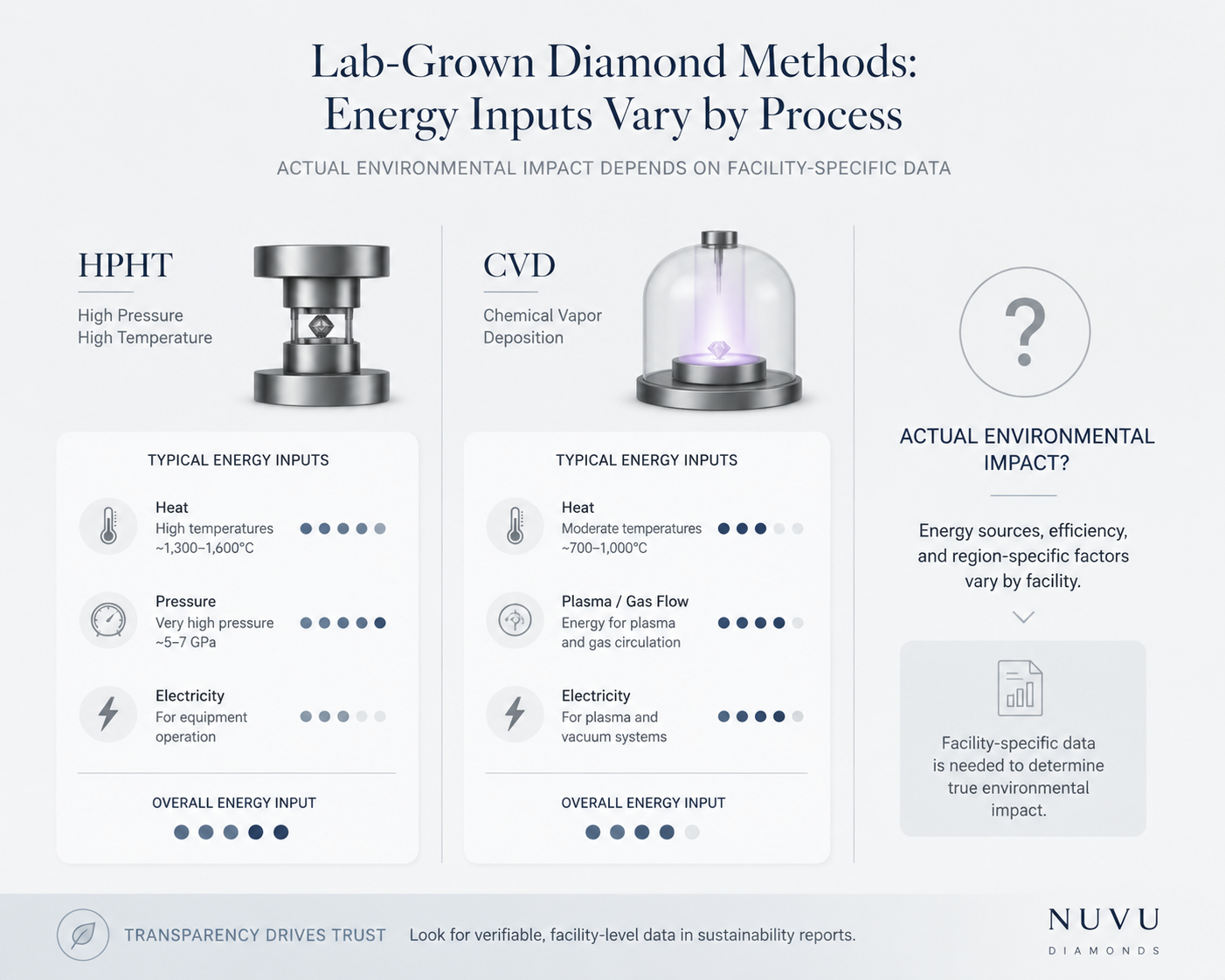
Both HPHT and CVD require substantial energy input. HPHT uses enormous pressure and high temperature to replicate the conditions deep within the earth. CVD uses vacuum chambers and carbon-rich gases to grow diamonds layer by layer. Neither process is automatically low-impact. The real environmental cost depends on where the facility sources its electricity, how efficiently it runs, and how it manages waste and emissions.
A CVD facility powered entirely by renewable energy may have a lower carbon footprint than an HPHT facility running on a coal-heavy grid. The reverse is equally possible. The method name tells you nothing about the energy mix or operational efficiency behind it.
Environmental impact in lab-grown diamond production is facility-specific, not method-specific. A manufacturer using solar or hydroelectric power will have a different footprint than one relying on fossil fuels—regardless of whether they use HPHT or CVD equipment. Buyers who care about sustainability need facility-level data, not method-level generalizations.
Environmental Claims Caution: Environmental and sustainability claims should be specific, documented, and limited to what can be substantiated. Generic statements like “eco-friendly” or “sustainable” without supporting evidence do not provide buyers with actionable information. Buyers seeking environmentally responsible options should request specific documentation about energy sources, production practices, and third-party certifications rather than relying on growth method as a proxy for environmental impact.
What Buyers Can Actually Verify
Meaningful sustainability claims require facility-specific data: energy source, production efficiency, water use, waste handling, and labor practices. A seller claiming “CVD is more sustainable” or “HPHT uses less energy” without providing third-party verification or facility-level data is making an assertion, not offering proof.
Sustainability claims should be specific and documented. Broad green language is less useful than clear information about production, energy, sourcing, and seller transparency. Buyers who prioritize environmental responsibility should ask for facility-level information and third-party certifications rather than accepting growth method as a proxy for sustainability.
When Sustainability Claims Are Marketing Noise
If a seller emphasizes growth method as a sustainability selling point, as detailed in HPHT vs CVD lab grown diamonds, but cannot point to facility certifications, energy audits, or supply-chain documentation, the claim is marketing framing. This does not mean the diamond is unethical or environmentally harmful. It means the seller has not provided evidence to support the claim.
Buyers who care about sustainability should ask for specifics: Is the facility powered by renewable energy? Does the producer have third-party environmental certifications? Can the seller provide any documentation about labor practices or emissions? If the answer is vague, the claim is not actionable.
The Federal Trade Commission has provided guidance cautioning against broad, unqualified environmental claims for jewelry products. Sellers making sustainability assertions should be prepared to substantiate those claims with specific, verifiable evidence rather than relying on general statements about production methods.[5]
How to Verify This Before Buying
If sustainability matters to you, ask sellers direct questions about facility practices and third-party certifications. Do not accept growth method as a proxy for environmental responsibility. The lab-grown diamond industry’s sustainability infrastructure is still evolving, and meaningful verification remains limited. A seller who admits uncertainty is more trustworthy than one who makes confident claims without evidence.
What Actually Matters When Comparing Lab-Grown Diamonds
After stripping away the myths, what should buyers focus on? Growth method is far less important than the specific qualities of the diamond in front of you. The following factors drive appearance, value, and satisfaction.
Cut Quality and Visual Performance
Cut is the single most important factor in how a diamond looks. A well-cut diamond reflects light effectively, showing brilliance, fire, and scintillation. A poorly cut diamond — regardless of growth method — appears dull, dark, or lifeless.
Prioritize excellent or ideal cut grades, but do not stop there. Review actual images and 360-degree videos when available. Certificates provide a grade, but they do not show how the diamond performs in real lighting. A diamond with strong visual performance will outperform a higher-graded stone with poor proportions.
Color and Clarity Relative to Your Preferences and Budget
Color sensitivity varies. Some buyers prefer the icy look of colorless diamonds (D–F), while others find near-colorless (G–J) indistinguishable once the stone is set. A lower color grade is not a flaw if it suits your preference and budget.
Clarity should be evaluated based on eye-cleanliness, not just the grade on paper. A VS2 diamond with visible inclusions may be a worse choice than an SI1 that is eye-clean. Magnified photos and videos help you assess what you will actually see.
Certificate and Documentation
A reputable grading report from IGI, GIA, or an equivalent laboratory confirms that the diamond is lab-grown and provides accurate specifications for carat, cut, color, and clarity. The certificate should match the stone and the seller’s description.
Documentation matters more than growth method. A diamond with clear, verifiable paperwork gives you confidence in what you are buying. A diamond without proper documentation — regardless of how it was grown — is a risk.
About Grading Reports: A grading report can document key characteristics, but it should be read alongside visual evidence, measurements, seller documentation, and the intended jewelry use. A grading report does not guarantee beauty, value, ethical sourcing, or investment potential. It provides verified information about the stone’s measured characteristics, which is valuable but incomplete without additional context.
Seller Reputation, Policies, and Transparency
The seller’s return policy, customer service, image and video availability, and willingness to answer questions matter more than whether the diamond is HPHT or CVD. A transparent seller who provides detailed information, high-quality visuals, and a reasonable return period is more valuable than a seller who markets based on growth method alone.
Before purchase, buyers should confirm the seller’s documentation, return policy, resizing terms, and after-sales support in writing. Clear communication about these practical matters is often more indicative of a reliable transaction than marketing claims about growth methods.
Total Value, Not Just Price
Price is only one component of value. Consider the full picture: carat, cut, color, clarity, certificate quality, setting craftsmanship, and service. A lower price is not a better deal if it comes with poor documentation, no return option, or inadequate visual information.
Growth method does not belong on this list as a primary factor. It may be interesting to know, but it should not drive your decision.
The buyers who get the best results are those who compare specific stones rather than filtering by categories. A diamond that looks beautiful, fits your budget, and comes with reliable documentation is a good choice—whether it grew through HPHT or CVD. The labels matter far less than the diamond itself.
What to Check Before You Decide
Build a personal checklist and evaluate each diamond against it:
- Cut grade (prioritize excellent or ideal)
- Color preference (based on your sensitivity and budget)
- Clarity and eye-cleanliness (review images, not just the grade)
- Certificate from a reputable laboratory
- High-quality photos and 360-degree video
- Seller return policy and responsiveness
- Total cost relative to the above factors
Add growth method to this checklist only if you have a specific reason to care. For most buyers, it will not change the outcome.
You are browsing lab-grown diamonds, and the claims start piling up. One seller insists HPHT is superior because it mimics nature. Another swears by CVD for its cleaner results. A forum post warns you to avoid CVD because of visible lines. A YouTube video claims one method is “more real.” By the time you have read through conflicting advice, you may wonder whether growth method should matter at all.
This article is designed to cut through the noise. The goal is not to convince you that HPHT is better or that CVD is better. The goal is to help you understand which claims deserve skepticism, which factors actually affect quality and value, and when you can safely ignore growth method entirely. By the end, you should have a clearer framework for evaluating lab-grown diamonds on their own merits — not on marketing labels.
Frequently Asked Questions
Should I choose HPHT or CVD for an engagement ring?
For most buyers, the choice between HPHT and CVD should not be a primary factor. What matters more is the specific diamond’s cut quality, visual performance, color, clarity, and overall value. A well-cut CVD diamond will look better than a poorly cut HPHT diamond, and vice versa. If you have no specific reason to prefer one method, evaluate each diamond individually rather than filtering by growth method.
Do CVD diamonds always have visible lines?
No. While CVD diamonds can show striations or grain lines related to their layer-by-layer growth process, many CVD diamonds show no visible lines to the naked eye or even under magnification. If striations are significant enough to affect appearance, they should be reflected in the clarity grade or visible in magnified photos. Do not assume all CVD diamonds have visible growth lines.
Is HPHT more expensive than CVD?
Not necessarily. Pricing depends on production costs, availability, market positioning, and seller strategy — not inherent quality superiority. In some markets, HPHT may command a premium due to lower production volume, but this reflects supply dynamics, not objective quality differences. Two diamonds with identical specifications but different growth methods should be priced similarly. If one carries a significant premium solely for the method label, question whether that premium is justified.
Does growth method affect diamond quality?
Growth method alone does not determine quality. Both HPHT and CVD can produce excellent diamonds and both can produce lower-quality stones. Quality depends on how well the growth process was controlled, the specific characteristics of each stone, and how it was cut and finished. Cut grade, color, clarity, and visual performance matter far more than which method was used to grow the rough material.
How can I tell if a diamond is HPHT or CVD?
In most cases, you cannot tell by looking at the diamond. Growth method is identified through laboratory testing that analyzes internal characteristics. Some grading reports list the growth method, but not all certificates include this information. If knowing the method matters to you, ask the seller directly and request confirmation in writing or check if the certificate specifies it.
Does the certificate always list the growth method?
No. Disclosure practices vary among laboratories and sellers. Some IGI and GIA reports list growth method when it can be determined, but others do not. The absence of growth method on a certificate does not indicate a problem with the diamond. If this information is important to you, ask the seller before purchasing.
Is one growth method more sustainable?
Neither method is automatically more environmentally friendly. Both HPHT and CVD require significant energy, and the environmental impact depends on the specific facility’s energy sources, efficiency, and practices — not the method category. Generic claims that one method is “greener” are rarely backed by facility-specific data. If sustainability is a priority, ask sellers for specific documentation rather than relying on growth method as a proxy.
Can I request a specific growth method when ordering?
Some sellers may accommodate requests for HPHT or CVD, especially for custom orders or larger purchases. However, this may limit your options, increase cost, or extend wait times. Before requesting a specific method, consider whether your preference is based on verified differences that matter for your specific stone, or on generalizations that may not apply. In many cases, you will find better value and a wider selection by focusing on the diamond’s actual qualities rather than its growth method.
Next Steps
By now, it should be clear that growth method is rarely the most important factor in choosing a lab-grown diamond. The myths surrounding HPHT and CVD have created unnecessary confusion for buyers who simply want a beautiful stone at a fair price.
What actually drives visual performance and value is cut quality, proportions, color, clarity, and how the specific diamond looks in real life — not the label on a certificate. A well-cut, well-documented diamond will outperform a poorly chosen one regardless of whether it grew under high pressure or through vapor deposition.
If you are ready to compare specific diamonds, focus on what matters: cut grade, visual documentation, certificate accuracy, and total value. Browse our lab-grown diamond selection with full images, videos, and certification details for every stone. Filter by the qualities that actually affect appearance and value — not by growth method.
If you are still building your understanding, continue with our guides on cut quality and visual performance, how to read a diamond certificate, or our lab-grown diamond buying guide. These resources will help you evaluate diamonds based on verifiable qualities rather than marketing claims.
For readers still deciding between lab-grown and natural diamonds, our comparison guide walks through the tradeoffs without the hype.
The right diamond is the one that meets your standards for beauty, documentation, and value — regardless of how it was grown.
[1] GIA, “Lab-Grown Diamonds,” Gemological Institute of America, explaining HPHT and CVD growth processes and their application in creating gem-quality diamonds.
[2] GIA, “Lab-Grown Diamonds: HPHT and CVD Growth Methods,” Gemological Institute of America, describing characteristic inclusions and internal features associated with each production method.
[3] Federal Trade Commission, “Guides for the Jewelry, Precious Metals, and Pewter Industries,” 16 CFR Part 23, addressing terminology and disclosure requirements for laboratory-created diamonds.
[4] GIA, “How to Read a GIA Grading Report,” Gemological Institute of America, outlining the information typically included on diamond grading reports and disclosure practices.
[5] Federal Trade Commission, “Environmental Marketing Claims,” FTC Guides, cautioning that broad unqualified environmental claims should be substantiated with specific evidence.
Disclosure: This article is for general educational purposes only. Diamond grading, pricing, availability, specifications, and seller policies can change, and readers should verify important details through grading reports, official laboratory tools, seller documentation, or qualified professionals before making a purchase decision. Laboratory-grown diamonds should be clearly distinguished from natural diamonds, and environmental or sourcing claims should be supported by specific documentation.