 Get a Quote
 Loose lab-grown diamonds10 shapes · IGI, GIA or NGTC reports
Custom Lab-Grown Diamond Jewelry Guide: From Stone Selection to Final Design
- The seven stages at a glance
- 1. When custom is worth it
- 2. Write the brief in numbers
- 3. Choose the stone, then finish the design
- 4. Set the budget before the metal
- 5. Approve the CAD by its measurements
- 6. Resin model or sample
- 7. Production and the final check
- Metal stamps and rules worth knowing
- Who is responsible for what
- Custom work for brands and retailers
- Lab-grown or natural for custom work
- Custom jewelry questions
- Start a custom piece with your brief
A buyer approves a CAD for an oval solitaire drawn around an 8.0 × 6.0 mm stone. A week later they choose a different oval: 8.9 × 6.2 mm, longer and with a different outline. The prongs in the approved model now land in the wrong places, the head sits at the wrong height, and the CAD has to be drawn again. Nothing went wrong with the design. The order of decisions did.
That is the main lesson of custom work. A custom lab-grown diamond piece moves through seven stages, and the stone has to be fixed before the design is final, because its length, width and depth decide where every prong goes. Most of the problems people blame on the workshop start earlier, in a brief that uses words instead of measurements or an approval given on a render alone.
The seven stages at a glance
- 1. DecideWhat happens: Custom or ready-madeWhat you sign off: Nothing yetWhat usually goes wrong: Paying for custom when a stock design already fits
- 2. BriefWhat happens: Piece, wearer, stone, metal, budget, referencesWhat you sign off: The briefWhat usually goes wrong: “Delicate” or “low” with no numbers
- 3. StoneWhat happens: A specific stone with a grading reportWhat you sign off: The stoneWhat usually goes wrong: Designing around a stone nobody has chosen
- 4. CADWhat happens: A 3D model built to that stoneWhat you sign off: A numbered CAD versionWhat usually goes wrong: Approving a render without the measurements
- 5. Model (optional)What happens: Resin or wax print, or a metal sampleWhat you sign off: The modelWhat usually goes wrong: Skipping it on a complex or repeat design
- 6. ProductionWhat happens: Casting, setting, polishingWhat you sign off: Only changesWhat usually goes wrong: Changes made without a new CAD
- 7. Check and deliveryWhat happens: Inspection, documents, shippingWhat you sign off: AcceptanceWhat usually goes wrong: Accepting before checking prongs, size and stone identity
1. When custom is worth it
Custom is worth the extra steps when:
- You want a stone shape, size or length-to-width ratio that stock rings are not made for.
- The design does not exist, or a stock design needs substantial changes to fit the wearer.
- You are a brand or retailer building your own collection.
- You want to decide how the money is split between stone, metal and work.
A ready-made ring is the better choice when a stock design already fits, the date is close, or the piece is mostly small pavé stones on a standard mount. A semi-mount (a finished setting that takes your center stone) sits between the two. See custom vs ready-made engagement rings.
2. Write the brief in numbers
A designer can only build what can be measured. Compare two briefs for the same ring:
Swipe the table to see more →
| Vague brief | Workable brief |
|---|---|
| “A delicate oval ring” | Oval, 8.5–9.0 mm long, ratio 1.35–1.45, G–H, VS2 or better, IGI report |
| “Thin band” | Band 1.8–2.0 mm wide at the base |
| “Sits low” | Top of stone no more than about 6 mm above the finger |
| “Like the photo” | Photo 1: prong shape. Photo 2: side profile. Ignore the halo in photo 2 |
| “Gold” | 18K yellow band, 18K white head |
| “Normal size” | US 6, worn next to a 2 mm straight wedding band |
Also note how the piece will be worn (daily, at work with the hands, occasionally), the total budget and how flexible it is, and the date it is needed. For earrings and pendants, give the drop length and the chain or back type. Reference photos are useful for one or two specific features each, not as a whole design to copy, because a photo hides scale. See custom jewelry mistakes.
3. Choose the stone, then finish the design
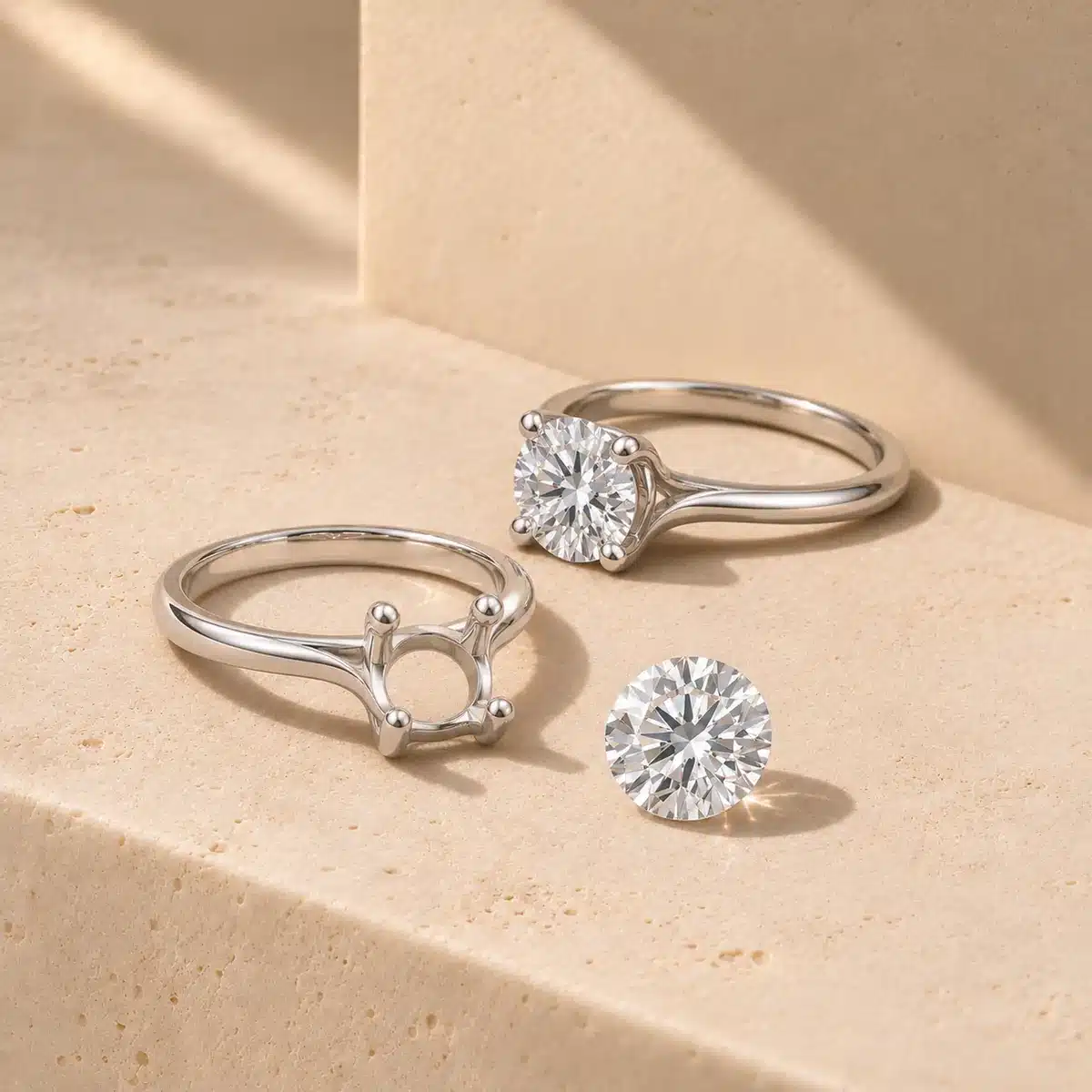
The order that avoids redrawing is: setting style first (prongs, bezel, halo), then the stone, then the final CAD built to that stone’s measurements.
Choose the center stone from its grading report and video. Look the report number up on the laboratory’s own website and give the designer the measurements as printed, not the carat weight. Two 1.50 ct ovals can differ by more than half a millimeter in length, and that changes the head. For how shape, setting and metal work together, see the ring design guide.
Two report points are worth checking before the stone goes to the bench:
- Which laboratory and which kind of result. IGI and NGTC give full color and clarity grades. GIA has given lab-grown diamonds a Premium or Standard assessment instead of letter grades since October 1, 2025. See IGI vs GIA.
- Growth method and treatment. If the piece will be sold as as-grown, the report has to say so. On IGI reports that is the comment “As Grown – No indication of post-growth treatment”. See how to read a report.
4. Set the budget before the metal
A custom quote has five parts: the center stone, the metal, design and labor, side stones, and finishing, reports and shipping. Because a lab-grown center stone costs far less than a mined one of the same size, metal and workmanship become a larger share of the total than buyers expect. Protect cut quality and the strength of the setting first, then spend what is left on size, side stones or a higher karat. See the budget guide.
5. Approve the CAD by its measurements
The piece is printed and cast from the CAD, so anything wrong in it ends up in the metal. A render shows how the piece might look in perfect light. The technical views, top, side and front with dimensions, show what will be built. Check:
- The stone outline against the report’s length and width.
- The height from the finger to the top of the stone.
- Band width at the top and base, and thickness at the thinnest point.
- Prong number, size and position, especially on points and corners.
- The gallery, and whether a straight wedding band sits flush.
- Ring size, metal and karat for each part.
Approve a numbered version, and note the ring size, metal and key measurements with the approval. Any later change to the stone, metal, size, band or setting height means a new version and a new approval. See what to check in a CAD.
6. Resin model or sample
A resin or wax print lets you see the real scale on the hand before metal is cast. It pays off for complex designs, large or unusual stones, unusual ring sizes, and anything a brand will reproduce. For a plain solitaire with clear measurements, many buyers go straight to casting.
7. Production and the final check
Production is casting, cleaning, setting the stones and polishing. The checkpoints that protect the buyer most are a photo or video of the stone with its report before setting, and photos of the finished piece from the top, the side and under the gallery. Read and photograph the girdle inscription before setting, because prongs can cover it.
On delivery, check that the stone matches its report, that every prong is tight and smooth, that the size and finish are right, and that the documents describe the stone as laboratory-grown. See the quality check guide.
Metal stamps and rules worth knowing
Swipe the table to see more →
| Stamp | What it means | Where the rule comes from |
|---|---|---|
| 14K / 585 | 58.3% gold | Karat definition; US FTC Guides require the karat next to the word gold |
| 18K / 750 | 75% gold | Same |
| Pt950 / 950Plat | At least 950 parts per thousand platinum | FTC: “Platinum” alone needs 950 |
| 925 / Sterling | At least 925 parts per thousand silver | FTC |
US stamping tolerances are 3 parts per thousand for gold items without solder and 7 for items with solder. In the EU, pieces in prolonged contact with the skin must release no more than 0.5 µg of nickel per cm² per week, and earring posts no more than 0.2, which is worth checking for white gold alloys. Brands selling in the UK also need to follow hallmarking law.
Who is responsible for what
Most disputes in custom work are about who decided what. Settle these at the start:
Swipe the table to see more →
| Item | Usually decided by | Record |
|---|---|---|
| Stone choice | Buyer | Report number on the order |
| Design and CAD | Designer, approved by buyer | Approved version number |
| Measurements and ring size | Buyer | On the approved CAD |
| Delivery date | Both | On the order, counted from CAD approval |
| A finished piece that differs from the CAD | Both | What counts as a difference, and the remedy |
| Design ownership (brands) | Both | Who owns it, and whether the maker may sell it to others |
Custom work for brands and retailers
A brand building a collection goes through the same stages with a few more records:
- A specification sheet per SKU: stone sizes and quality ranges, metal and weight range, finish, stamps.
- A physical sample as the production reference, not the render.
- A size range, and how resizing and special sizes are handled.
- Repeatability: keep the approved CAD and sample, and agree how reorders are checked against them.
- Design ownership, agreed before production.
See private label and OEM and the OEM sampling process.
Lab-grown or natural for custom work
For the same budget, lab-grown diamonds allow a larger center stone, unusual shapes and multi-stone layouts, and matched pairs are easier to source. Natural stones suit buyers for whom mined origin is the point. Either way, the description on the invoice and tag has to name the stone correctly. See lab-grown vs natural for custom jewelry.
Custom jewelry questions
How long does a custom piece take?
It depends on the design, whether the stone is in stock, and how quickly each approval comes back. Approvals are often the slowest step, so count delivery from CAD approval.
Can I change the stone or metal after approving the CAD?
Before casting, usually yes, with a new CAD version. It can change the price and the date.
Should I choose the setting or the stone first?
The setting style first, then the stone, then the final CAD built to the stone.
Can a brand reorder the same design later?
Yes, if the approved CAD, the sample and the specification sheet are kept and the reorder is checked against them.
Start a custom piece with your brief
Send the piece type, the wearer’s size, the stone you have in mind or its report number, the metal, the setting style, two or three references with a note on each, your budget and your date. Design ownership is agreed with you before work starts. NUVU can arrange IGI, GIA or NGTC reports for the center stone. Start your custom design or message us on WhatsApp / WeChat at +86 19118403930.
Sources

11+ years supporting global clients with lab-grown diamond product consultation and market analysis.
About NUVU. NUVU is the international brand of New Perspective Superhard Materials Co., Ltd. in Zhecheng, Henan, China. We grow HPHT lab-grown diamonds in-house and cut, polish and match stones in our own workshop.
Related Guides
Custom process
How a custom lab-grown diamond piece is made: brief, stone selection, CAD approval, casting and setting, final QC…
Read more →CustomSetting styles
Solitaire, halo, hidden halo, three-stone and vintage settings compared: look, stone protection, height, wedding…
Read more →CustomCustom gallery
Custom lab-grown diamond ring ideas by shape, setting and metal: solitaire, hidden halo, halo, three-stone and vintage.
Read more →