- Shop
Diamonds & Jewelry
Loose Lab Diamonds Yellow Lab Diamonds Pink Lab Diamonds Blue Lab Diamonds Engagement Rings Fine Jewelry Shop All Loose lab-grown diamonds10 shapes · IGI, GIA or NGTC reports
- Wholesale
- Custom Design
- Education
- About
Lab-Grown Diamond Shapes Guide: How Shape Changes Price, Visual Size, and Everyday Wear
- All shapes at a glance
- How shape changes visual size
- How shape changes price
- How the 4Cs change by shape
- Shape and everyday wear
- Shape and setting
- How to choose a shape
- For jewelry brands and retailers
- Shape guides
- Shapes by jewelry type
- What reports say about shape
- How to compare shapes on video
- Common shape-buying mistakes
- Matching fancy shapes in quantity
- Shape questions
- Compare shapes for your design
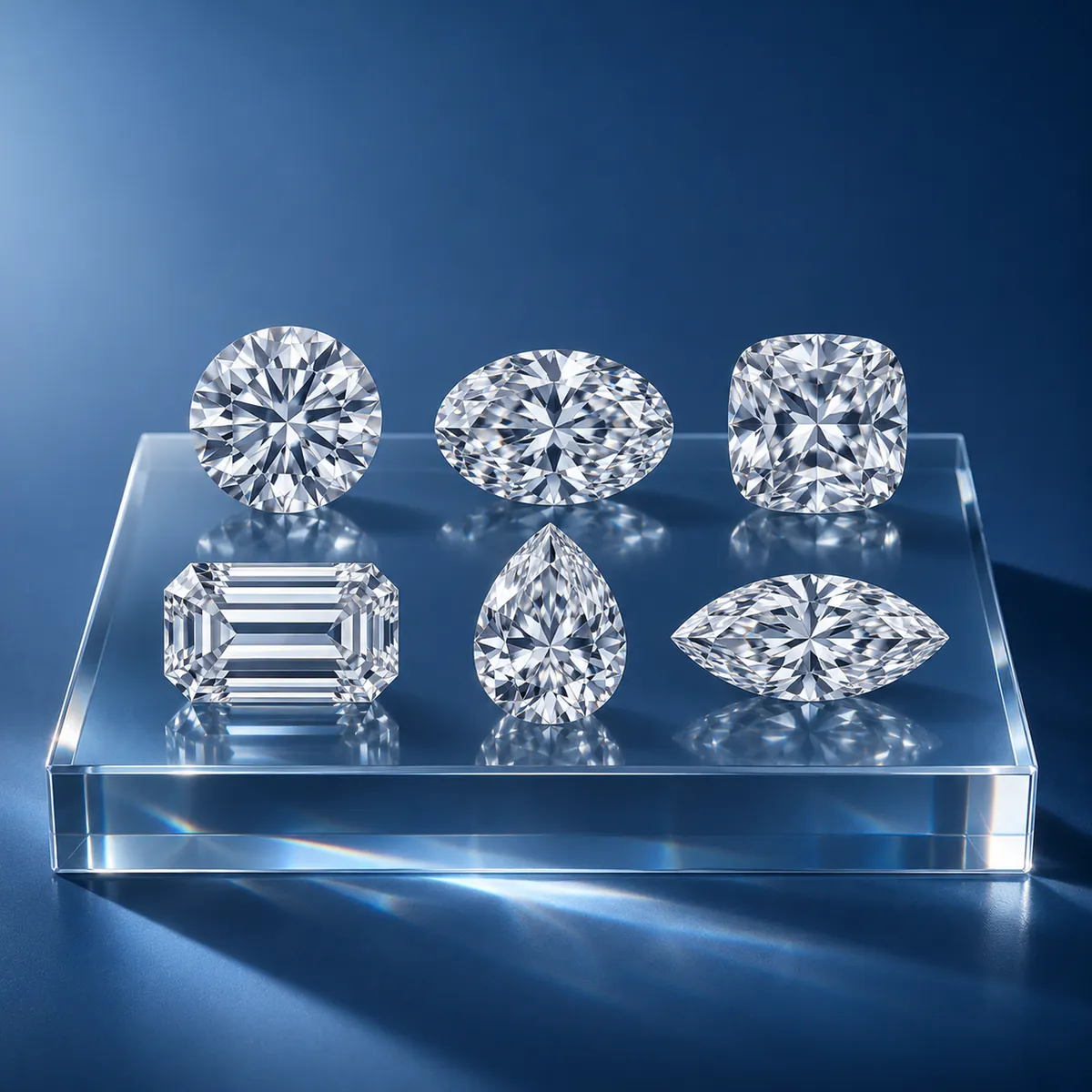
Lay out ten lab-grown diamonds that each weigh exactly 1.00 ct. The marquise measures about 10 × 5 mm and covers the most finger. The round is about 6.4 mm across. The princess and the Asscher are about 5.5 mm square and look smallest of all. Same weight, same price class, very different stones on the hand, and that is before color, clarity and durability come into it.
Shape changes more than style. It changes how large a stone looks for its weight, how much it costs per carat, how much color and inclusions show, how durable the corners are and how the 4Cs should be weighed. Round brilliants give the most sparkle and the most reliable cut grades; in lab-grown they no longer cost much more per carat than other shapes. Elongated shapes such as oval, pear and marquise look larger for the weight. Step cuts such as emerald and Asscher need higher clarity. Choose the shape first, then apply the right checks for that shape.
All shapes at a glance
Swipe the table to see more →
| Shape | Look | Face-up size per carat | Typical ratio | Color | Hides inclusions | Main check | Corners/points |
|---|---|---|---|---|---|---|---|
| Round | Maximum sparkle | Baseline | 1.00 | Hides it best | Best | Cut grade | None |
| Oval | Elongated, soft | Larger | 1.30–1.50 | Tips may show color | Well | Bow-tie, ratio | None |
| Emerald | Step cut, elegant | Similar | 1.30–1.50 | Shows more | Least | Clarity, step symmetry | Cut corners |
| Radiant | Brilliant rectangle or square | Similar to slightly smaller | 1.00–1.40 | Corners may show color | Well | Depth, pattern | Cut corners |
| Cushion | Soft, vintage | Often smaller | 1.00–1.25 | Corners may show color | Well | Depth, pattern | Rounded |
| Pear | Teardrop | Larger | 1.45–1.75 | Point may show color | Well | Symmetry, bow-tie | Point |
| Marquise | Long, dramatic | Largest | 1.75–2.25 | Points may show color | Well | Symmetry, bow-tie | Two points |
| Princess | Square brilliant | Smaller | 1.00–1.05 | Well | Well | Corners | Sharp corners |
| Asscher | Square step cut | Smaller | 1.00–1.05 | Less | Least | Clarity, windmill pattern | Cut corners |
| Heart | Symbolic | Similar | 0.90–1.10 | Fairly well | Well | Symmetry, cleft | Point |
Ratios are common ranges, not rules. Personal preference decides.
How shape changes visual size
Carat is weight; what people see is the face-up outline. Approximate face-up measurements for a well-proportioned 1.00 ct stone:
Swipe the table to see more →
| Shape | Approx. measurements |
|---|---|
| Round | 6.4 mm |
| Oval | 7.7 × 5.7 mm |
| Emerald | 7.0 × 5.0 mm |
| Radiant (elongated) | 6.8 × 5.2 mm |
| Cushion (square) | 5.6 × 5.6 mm |
| Pear | 8.5 × 5.5 mm |
| Marquise | 10.0 × 5.0 mm |
| Princess | 5.5 × 5.5 mm |
| Asscher | 5.5 × 5.5 mm |
| Heart | 6.2 × 6.6 mm |
Actual stones vary with depth and cutting. Compare the measurements on the report rather than the carat weight. A deep stone hides weight below the girdle and faces up smaller.
How shape changes price
In natural diamonds, round brilliants cost the most per carat, because cutting a round loses more of the rough and demand is highest. In lab-grown diamonds that premium has almost disappeared: in October 2026 the average asking price for a 1 ct lab-grown round ($517) was about the same as for an oval ($522) or a pear ($536). Choose the shape for its look and face-up size, not for a discount. See the shape price comparison.
How the 4Cs change by shape
Cut
Most labs give an overall cut grade only for round brilliants. For fancy shapes you judge cut from proportions, symmetry, polish, ratio and video. Watch for:
- Bow-tie in ovals, pears and marquises: a dark band across the center. Some is normal; a strong one is not.
- Windowing in emeralds, Asschers and shallow ovals: a washed-out area in the center where light passes through.
- Extinction in deep stones: dark areas that don’t return light.
Color
Round brilliants hide color best. Elongated shapes gather color at the tips, cushions and radiants hold it in the corners, and step cuts (emerald, Asscher) show it most. In yellow or rose gold, slightly warmer stones look white; GIA notes that J–K can look acceptable there, while H or better looks colorless in white metal.
Swipe the table to see more →
| Shape group | Color that often looks white in white metal |
|---|---|
| Round, oval | G–H |
| Cushion, radiant | G–H, or one grade higher for large stones |
| Pear, marquise | F–H (points concentrate color) |
| Emerald, Asscher | F–G |
Clarity
Brilliant cuts hide inclusions with their sparkle. Step cuts have open, glassy facets that show inclusions clearly.
Swipe the table to see more →
| Shape group | Clarity that is often eye-clean |
|---|---|
| Round, oval, radiant, cushion, pear, marquise, princess, heart | VS2–SI1 (check video) |
| Emerald, Asscher | VS1 or better |
Carat
Elongated shapes look larger for the weight. Price jumps at round numbers (1.00, 1.50, 2.00 ct) for all shapes.
Shape and everyday wear
All diamonds are hard, but corners and points are where chips happen. Protect them:
- Pear and heart points: V-prong.
- Marquise points: V-prongs at both ends.
- Princess corners: V-prongs or a bezel.
- Emerald, Asscher and radiant have cut corners, which helps, but still benefit from claw prongs.
Round, oval and cushion have no points and are the easiest to wear.
Shape and setting
Swipe the table to see more →
| Shape | Settings that flatter it |
|---|---|
| Round | Any |
| Oval | Solitaire, hidden halo, east-west, three-stone with pears |
| Emerald | Claw prongs, three-stone with baguettes, bezel |
| Radiant | Solitaire, halo, three-stone with trapezoids |
| Cushion | Halo, vintage, solitaire |
| Pear | Halo following outline, V-prong solitaire |
| Marquise | East-west, V-prong solitaire, vintage |
| Princess | Bezel, V-prong solitaire, channel bands |
| Asscher | Art Deco halo, bezel |
| Heart | Pendants, V-prong solitaire |
How to choose a shape
- Look at photos and video of each shape on a hand or in the type of jewelry.
- Decide what comes first: sparkle (round), size (oval, pear, marquise), elegance (emerald), softness (cushion), modern edge (princess, radiant).
- Apply that shape’s checks: ratio, bow-tie, windowing, clarity for step cuts.
- Compare measurements, not carat weight alone.
- Look the report up and watch video of the stone.
For jewelry brands and retailers
For multi-stone designs and retail programs, shape affects sourcing: rounds and ovals are easiest to match in quantity; fancy shapes need agreed ratio tolerances on the order. See bulk loose stones.
Shape guides
Round · Oval · Emerald · Radiant · Cushion · Pear · Marquise · Princess · Asscher · Heart
Shapes by jewelry type
Swipe the table to see more →
| Jewelry | Shapes that work especially well | Why |
|---|---|---|
| Engagement rings | Round, oval, emerald, cushion, radiant, pear | Classic or elongated centers |
| Stud earrings | Round, princess, cushion, oval, heart | Easy to match in pairs |
| Pendants | Pear, round, oval, heart | Hang naturally; seen from a distance |
| Tennis bracelets and eternity bands | Round, princess, emerald, oval | Calibrated sizes sit in a line |
| Vintage and cluster designs | Marquise, pear, old-style cushions | Decorative outlines |
| Three-stone side stones | Pear, trapezoid, baguette, round | Frame the center |
What reports say about shape
Reports list the shape and cutting style (for example “cushion modified brilliant” or “emerald step cut”) and the measurements. GIA gives an overall cut grade to round brilliants only (fancy-shape grades are planned for 2027); IGI can also grade loose fancy shapes. On every report, polish and symmetry are graded and proportions are listed. Since October 2025, GIA lab-grown reports use a Premium or Standard category instead of full color and clarity grades, with cut required only for rounds. IGI lab-grown reports give full grades.
How to compare shapes on video
- Watch each stone face-up, then tilted slowly side to side.
- Look for dark areas: bow-ties in elongated shapes, extinction in deep stones.
- Look for windows: a see-through center in shallow stones.
- Check the outline from directly above for symmetry.
- Compare stones of similar weight side by side, in the same lighting.
Common shape-buying mistakes
- Comparing carat weights instead of millimeter measurements.
- Buying an elongated shape without checking the bow-tie.
- Choosing low clarity in a step cut.
- Leaving points and corners unprotected.
- Assuming one cushion or radiant looks like another with the same grades.
Matching fancy shapes in quantity
For pairs and multi-stone jewelry, fancy shapes need agreed tolerances on measurements and ratio, not only weight and grades. Ovals, pears and marquises should match in outline and bow-tie as well. Rounds and princess cuts are the easiest to supply calibrated. See wholesale melee and calibrated stones.
Shape questions
Which diamond shape looks biggest for its carat weight?
Marquise, then pear and oval.
Which shape sparkles the most?
Round brilliant.
Which shapes need higher clarity?
Emerald and Asscher step cuts.
Do fancy shapes get a cut grade?
Usually not. Reports grade polish and symmetry and list proportions; judge the overall look on video.
Compare shapes for your design
Tell us the shapes and sizes you are considering, for a single stone or matched quantities, and we will suggest stones in each so you can compare their measurements and reports. NUVU can arrange IGI, GIA or NGTC reports. Browse loose lab diamonds or send your requirements, WhatsApp / WeChat +86 191 1840 3930.
Sources

12+ years in lab-grown diamond grading, identification and quality assurance for both HPHT and CVD stones.
About NUVU. NUVU is the international brand of New Perspective Superhard Materials Co., Ltd. in Zhecheng, Henan, China. We grow HPHT lab-grown diamonds in-house and cut, polish and match stones in our own workshop.
Related Guides
4Cs guide
The 4Cs for lab-grown diamonds in one page: which cut, color, clarity and carat to choose for your shape and metal…
Read more →Engagement ringsRound vs oval vs emerald vs cushion
Round, oval, emerald or cushion lab-grown diamond engagement ring?
Read more →EducationCertification knowledge
IGI, GIA and NGTC lab-grown diamond reports explained: what each lab grades, GIA’s 2025 Premium/Standard change, ‘As…
Read more →